It all comes down to a single, measurable vertical distance that separates chaotic splashing from a stable, flowing stream. The Transport Disengaging Height (TDH) is the freeboard elevation above the dense fluidized bed where the concentration of entrained solid particles stops decreasing and becomes constant. Designing the column to be at least as tall as the TDH is critical because it ensures that nearly all larger, heavier particles fall back into the bed, allowing only the finest, lightest material to exit. This dramatically reduces solid carryover, unloads downstream cyclone separators, and preserves a consistent solids inventory—making the dimension foundational for both reliable operation and meaningful pilot plant data.
A gas-solid fluidization column’s freeboard isn’t just empty space; it’s a dynamic classification zone. Failing to meet the TDH floods downstream equipment with excess solids and destabilizes the bed, while building beyond it adds cost without benefit. Calculating and respecting this height is the difference between a controlled process and a messy, unrepresentative experiment.
Understanding Transport Disengaging Height
Before you can appreciate why TDH matters, you need to see what it actually separates in a real column.
The Two Zones of a Fluidized Bed
A gas-solid fluidized bed is not a uniform soup.
It is a two-zone system: a dense phase at the bottom, where most particles reside and bubble like a boiling liquid, and a dilute or freeboard zone above it, where particles are thrown up by erupting bubbles.
The freeboard itself is not uniform.
Immediately above the bed surface, the solid concentration is high and highly variable, with large particles splashing upward. That concentration then drops steadily as you move higher, until it eventually plateaus.
Defining TDH: Where Entrainment Stabilizes
The Transport Disengaging Height is the exact freeboard elevation where that decrease in solid concentration stops.
Beyond this point, the amount of particles carried upward per unit volume of gas becomes constant. These remaining airborne solids are the elutriable fines—particles whose terminal settling velocity is lower than the gas velocity, meaning they will never fall back.
Below the TDH, larger and denser particles temporarily entrained by bubble bursts decelerate due to gravity and rejoin the dense bed.
Above the TDH, only the true carryover fraction escapes, independent of the column’s additional height.
Why TDH Dictates Column Design
Designing a fluidization column without accounting for TDH is like building a chimney without considering plume dispersion—you’ll have a mess on your hands.
Minimizing Solid Carryover
The most direct consequence of respecting TDH is a dramatic reduction in gross particle carryover.
If the column’s freeboard is shorter than the TDH, a large population of medium-sized particles that would otherwise fall back are instead physically forced out of the top. This raw material loss can be enormous in continuous processes.
By designing the column height to be at least as long as the TDH, you ensure that only the ultra-fine, inherently uncapturable fraction leaves the vessel.
The entrainment rate becomes predictable and minimal.
Protecting Downstream Equipment
When the column is too short, the exit gas stream is loaded with a much higher-than-expected solids mass.
This overloads the cyclone separators, increasing their pressure drop, accelerating erosion, and potentially causing them to flood, which lets particles pass straight through to filters or even the atmosphere.
A correctly sized freeboard—reaching TDH—acts as a first-stage disengagement zone.
It offloads these mechanical separators, extending their life and ensuring they operate within their design efficiency range.
Maintaining a Stable Solids Inventory
For the fluidized bed itself to behave predictably, its mass of particles must be constant.
A column that ejects a broad particle size distribution (PSD) because it lacks sufficient TDH will continuously lose inventory, altering the bed’s particle size distribution and bulk density over time.
Reaching the TDH stabilizes the solid entrainment rate and keeps the inventory consistent.
This is especially critical in pilot plants and research settings where a fixed bed mass is assumed for reaction kinetic studies; a drifting inventory corrupts the data.
Operational Reliability and Meaningful Data
Beyond hardware protection, TDH has a profound influence on the quality and scalability of your process knowledge.
Consistency for Pilot Plants
In a pilot fluidized bed, data is meant to reflect intrinsic reaction or contacting behavior, not the artifact of a poorly designed column.
If the freeboard is below the TDH, the measured carryover rate and exit gas composition will be a function of the column’s arbitrary height, not the actual material properties.
Designing the pilot unit to include a full TDH eliminates this height-dependent effect.
The result is a steady, reproducible entrainment profile that can be confidently compared across different experimental runs and scales.
The Foundation for Scale-Up
Commercial fluidized-bed reactors or dryers are built with enough freeboard to reach TDH for the same fundamental reason.
A commercial column that cannot disengage solids properly will suffer the same inventory loss and cyclone overload, but at a much larger scale with costly downtime.
The TDH is scale-dependent; it grows with column diameter and gas velocity.
Using pilot-plant data from a unit that respects its own TDH allows engineers to predict the larger TDH needed at industrial scale, linking lab demonstration directly to commercial design.
Understanding the Trade-offs
No engineering decision is free of compromise. Respecting TDH comes with its own costs, and ignoring it is not the only pitfall.
The Cost of an Overly Tall Column
Once the freeboard height exceeds the TDH, the solids concentration in the gas is already stable.
Adding more freeboard beyond this point yields zero improvement in solid disengagement—it only increases the column’s capital cost, structural steel, and overall pressure drop for no process benefit.
The goal is to be at or marginally above the TDH, not to build the tallest possible vessel.
Accurate calculation is essential to avoid wasting resources.
The Risk of Underestimating TDH
The value of TDH is a function of gas velocity, particle size distribution, and column diameter.
If you design solely for the lowest expected gas flow or a specific bed material but later operate at higher rates, the actual TDH can increase and suddenly exceed the physical freeboard you built.
This introduces a latent operating risk where an otherwise functional column begins spraying excess solids into its cyclones or downstream piping.
The design must account for the entire expected operating envelope to remain safe.
Making the Right Choice for Your Goal
How you prioritize and apply TDH depends entirely on what you are trying to achieve with your fluidized-bed column.
After a firm understanding of the phenomenon, you can tailor the decision to your specific constraints.
- If your primary focus is protecting downstream equipment and preventing material loss: Design the column freeboard to equal or slightly exceed the calculated TDH at your maximum operating gas velocity. This will minimize gross carryover and keep your cyclones and filters operating efficiently.
- If your primary focus is generating representative pilot-plant data for scale-up: Ensure your pilot unit physically includes the full TDH for the range of conditions you are testing. Without it, your entrainment data are an artifact of the vessel, not the physics.
- If your primary focus is minimizing capital cost: Calculate TDH precisely for your confirmed operating conditions and column diameter, and design the freeboard height to match that exact value. Avoid adding safety factor height that would only drive up cost without improving process performance.
In gas-solid fluidization, freeboard is never just empty headspace. When you respect the Transport Disengaging Height, you design a vessel that classifies itself naturally, turning an unpredictable splashing zone into a stable, predictable system.
Summary Table:
| Design Scenario | Solid Carryover Rate | Downstream Equipment Impact | Solids Inventory Stability | Capital Cost Efficiency |
|---|---|---|---|---|
| Below TDH (Too Short) | High (large particles escape) | Overloaded cyclones & filters | Unstable (constant drift) | Poor (high operational losses) |
| At/Near TDH (Optimal) | Minimal (only true fines escape) | Protected & highly efficient | Stable & predictable | Excellent (maximum performance) |
| Above TDH (Too Tall) | Minimal (no further reduction) | Protected & highly efficient | Stable & predictable | Poor (unnecessary structure/cost) |
Optimize Your Fluidization Processes with LABPARK
To ensure precise column dimensions and reliable experimental data, partnering with the right equipment provider is key. LABPARK designs and delivers state-of-the-art Educational and Vocational Unit Operations Pilot Plants in chemical engineering, bioprocess & biotech, and environmental & water treatment.
Whether you are a university, research institute, or enterprise, our systems help you model transport disengaging height (TDH) accurately and scale up with confidence. Contact us today to discuss your project requirements!
Related Products
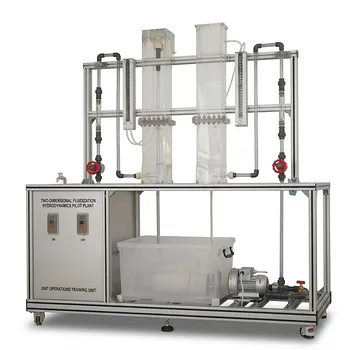
- Two-Dimensional Fluidization Hydrodynamics Educational Pilot Plant for Unit Operations Training
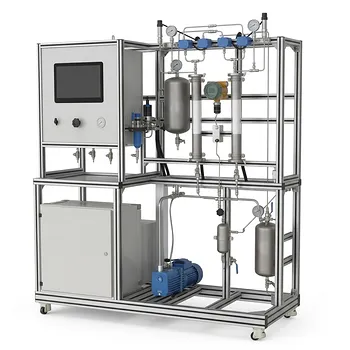
- Fluidized Bed Gas Solid Catalytic Reaction Educational Pilot Plant
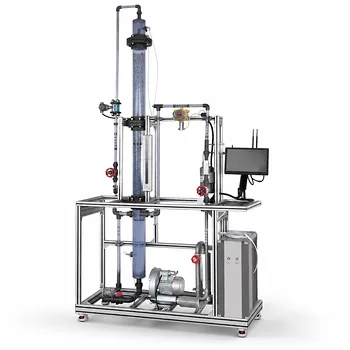
- Pressure Swing Adsorption Educational Unit Operations Pilot Plant
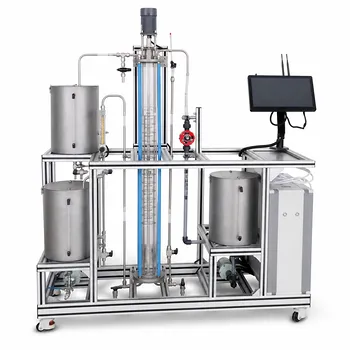
- Packed Bed Absorption Educational Unit Operations Pilot Plant
- Educational Rotary Disc Liquid-Liquid Extraction Pilot Plant
People Also Ask
- What pressure drop characteristics should students & researchers monitor in a fluidization pilot plant?
- How does active time pulsing mixing enhance fluid homogenization? Configuration Guide for Educational Pilot Plants
- How can acoustic chemometrics prevent reactor clogging in educational fluidized bed pilot plants?
- What is the operational significance of solids feed rate on emulsion phase dynamics in fluidized bed pilot plants?
- Why is UB/Ui critical in fluidized bed pilot plant modeling? Master Gas-Solid Contact