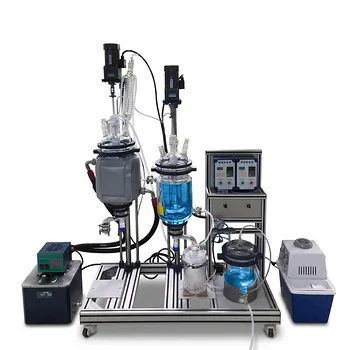
The study of polymorphism is not an academic abstraction—it is the central control variable that determines whether your crystallization pilot plant delivers a scalable, reproducible process or a regulatory and manufacturing disaster. Different crystal structures of the same molecule can exhibit fundamentally divergent solubility, stability, dissolution rate, and mechanical behavior. In a pilot plant setting, where the goal is to lock in operating parameters for commercial production, overlooking polymorphic identity will virtually guarantee batch-to-batch variability, unexpected phase transformations, and a process that fails when scaled.
Process development in a crystallization pilot plant is ultimately a race to pin down the right crystal form. Yield and purity are table stakes; the real battle is fought over the arrangement of molecules in the solid state. A single unintended polymorphic transition can erase months of optimization work by altering solubility, bioavailability, or powder handling—turning a promising drug into a development dead end.
The Fundamental Risk: Why Polymorphic Form Matters
A chemical compound’s identity is defined by more than its molecular formula. The way those molecules pack into a crystal lattice dictates everything the downstream process and the final product depend on.
Distinct Properties That Break a Process
Different polymorphs are, from a physicochemical standpoint, essentially different materials.
- Solubility differences change crystallization yield and dissolution performance.
- Stability variations dictate whether a product survives storage or manufacturing shear.
- Mechanical properties such as hardness and milling behavior directly impact tableting and formulation.
- Dissolution rate shifts can mean the difference between therapeutic success and failure in pharmaceuticals.
Failing to recognize that you have produced the wrong polymorph is not a subtle error—it cascades into every subsequent unit operation.
The Ammonium Nitrate Warning
A classic, hazardous illustration: ammonium nitrate exists in multiple crystal forms that transition at specific temperatures. Operating a crystallization step just a few degrees outside the stable window can trigger a phase change during cooling or storage, altering the solid’s density and sensitivity. In pilot-plant work, such a transition can invalidate scale-up correlations overnight, forcing a complete re-design of temperature and residence time profiles.
Thermodynamic and Kinetic Control: Two Sides of the Same Crystal
Polymorph selection is a tug-of-war between what is energetically favored and what actually happens at a given moment. Pilot plants must orchestrate both dimensions to nail the target form.
The Stability Landscape: Monotropic vs. Enantiotropic
Understanding the thermodynamic relationship between polymorphs is non-negotiable.
- In a monotropic system, one crystal form remains the most stable (lowest Gibbs free energy) across the entire temperature range up to the melting point. Metastable forms will eventually convert to it, given time or energy.
- In an enantiotropic system, a transition temperature exists below the melting points. Below this temperature, form A is stable; above it, form B becomes stable. Cooling the wrong polymorph through this transition point invites a wholesale transformation.
Pilot-plant protocols must include rigorous determination of this transition temperature. Isolating crystals at a condition where your desired polymorph is thermodynamically unstable is like building a sandcastle at low tide—it will collapse.
Kinetic Traps: The Pilot Plant’s Levers
Thermodynamics sets the destination; kinetics determines whether you get there or get stuck at a metastable waypoint. Pilot-plant control is exercised through:
- Supersaturation level—the primary engine of nucleation, heavily influencing which polymorph nuclei form first.
- Cooling rate—rapid cooling often kinetically traps metastable forms, while slower ramps favor stable growth.
- Stirring and mixing—shear and collision can promote secondary nucleation or surface-induced transitions.
- Impurities and additives—even trace levels can selectively poison the growth of one polymorph, effectively templating the undesired form.
Mastering these levers means you can deliberately produce a metastable polymorph for performance reasons—and hold it there—or consistently land on the stable form for maximum shelf life.
The Hidden Architect: Solvent Selection and Conformational Polymorphism
Solvent is not an inert bystander; it actively selects the polymorph by shaping the molecular population in solution.
Conformer Population Drives Nucleation
A flexible molecule can adopt multiple conformations in solution. Each crystal polymorph corresponds to a specific conformer locked into the lattice. The solvent environment shifts the equilibrium concentrations of these conformers—a higher population of the “right” shape feeds nucleation of the matching polymorph dramatically faster.
Rational Solvent Protocols
Chemical engineering pilot plants must move beyond trial-and-error solvent screening by evaluating:
- Solubility capacity—enough to enable practical crystallization yields.
- Conformational bias—does the solvent stabilize the molecular geometry that matches your target polymorph?
- Thermal history sensitivity—how does the conformer ratio change with cooling or anti-solvent addition?
When solvent selection is treated as a design parameter rather than an afterthought, the nucleation outcome becomes far more predictable, eliminating one of the largest sources of polymorphic surprise.
Process-Induced Transformations: When Unit Operations Become Enemy Territory
The polymorph story does not end at the crystallizer discharge. Downstream processing can undo everything you’ve engineered.
Mechanical Energy and Phase Transitions
Milling, wet granulation, drying, and compaction all inject thermal and mechanical energy. A metastable polymorph meticulously nurtured in the crystallizer can catastrophically convert to the stable form during a high-shear granulation step, altering dissolution rate and tablet integrity. In a pilot plant, each processing unit must be tested for its polymorphic impact—a demonstration that often shocks students into realizing that “finishing” steps are actually part of the crystallization process.
Demonstrating the Link for Robust Design
Running milling trials on small-scale batches in the pilot facility reveals exactly how much energy input is safe before transformation occurs. This data feeds directly into equipment selection (e.g., mill type, residence time) and formulation strategies (excipients that stabilize the metastable form), ensuring the product emerging from the commercial line matches what was developed at pilot scale.
Understanding the Trade-offs
Polymorphism control is not about always picking the “best” form; it’s about making informed trade-offs with eyes wide open.
The Stability-Solubility Dilemma
The thermodynamically stable polymorph offers peace of mind—it won’t convert during storage—but often has lower solubility and slower dissolution. A metastable form, by contrast, can deliver higher bioavailability or faster process throughput, but it exists in a constant state of existential threat. The pilot plant’s role is to quantify how much process intensity (shear, heat, moisture) the metastable form can tolerate before you lose the advantage.
The Pilot Plant as a Forgiving Sandbox
Many organizations push straight to commercial batches without stress-testing polymorphic resilience. The trade-off is that a pilot-scale failure costs fractions of a full-scale disaster. Intentionally crashing batches—running cooling ramps too fast, holding the slurry at a temperature near the enantiotropic transition, or simulating extreme drying conditions—builds a safety envelope that makes the commercial transfer resilient.
Making the Right Choice for Your Goal
Your process development strategy should pivot based on what matters most for your product and regulatory path. Use these guideposts to align your polymorphism study with your endgame:
- If your primary focus is regulatory certainty: Front-load the polymorph landscape mapping. Submit the stable form, and prove that your crystallization and downstream parameters keep it invariant under all foreseeable manufacturing deviations.
- If your primary focus is bioavailability or dissolution performance: Deliberately target a metastable polymorph, but simultaneously develop the formulation and processing boundaries that prevent its conversion during milling, granulation, and storage. This data becomes your justification for using the “risky” form.
- If your primary focus is fast, repeatable scale-up: Default to the polymorph that is thermodynamically stable at ambient conditions and ensure your pilot-plant cooling profile never crosses into the enantiotropic transition zone. Simplicity in form selection pays compound interest in manufacturing consistency.
Don’t let your pilot plant be a place where crystallization “just happens.” When you treat the crystal structure as the primary product specification, you transform a risky art into a reproducible science—and that is what makes scale-up work the first time.
Summary Table:
| Key Factor | Process Impact | Control Strategy |
|---|---|---|
| Thermodynamics | Determines stable vs. metastable crystal forms | Map transition temperatures and cooling profiles |
| Kinetics | Influences nucleation rates and polymorphic trapping | Optimize supersaturation, cooling rate, and agitation |
| Solvent Influence | Shapes molecular conformation before crystallization | Evaluate solubility capacity and conformational bias |
| Downstream Process | Mechanical/thermal energy can trigger transitions | Conduct milling and drying stress tests in pilot scale |
Optimize Your Crystallization Scale-Up with LABPARK
Mastering complex processes like polymorphism control requires hands-on training and robust testing systems. LABPARK provides premium Educational and Vocational Unit Operations Pilot Plants in chemical engineering, bioprocess & biotech, and environmental & water treatment tailored for universities, research institutes, and enterprises.
Equip your facility with the industry-grade tools needed to bridge the gap between theory and scale-up reality. Contact us today to find your pilot plant solution!
Related Products
- Multi Functional Membrane Crystallization Educational Unit Operations Pilot Plant
- Potassium Salt Thermal Dissolution and Crystallization Separation Educational Unit Operations Pilot Plant
- Multi-Functional Special Distillation Educational Pilot Plant
- Ethyl Acetate Synthesis Unit Operations Pilot Plant for Practical Training
- Multi-Modal Distillation Unit Operations Training Pilot Plant
People Also Ask
- Control Crystallization Pilot Plant Secondary Nucleation: 4 Key Adjustments
- Why is precise temperature control critical in crystallization pilot plants? Key to Scale-Up Success
- What key factors should be considered when configuring a crystallization unit operations pilot plant?
- What are the benefits of integrating online PAT tools like ATR-FTIR into crystallization unit operations pilot plants?
- How to use crystallization pilot plant agitation speed to identify diffusion vs reaction growth?