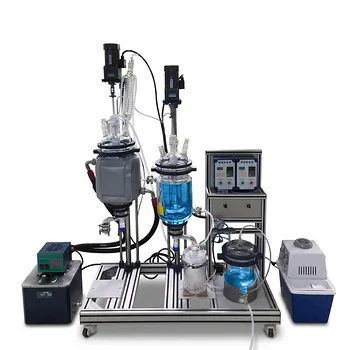
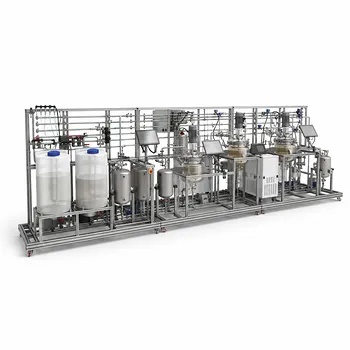
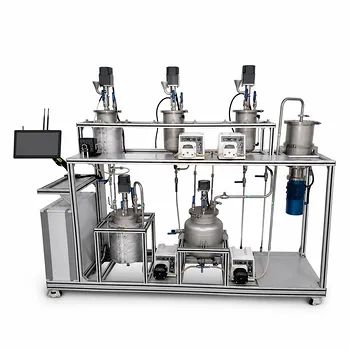
The study of eutectic mixtures is not just a textbook exercise in thermodynamics; it is the foundational principle for designing some of the most critical separation and purification processes in the chemical industry. In a chemical engineering lab, mastering this concept allows you to predict how a multicomponent mixture will solidify, and a crystallization pilot plant provides the essential bridge to apply that theory, by enabling you to manipulate cooling rates, observe crystal formation, and control the purity of the final product in a dynamic, real-world system.
The core challenge is moving from a theoretical phase diagram to a tangible, pure product. A crystallization pilot plant is the essential tool for this journey, transforming abstract concepts like the eutectic point into an operational mastery of separation, where you learn to control the process, not just understand it.
Deconstructing the Eutectic Point: The Heart of Separation
Understanding a eutectic system is like finding a master key for separation. It's the one specific composition in a mixture that behaves like a pure substance, with a single, sharp melting point lower than any of its individual components.
The Principle of Minimum Melting Temperature
In a simple binary system like lead and antimony, the pure metals have high melting points. However, a specific mixture of 90% lead and 10% antimony freezes at a single, much lower temperature of 247°C. This is the eutectic point.
At this precise composition, the liquid transforms directly into a finely dispersed, homogeneous solid mixture of two phases upon cooling, without going through a slushy two-phase region. This unique solidification behavior is the fundamental concept behind countless alloy designs and purification steps.
From Cooling Curves to Process Design
A pilot plant allows you to go beyond a static diagram and generate dynamic cooling curves. By placing precise temperature sensors in a jacketed crystallizer, you can track temperature over time as a melt cools.
The curve will show a plateau at the melting point of the first component to precipitate, followed by another distinct thermal arrest at the eutectic temperature when the remaining liquid solidifies. This hands-on exercise reveals the kinetics of nucleation and crystal growth, helping you understand that solubility limits are not just lines on a graph but live thresholds you can observe and control.
The Pilot Plant’s Role in Morphology and Control
The true value of a pilot plant is revealed when you move beyond simple solid-liquid separation to controlling the very structure of the material you are creating. This is where basic chemistry meets advanced materials engineering.
Engineering Morphology Through Phase Behavior
Consider a crystalline polymer dissolved in a high-melting-point solvent. The two are completely miscible when molten but immiscible as solids. In a research pilot plant, precipitating the polymer precisely at the eutectic composition produces a unique fibrillar morphology.
This interlocking, fibrous network is exceptionally valuable for manufacturing specialized porous membranes and filters. The pilot plant’s ability to map this real phase behavior is critical, because real-world crystallization kinetics often cause significant deviations from theoretical predictions, like those from the Flory-Huggins model. You must experiment to find the truth.
The Metastable Zone: The Operating Window for Perfection
A beaker in a lab has a wide, forgiving metastable zone where a solution can be supersaturated without spontaneously nucleating. In a pilot plant, this safe operating window shrinks dramatically.
A pilot-scale vessel with poor mixing creates localized zones of high supersaturation, especially near a cooling jacket or a feed point. These hot spots trigger uncontrolled, spontaneous nucleation, leading to a final product with a wide, unpredictable particle size distribution. Learning to manipulate agitation and cooling profiles in a pilot plant teaches you how to widen the metastable zone and achieve batch consistency—a skill non-negotiable for industrial production.
Bridging Operational Gaps with Advanced Analytics
The greatest educational leap a pilot plant facilitates is integrating the theoretical with the digital. It's a test bed for the modern, data-driven chemical plant, moving from manual sampling to real-time, predictive control.
The Power of Predictive Process Monitoring
Imagine being able to predict the crystallization temperature of your feed mixture without a lab analysis. A pilot plant equipped with an acoustic sensor downstream of an orifice plate can do just that.
The turbulent flow generates a specific acoustic signature that correlates with the liquid’s physical properties. Using multivariate analysis techniques like PLS regression, you can build a model that links this sound to the solution's composition. This allows for instantaneous, real-time monitoring, which is a powerful demonstration of how process analytics can transform quality control from a reactive test to a proactive prediction.
Validating Models with Real Multiphase Dynamics
The complexity doesn’t stop at crystallization. The principles of fluidization are equally critical. A three-phase fluidized bed pilot plant allows you to study the complex dance between gas, liquid, and solid catalyst particles, a common scenario in reactors for coal liquefaction.
Here, you can experimentally determine the minimum fluidization velocity and observe bubble behavior and bed expansion firsthand. This practical work is indispensable for validating the many assumptions buried in multiphase flow equations, transforming a theoretical calculation into a confident reactor design parameter.
Understanding the Trade-offs
Scaling up a crystallization process is never a simple matter of using a bigger beaker. The pilot plant’s most humbling and valuable lesson is that mixing, mass transfer, and heat transfer all change non-linearly with scale, introducing pitfalls that can ruin a batch.
- The Scale-Up Mixing Paradox: A magnetic stir bar ensures perfect homogeneity in a flask. In a 50-liter pilot reactor, even an optimized impeller and baffle system can struggle. Inadequate mixing creates temperature gradients and dead zones, leading directly to a mix of fine particles, large agglomerates, and trapped impurities that didn't exist in the bench-scale experiment.
- Thermodynamic Ideality vs. Kinetic Reality: The eutectic point on a theoretical phase diagram assumes equilibrium. In a real pilot plant, rapid cooling can easily miss the eutectic, trapping a glassy, amorphous solid far from equilibrium. The pilot plant teaches the painful lesson that a successful process is designed for the kinetics of crystallization, not just its thermodynamics.
- Hidden Multifaceted Costs: A pilot plant is not just an expensive piece of equipment to buy. It consumes far more raw materials than bench experiments. A single failed run results in significant waste and increases batch turnaround time dramatically, creating a genuine commercial pressure to get the process right the first time.
Making the Right Choice for Your Learning Goal
Your approach to using a crystallization pilot plant should be driven by the specific engineering skill you need to build. The machine is a versatile teacher, capable of providing advanced lessons in materials science, process control, or industrial design.
- If your primary focus is mastering separation and purification: Concentrate on cooling curve experiments and the phase diagram. Practice identifying the perfect eutectic composition and timing the precipitation of each component to achieve maximum purity.
- If your primary focus is designing functional materials: Use the polymer-solvent systems. Manipulate the quenching conditions near the eutectic point to explore how different cooling rates and compositions control the final fibrillar or porous morphology of your material.
- If your primary focus is tackling industrial scale-up and mixing: Design experiments that intentionally create poor mixing. Measure the resulting wide particle size distribution and use that data to justify agitator selection, baffle placement, and the development of a robust seeding strategy.
The pilot plant is where the elegant simplicity of a phase diagram meets the chaotic reality of a physical process. Mastering that intersection is what defines a truly skilled chemical engineer.
Summary Table:
| Focus Area | Core Engineering Concept | How Pilot Plants Facilitate Learning |
|---|---|---|
| Separation & Purity | Eutectic Point & Cooling Curves | Track nucleation kinetics and temperature arrests in real-time |
| Morphology Control | Phase Behavior & Supersaturation | Manipulate cooling rates to engineer specialized porous membranes |
| Scale-Up Challenges | Fluid Dynamics & Mixing Kinetics | Manage temperature gradients and prevent particle agglomeration |
| Process Analytics | Predictive Monitoring | Integrate acoustic sensors and PLS regression for quality control |
Bring Industrial Reality to Your Chemical Engineering Lab
Bridge the gap between thermodynamic theory and practical engineering with LABPARK. We provide advanced Educational and Vocational Unit Operations Pilot Plants in chemical engineering, bioprocess & biotech, and environmental & water treatment.
Designed specifically for universities, research institutes, and enterprises, our pilot plants empower students and researchers to master crystallization, fluid dynamics, and process scale-up.
Ready to elevate your lab's capabilities? Contact LABPARK today to discuss the ideal pilot plant solution for your institution!
Related Products
- Multi Functional Membrane Crystallization Educational Unit Operations Pilot Plant
- Potassium Salt Thermal Dissolution and Crystallization Separation Educational Unit Operations Pilot Plant
- Multi-Functional Special Distillation Educational Pilot Plant
- Ethyl Acetate Synthesis Unit Operations Pilot Plant for Practical Training
- Multi-Modal Distillation Unit Operations Training Pilot Plant
People Also Ask
- Control Crystallization Pilot Plant Secondary Nucleation: 4 Key Adjustments
- Why is precise temperature control critical in crystallization pilot plants? Key to Scale-Up Success
- What key factors should be considered when configuring a crystallization unit operations pilot plant?
- What are the benefits of integrating online PAT tools like ATR-FTIR into crystallization unit operations pilot plants?
- How to use crystallization pilot plant agitation speed to identify diffusion vs reaction growth?