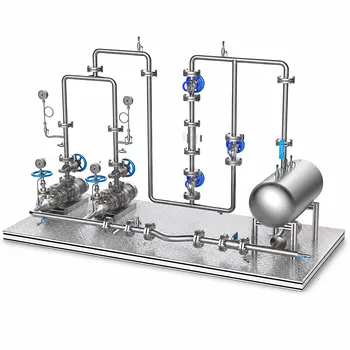
The selection of materials of construction (MOC) and containment engineering controls is not merely a design preference but the foundational strategy for managing risk and ensuring pedagogical integrity in a chemical engineering training pilot plant. The MOC ensures the physical system can survive contact with a wide range of corrosive and hazardous chemicals, preventing leaks and catastrophic equipment failure. Simultaneously, integrated engineering controls shift the safety paradigm from relying on fallible human behavior (PPE) to robust, passive systems that inherently protect students while teaching them the industry’s gold standard for process safety and operator protection.
The core challenge is designing a single, versatile system that can safely handle an unpredictable curriculum of chemical experiments. The solution lies in an integrated approach: selecting corrosion-resistant materials as the primary defense against chemical attack and structural failure, while embedding containment controls like fume hoods and barriers to manage exposure risks proactively, not reactively.
Building the First Line of Defense: Material Selection
Material selection is the fundamental engineering decision that determines a pilot plant’s chemical compatibility, structural integrity, and lifespan. In a training environment, this choice must be a broad-spectrum solution, not one optimized for a single process.
The Primacy of Broad Chemical Compatibility
In an industrial plant, MOC is fine-tuned for a specific, unchanging process fluid. A training plant faces a unique challenge: you never know precisely what a new class of students will run next. This demands a material strategy built on versatility. Materials like glass, glass-lined steel, Teflon (PTFE), and high-grade stainless steel become essential because they offer a wide range of corrosion resistance, allowing exploratory chemistries without immediate degradation.
Selecting carbon steel for a training unit handling even mildly corrosive fluids would be a critical failure. You would be teaching students about process engineering while simultaneously demonstrating how quickly their tools can rust, leak, and become unsafe.
Navigating the Spectrum of Materials
Moving beyond a single solution requires understanding the trade-offs between different material classes, each suited to specific operational profiles in a pilot plant.
The Metallic Workhorses: Stainless Steel and High-Grade Alloys
Stainless steels like 304 and 316 are the bedrock of pilot plant construction for good reason. They offer an excellent balance of durability, structural strength, and fabrication simplicity without requiring specialized cleanroom techniques. For high-demand environments like fixed-bed reactors operating at elevated temperatures and pressures with hydrogen, this choice is the first line of defense against a specific threat: hydrogen embrittlement and chemical degradation.
Ductility and toughness are equally critical here. A material’s ductility allows it to deform under stress during fabrication, while its toughness prevents a catastrophic brittle fracture if the system experiences a sudden physical impact or stress variation, ensuring it can absorb energy and deform rather than shatter.
The Visual and Inert Option: Glass and Glass-Lined Steel
Where compatibility is extreme or visual observation is a non-negotiable pedagogical goal, glass and glass-lined steel are unmatched. A transparent glass distillation column allows students to visually diagnose hydrodynamic phenomena like flooding, weeping, and packing wetting—turning an abstract concept into tangible reality. Glass-lined steel combines this near-universal chemical inertness with the structural integrity of a metal jacket, creating a vessel that is both safe and instructive.
Specialized Applications: Microreactors and Liquid Recovery
The material strategy becomes even more nuanced in specialized units. In microreactor technology, the substrate choice dictates performance. Metals offer durability and easy fabrication, while Low-Temperature Co-fired Ceramics (LTCC) provide low thermal conductivity but present sealing challenges. For liquid effluent recovery, where dilute products are separated from often corrosive aqueous waste streams, robust, corrosion-resistant materials are mandatory to withstand fouling and corrosive attack during the energy-intensive separation process.
The Critical Validation of Structural Integrity
Selecting the right material is only the first step; proving its integrity under stress is the second. Before any student experiment begins, a critical quality-control step like a hydrostatic pressure test is non-negotiable. By testing a reactor vessel with water at a pressure well above its design limit (without the catalyst), you validate weld integrity and seal tightness, confirming the entire vessel can safely handle the combined stresses of internal pressure, thermal expansion, and catalyst bed weight.
Embedding Safety Through Engineering Controls
The selection of robust materials is a passive defense. The active protection strategy in a teaching environment shifts from a reliance on people to a reliance on systems. This is where containment engineering controls become indispensable.
The Hierarchy of Mitigation vs. Personal Protective Equipment
Relying solely on personal protective equipment (PPE) in a training environment is a fundamentally flawed approach. It places the entire burden of safety on a student who is, by definition, learning. The correct, industry-standard approach is to integrate engineering controls—down-flow booths, fume hoods, and barrier technologies—directly into the pilot plant design.
This strategy mitigates worker exposure at the source, teaching students that their first line of defense is not a pair of gloves but a well-designed process. It also prevents cross-contamination between different experimental runs, a critical factor for maintaining scientific integrity in an educational setting.
Teaching Hazard Awareness Through Material Properties
Effective controls are designed with a deep understanding of the hazards present. The Material Factor (MF) , a basic measure of a chemical's intrinsic flammability and reactivity, becomes a powerful teaching tool. By evaluating the MF of substances in their experiment, students learn to identify which process units are most susceptible to fire or explosion.
This exercise directly informs the design of safety checklists and the configuration of emergency relief systems. It transforms an abstract safety protocol into a logical outcome of material properties, teaching future engineers how to derive safety strategies from first principles.
Understanding the Trade-offs and Pitfalls
No single material or control strategy is perfect. Ignoring the inherent trade-offs leads to brittle designs that are either unsafe, prohibitively expensive, or impossible to operate for a broad curriculum.
- The Cost vs. Capability Trap: Carbon steel is economical for simple, non-corrosive heating or cooling fluids, and it has a valid place in a training plant to teach about cost optimization. However, the temptation to use it in a versatile, multi-purpose unit to save budget is a common pitfall that results in rapid degradation and safety risks the moment a corrosive experiment begins.
- The Performance vs. Practicality Balance: Silicon offers exquisite precision for microreactors but is fragile and demands a cleanroom, making it wholly impractical for a hands-on teaching lab. Similarly, a polymer may offer the right chemical compatibility but fail due to its limited thermal stability, creating a meltdown hazard.
- The Sealing and Fabrication Challenge: Advanced materials like LTCC offer excellent performance characteristics but bring non-standard fabrication and sealing challenges. A pilot plant that cannot be reliably maintained or modified by engineering staff loses its core educational value.
Making the Right Choice for Your Training Goal
Your selection of MOC and engineering controls should be a direct reflection of your primary educational and operational objective. Balance the risks against the learning outcomes.
- If your primary focus is chemical versatility and student safety across a wide-ranging curriculum: Prioritize a foundation of 316 stainless steel and integrate glass components for visual observation. Default to fume hoods and down-flow booths as primary containment, teaching the hierarchy of controls from the first experiment.
- If your primary focus is demonstrating specific high-pressure or corrosive reactions: Select high-grade alloys specific to those chemistries and rigorously validate structural integrity through hydrostatic testing. Use this as a case study to explicitly teach mechanisms like hydrogen embrittlement.
- If your primary focus is operational economics and system integrity for non-corrosive fluids: Carbon steel is a valid, cost-effective choice, but only if the system is explicitly and permanently restricted to that safe operating envelope. Use this to teach the economic and safety trade-offs of material selection.
Ultimately, a well-designed training plant does not just withstand the chemicals inside it; it uses its very construction as a silent, immersive lesson in process safety, material science, and responsible engineering for every student who touches it.
Summary Table:
| Material / Control | Key Advantages | Best Applications | Limitations / Pitfalls |
|---|---|---|---|
| Stainless Steel (316) | High durability, tensile strength, resists hydrogen embrittlement | High-pressure reactors, general piping | Costly compared to carbon steel |
| Glass / Glass-Lined | Visual monitoring, near-universal chemical inertness | Distillation columns, highly corrosive processes | Fragile, lower pressure limits |
| Carbon Steel | Economical, easy to fabricate | Non-corrosive utilities (water, steam) | Subject to rapid rust and chemical attack |
| Engineering Controls | Passive safety, prevents exposure/contamination | Fume hoods, down-flow booths | Requires careful design integration |
Design Your Safe and Versatile Training Lab with LABPARK
Building a safe, durable, and highly educational training environment requires expert pilot plant engineering. At LABPARK, we design and manufacture industry-grade Educational and Vocational Unit Operations Pilot Plants across chemical engineering, bioprocess & biotech, and environmental & water treatment.
We help universities, research institutes, and enterprises bridge the gap between theory and practice by providing:
- Custom MOC Selection: Optimized material configurations (stainless steel, glass, alloys) to match your chemical curriculum safely.
- Robust Engineering Controls: Built-in containment, ventilation, and passive safety systems that protect students.
- Versatile, Turnkey Solutions: Flexible designs that accommodate changing experimental needs and maximize your budget.
Ready to elevate your engineering training programs? Contact us today to collaborate on your custom pilot plant design!
Related Products
- Multi-Reactor Educational Pilot Plant for Reaction Engineering Unit Operations
- Multi Pump Fluid Transport Process Piping Unit Operations Training Pilot Plant
- Green Anhydrous Ethanol Refining Practical Training Pilot Plant
- Natural Product Extraction Unit Operations Training Pilot Plant
- Multi-Functional Special Distillation Educational Pilot Plant
People Also Ask
- How do reactor pilot plants define QbD design space? Master chemical process scale-up.
- When configuring a reactor unit operations pilot plant for highly exothermic reactions, how to prevent thermal runaway?
- How do metal ion-catalyzed reaction mechanisms inform chemical engineering pilot plant design? From kinetics to scale-up
- What role do educational pilot plants play in scaling green chemistry? Bridging the Lab-to-Industry Gap
- What are the barriers to process intensification & how do pilot plants help?