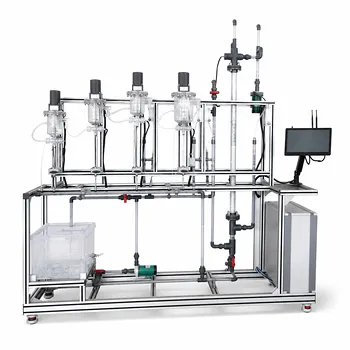
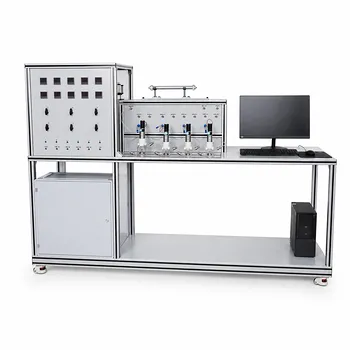
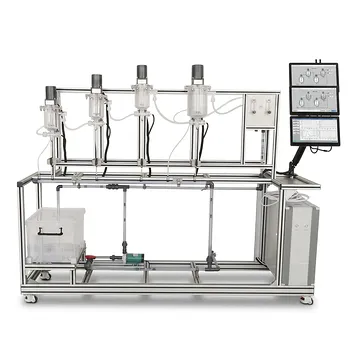
Residence Time Distribution (RTD) is the single most important diagnostic for scale-up because it directly quantifies how real flow deviates from ideal assumptions. In chemical engineering pilot plants, measuring the RTD reveals non-ideal flow behaviors—channeling, stagnant zones, and internal recycling—that remain invisible in batch mixing tests. This empirical flow fingerprint is critical because, during scale-up, a reactor’s mixing time often grows while residence time stays constant, potentially destroying conversion or selectivity. By exposing these deviations early, RTD analysis prevents the design errors that would otherwise doom a commercial-scale unit.
Scaling a continuous mixer without understanding its RTD is like scaling a recipe without tasting it at every stage. RTD measurements on a pilot plant provide the ground truth of fluid dynamics—exposing mixing inefficiencies, defining mixing time constraints, and building a flow model that guides reactor configuration and scale-up with confidence, avoiding both costly overdesign and underperformance.
Why RTD Is the Scale-Up Linchpin
The Failure of Batch Analogies
Batch blending relies on a single target—blend time. Continuous mixing, however, is governed by the entire distribution of times that material spends inside the system. Two reactors with the exact same mean residence time can perform radically differently if one channels fluid sharply while the other back-mixes heavily. RTD makes these differences measurable.
The Flow Patterns That Sabotage Scale-Up
The primary reference rightly focuses on three hallmark deviations: channeling (fast paths that shortcut the active volume), stagnant regions (dead zones that trap reactants and reduce effective capacity), and internal recycling (recirculation that broadens the distribution). On a pilot unit, an RTD curve immediately exposes these flaws. For instance, a long, unbaffled tube may appear well-mixed but actually exhibits severe bypassing—an early breakthrough peak in the RTD reveals the danger long before it locks into a capital project.
Sensitivity Testing Before It’s Too Late
During scale-up, residence time is typically held constant while mixing time increases due to larger vessel dimensions. If a reaction is complex and non-linear, it can be extremely sensitive to these mixing gaps. Pilot plants allow teams to run sensitivity analyses: by deliberately varying agitation rate or throughput and measuring the resulting RTD, engineers map the boundary between acceptable and unacceptable conversion. This directly answers the question “Can we scale this configuration, or must we redesign?”
Connecting RTD to Mixing Time and Scale-Up Rules
The Variance as a Warning Light
The variance of the RTD quantifies the spread of residence times around the mean. A variance of zero indicates pure plug flow; a large variance signals CSTR-like behavior or problematic channeling. In educational and industrial pilot reactors alike, calculating the variance instantly tells you how far the system strays from ideal assumptions. If that variance puts you beyond the permissible mixing window, the scaled reactor will underperform.
Bracket Reality with Limiting Cases
A powerful scale-up shortcut is bracketing: measure the RTD for the two extreme mixing limits—segregated flow (no macromixing) and maximum mixedness (perfect micromixing). You can approximate these edges with careful tracer injection on a pilot plant. The true performance must lie between those bounds. If the difference in predicted conversion is small, mixing dynamics are not a scale-up risk. If it’s large, you need to refine your flow model or change the reactor design entirely. This approach focuses effort only where mixing truly matters.
Practical RTD Measurement on Pilot Plants
The Three Non-Negotiable Conditions
Reliable RTD data is built on a tripod of conditions enumerated in the supplementary references:
- System stationarity – the reactor must be at steady state, with a monotonic step response and repeatable consecutive runs. In turbulent flows, a high length-to-diameter ratio or mechanical agitators help dampen large eddies.
- Tracer response linearity – the system’s response must be proportional. Run two step tests of different magnitudes; if the normalized RTD curves overlap perfectly, linearity holds.
- Tracer behavior match – the tracer must mimic the process fluid. In homogeneous stirred tanks, conductivity salts or dyes work well. In fluidized-bed or multiphase systems, you must select a tracer that avoids adsorption, reaction, or phase transfer that would distort the signal.
Meeting all three conditions is demanding, which leads directly to the limitations.
Understanding the Limitations and Trade-Offs
The Homogeneous Assumption Trap
Standard RTD theory is rigorously correct only for homogeneous, single-phase systems. When moving to gas-liquid, fluidized-bed, or catalytic reactors, you must examine both the gas-phase RTD and the contact-time distribution with a catalyst. If mass transfer resistance is negligible, the contact-time distribution stays constant and scaling is straightforward. But if resistance is significant, a liquid-phase RTD can mislead you into thinking mixing is adequate when it is not. Pilot plants are the right place to detect these multiphase complications side by side.
Tracer Selection Pitfalls
Choosing the wrong tracer corrupts everything. The tracer must not alter the flow, must remain conservative (no reaction, volatilization, precipitation, or adsorption), and must be easily detectable at the outlet. In heterogeneous catalytic systems, a dye that adsorbs onto catalyst pores will produce a falsely broadened RTD, mimicking backmixing that doesn’t exist. Always validate tracer behavior with blank (no-reaction) reactor tests before interpreting the curve.
When Stationarity Breaks Down
During startup, shutdown, or process upsets, the reactor is not stationary. An RTD measured during transients will reflect a time-averaged artifact, not a true flow pattern. Therefore, measurements must only begin after all process variables have stabilized, and consecutive runs must produce identical curves. This discipline is especially critical in short-duration pilot campaigns.
Making the Right Choice for Your Goal
Your approach to RTD analysis should align directly with your core scale-up objective. The pilot plant data gives you the leverage; how you use it determines the outcome.
- If your primary focus is eliminating hidden scale-up risks: Use RTD to scan for channeling and dead zones early in the pilot phase. The curve’s tail and early breakthrough are far cheaper to fix than a hot spot or runaway in a production reactor.
- If your primary focus is predicting conversion and selectivity with high fidelity: Combine RTD data with a compartment model that captures non-ideal flow. Perform sensitivity tests to bracket performance, and only invest in detailed CFD if the RTD reveals strong mixing-sensitivity.
- If your primary focus is reducing the experimental burden of scale-up: Treat the RTD as an empirical system model. A well-characterized RTD replaces many batch optimization runs, giving you a scaling law that directly links pilot performance to projected commercial output.
RTD transforms scale-up from a high-stakes guess into a systematic, data-driven decision—provided you respect its foundational assumptions and measure it with care.
Summary Table:
| RTD Indicator | Flow Behavior | Scale-Up Impact |
|---|---|---|
| Early Breakthrough | Channeling / Bypassing | Reduces conversion; reactants bypass active zones. |
| Long Tail on Curve | Stagnant / Dead Zones | Reduces effective volume; risks product degradation. |
| High Variance | Severe Backmixing | Alters residence time spread; hurts product selectivity. |
Master Chemical Reactor Scale-Up with LABPARK
Accurate RTD characterization starts with precision engineering. LABPARK provides state-of-the-art Educational and Vocational Unit Operations Pilot Plants in chemical engineering, bioprocess & biotech, and environmental & water treatment for universities, research institutes, and enterprises.
Our advanced pilot systems empower your teams to safely simulate real-world mixing, validate flow models, and eliminate costly scale-up errors before moving to commercial production.
Ready to elevate your research and training capabilities? Contact us today to find the perfect pilot plant solution for your lab.
Related Products
- Residence Time Distribution and Reactor Flow Characteristics Determination Educational Pilot Plant
- Gas Phase Mixing and Residence Time Distribution Determination Educational Unit Operations Pilot Plant
- Multi-Stage Stirred Tanks in Series Residence Time Distribution and Mixing Performance Determination Educational Pilot Plant
People Also Ask
- Why is temperature regulation via a cooling jacket a critical feature in CSTR pilot plants used for laboratory training?
- What parameters to monitor transitioning from Batch to CSTR? Master Pilot Plant Setup
- How does steady-state multiplicity affect the operation and safety of exothermic reactions within a CSTR pilot plant? - Guide
- What role do customizable reactor pilot plants play in evaluating heat and catalyst performance? Scale-up Guide
- Importance of heat balance calculations in reactor pilot plants & how they are taught via unit ops equipment.