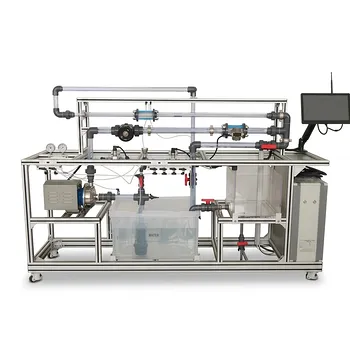
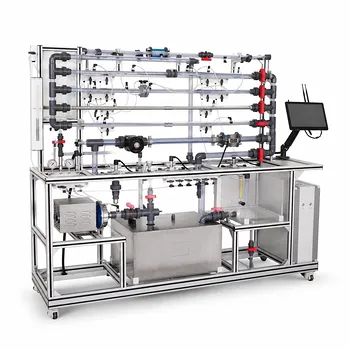
The ion product ($Q$) versus solubility product ($K_{sp}$) relationship is the thermodynamic gatekeeper for every precipitation and scaling reaction in a water treatment pilot plant.
This single comparison tells you whether solids will form, dissolve, or remain in equilibrium. In pilot‑scale operations, where real‑time control over contaminant removal, scale prevention, and chemical dosing is paramount, monitoring $Q$ against $K_{sp}$ transforms a theoretical concept into the central decision‑making tool. A pilot plant tests whether the equilibrium you predict on paper holds up under continuous flow, variable water chemistry, and fluctuating temperature.
The $Q$–$K_{sp}$ relationship is the blueprint for designing precipitation-based processes; a pilot plant is where that blueprint is stress‑tested against the messy realities of ionic strength, kinetics, and mixing to deliver a reliable, regulation‑compliant treatment train.
The Thermodynamic Rulebook: How $Q$ and $K_{sp}$ Govern Precipitation
The Fundamental Comparison
Every sparingly soluble salt has a solubility product constant ($K_{sp}$) — the maximum product of ion concentrations that can exist in a saturated solution at a given temperature.
The ion product ($Q$) is the actual product of those same ions at any moment in your process.
The system’s fate hangs on three simple inequalities:
- $Q < K_{sp}$: Unsaturated; no precipitation occurs; existing solids may dissolve.
- $Q = K_{sp}$: Exactly saturated; equilibrium.
- $Q > K_{sp}$: Supersaturated; precipitation is thermodynamically favoured.
Why This Matters for Water Treatment
When you want to remove a pollutant (e.g., heavy metals, phosphate), you intentionally push $Q$ above $K_{sp}$ to force precipitation.
When you want to prevent scaling on membranes, sensors, and pipe walls, you must keep $Q$ below $K_{sp}$ — or manage supersaturation with inhibitors.
In both cases, the $Q$–$K_{sp}$ comparison provides the thermodynamic target.
Pilot plants are where you learn exactly how to hit that target reliably.
Why Pilot Plants Are the Ultimate Testing Ground
From Batch Beakers to Continuous Flow
Laboratory $K_{sp}$ values are measured under idealized, well‑mixed, constant‑temperature conditions.
A pilot plant introduces continuous feed streams, residence time distributions, temperature gradients, and variable water matrices.
The primary reference highlights that pilot plants allow operators to study precipitation boundary conditions under continuous flow and variable temperature.
This bridges the gap between a thermodynamic “should happen” and an operational “does happen at scale.”
Validating Dosing Strategies and Sensor Placement
A pilot run reveals whether your chemical dosing system can maintain the desired $Q$ in real time.
It tells you where to place turbidity monitors, pH probes, and ion‑selective sensors to catch dangerous $Q$ excursions before they trigger a scaling event or fail a discharge test.
For example, in a phosphorus removal pilot, you might dose calcium salts to form calcium phosphate.
By monitoring calcium and phosphate concentrations and calculating $Q$, you can directly correlate system performance with the degree of supersaturation — fine‑tuning the dose to stay just above $K_{sp}$ without wasting chemicals.
Key Factors That Distort the Simple $Q$–$K_{sp}$ Picture
Temperature’s Double‑Edged Sword
$K_{sp}$ is highly temperature‑dependent.
A pilot plant operating outdoors or handling heated industrial effluents will see shifts in $K_{sp}$ that alter the precipitation window.
The supplementary references note that for asymmetric electrolytes like $Mg(OH)2$, the solubility relationship is non‑linear ($K{sp} = 4s^3$), making temperature swings even more critical.
In high‑temperature environments (such as hydrothermal or subcritical systems), the ion product of water itself climbs dramatically — up to $10^{-8} ; \text{mol}^2/\text{L}^2$ at 500 °C.
This fundamentally changes the solubility of minerals and can hydrolyse salts that are stable at ambient conditions. A pilot plant is the only safe place to evaluate these effects before full‑scale deployment.
The Common‑Ion Effect as a Design Lever
When you want to drive precipitation to completion, adding an excess of a precipitant that shares a common ion with the target solid shifts the equilibrium according to Le Chatelier’s principle.
For removing barium with sulfate, the supplementary materials explain that excess sulfate dramatically lowers the residual barium concentration — a direct application of the $Q$–$K_{sp}$ relationship.
A pilot plant quantifies how much excess is truly needed, avoiding secondary pollution from over‑dosing while still hitting discharge limits.
Ionic Strength and Activity Corrections
Real wastewater is not an ideal dilute solution.
High ionic strength decreases the activity coefficients of dissolved ions, meaning their effective “active” concentration is lower than the measured molar concentration.
When you calculate $Q$ using molarities alone, you may think you’ve achieved $Q > K_{sp}$, but the true thermodynamic driving force is weaker.
Pilot operations that incorporate activity corrections avoid the trap of under‑performance that simple calculations can’t predict.
Understanding the Trade‑offs and Pitfalls
The Supersaturation Sweet Spot
Achieving $Q > K_{sp}$ is necessary, but too much supersaturation creates problems.
Extremely high $Q$ can trigger homogeneous nucleation, producing a cloud of fine particles that settle poorly, foul membranes, or pass through filters.
A controlled, moderate supersaturation often yields larger, more easily separated crystals — a lesson only a pilot plant can teach for your specific water chemistry.
Kinetic Hurdles May Defy Thermodynamics
Even when $Q$ greatly exceeds $K_{sp}$, precipitation may not occur instantaneously.
Slow nucleation or particle growth kinetics can let the water exit the reactor before solids form, causing downstream scaling.
Pilot plants reveal the optimal residence time and mixing intensity needed to overcome kinetic barriers.
The Danger of Unintended Scaling
The primary reference explicitly warns that careful control is required “to prevent unwanted scale formation on sensors, pipes, and membrane filtration units.”
A poorly designed precipitation stage that pushes $Q$ too high can export supersaturated water into the next unit operation, where scale will build on heat exchangers or reverse osmosis membranes.
In pilot testing, you can install coupon racks and detection instrumentation to catch this before it escalates to a full‑scale catastrophe.
Making the Right Choice for Your Pilot Plant Goals
The $Q$–$K_{sp}$ relationship is not an abstract number; it’s a compass. The way you navigate depends on your primary treatment objective.
- If your primary focus is contaminant removal: Use the common‑ion effect and pH adjustments to maintain $Q$ safely above $K_{sp}$, then validate the residual concentration in pilot runs. Apply activity corrections when treating high‑TDS waters to avoid under‑dosing.
- If your primary focus is preventing scale formation: Continuously monitor $Q$ for problematic salts and keep it below $K_{sp}$ by adjusting pH, removing hardness upstream, or dosing antiscalants. Pilot trials will show you where localized supersaturation might still occur.
- If your primary focus is chemical cost optimization: Use the pilot plant to find the minimum effective $Q$ that meets discharge standards. Test whether a slight under‑saturation ($Q$ just below $K_{sp}$) can be compensated by longer residence time or seeding.
- If your primary focus is handling temperature‑sensitive processes: Characterize how both $K_{sp}$ and the water’s ion product ($K_w$) change across your operating temperature range. A pilot with accurate temperature control is non‑negotiable for scaling the design.
Master the $Q$–$K_{sp}$ relationship in your pilot plant, and you transform a theoretical equilibrium into a predictable, cost‑effective, and regulation‑proof water treatment process.
Summary Table:
| Relationship | Thermodynamic State | Pilot Plant Action & Impact |
|---|---|---|
| Q < Ksp | Unsaturated | Prevents scaling; existing solids dissolve. |
| Q = Ksp | Saturated | Dynamic equilibrium; system baseline. |
| Q > Ksp | Supersaturated | Drives precipitation for pollutant removal; risk of fouling. |
Scale Up with Precision: Partner with LABPARK
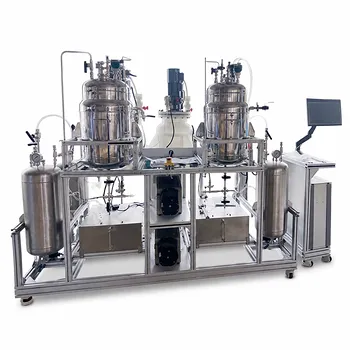
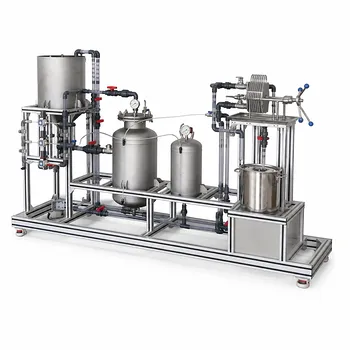
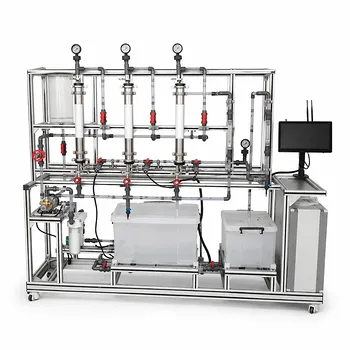
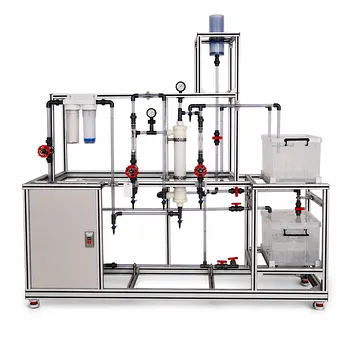
Are you looking to bridge the gap between thermodynamic theory and real-world water treatment? LABPARK provides state-of-the-art Educational and Vocational Unit Operations Pilot Plants in chemical engineering, bioprocess & biotech, and environmental & water treatment.
Designed specifically for universities, research institutes, and enterprises, our pilot plants enable you to safely test precipitation kinetics, optimize chemical dosing, and prevent scaling before full-scale deployment.
Ready to enhance your research and training capabilities? Contact us today to find the perfect pilot plant solution for your needs.
Related Products
- Electrochemical Water Treatment Educational Unit Operations Pilot Plant
- Thermal Desorption Exhaust Gas and Tail Water Treatment Educational Pilot Plant
- Ion Exchange Water Purification Educational Pilot Plant for Engineering Unit Operations
- Alkaline Membrane Water Electrolysis Educational Pilot Plant Unit Operations Training System
- Water Electrolysis Hydrogen Production and Storage Educational Pilot Plant
People Also Ask
- What design features do educational electrochemical pilot plants utilize to manage gas liberation and water loss?
- How can unit operations pilot plants show lead-acid concentration vs state of charge? Real-time monitoring guide.
- How do educational electrochemical pilot plants scale up electrolysis? Master industrial engineering.
- How to Estimate Sulfate in Water Treatment Pilot Plant Deposits: Gravimetric Guide
- How can foaming be managed during steam generation experiments in water treatment unit operations pilot plants? Tips