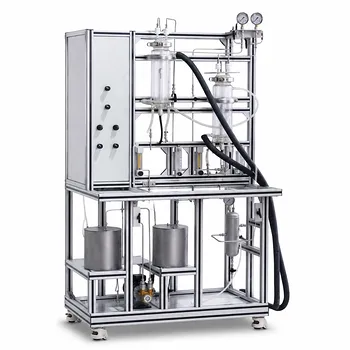
The answer lies in the fundamental challenge of designing and scaling reactors where nothing stays constant. Numerical solutions of coupled ordinary differential equations (ODEs) are critical because they transform the complex, non-linear mass and energy balances of pilot plant reactors into predictable dynamic profiles. This enables engineers to simulate transient behaviors—startup, shutdown, and disturbances—that purely steady-state models miss. Without these dynamic simulations, designing robust process control, evaluating safety protocols, and extracting the kinetic parameters needed for scale-up would be a trial-and-error gamble in the dark.
While pilot plants generate empirical data that validate scale-up, the numerical integration of coupled ODEs provides the first-principles understanding of how a reactor will behave over time. This bridges the gap between theoretical kinetics and real-world dynamics, forming the essential backbone for control strategy design, safety analysis, and scalable reactor engineering.
The Central Role of Dynamic Mass and Energy Balances
A pilot plant reactor is never truly at steady state. Feeding raw materials, exothermic reactions, and cooling fluctuations create a constantly shifting environment where concentrations and temperatures are intertwined. This coupling makes analytical solutions impossible, so we turn to numerical ODE solvers.
Modeling the Transient Reality
Every reactor’s behavior is governed by conservation laws. Mass balances dictate how reactant and product concentrations change, while energy balances track heat generation and removal.
These balances form a system of coupled, first-order differential equations where the rate of change of one variable depends on the current value of others. For example, a faster reaction rate increases temperature, which in turn accelerates the reaction further—a classic feedback loop.
Why Steady-State Assumptions Fall Short
A steady-state model might tell you the final conversion, but it ignores the path taken to get there. Startup overshoots, temperature excursions, and recovery from disturbances can ruin a batch or trigger a safety incident.
Numerical ODE integration lets you see the entire trajectory. You can identify when a hot spot will form, how long it takes to reach nominal operation, and whether the control system can handle a sudden loss of cooling—all before a single valve is opened.
From Concentration Profiles to Control and Safety
Dynamic simulations do more than paint a pretty picture. They directly inform the design of the systems that keep a pilot plant—and ultimately the commercial site—safe and efficient.
Designing Control Strategies That Work in the Real World
A PID controller tuned only on steady-state gain often performs poorly during transients. By solving the coupled ODEs, you generate time-series data that reveal process dead times, inverse responses, and non-linearities.
You can test different control pairings and algorithms in simulation. This allows you to stabilize an exothermic reactor with cascade control or feedforward action before implementing it in hardware, significantly reducing commissioning risk.
Evaluating Safety Protocols Under Extreme Conditions
Every pilot plant must handle worst-case scenarios like cooling failure or a mischarged catalyst. Analytical methods can’t account for the simultaneous thermal runaway and pressure buildup these events trigger.
Numerical simulation of the energy and species balances models these runaway scenarios with high fidelity. You can use the results to size emergency relief systems, set interlock thresholds, and define safe operating envelopes grounded in physics, not guesswork.
The Scale-up Bridge: Extracting Kinetics from Dynamic Data
Scaling a reaction from a bench to a pilot plant isn’t just about making it bigger. It requires intrinsic kinetic parameters that are independent of vessel geometry—and these are best extracted using transient models.
Unmasking True Kinetics from Noisy Pilot Data
In a small laboratory flask, heat and mass transfer are nearly perfect, masking the true reaction rate. A pilot plant introduces realistic gradients, but analyzing that data requires a model that accounts for both kinetics and transport effects.
Coupled ODEs describing material balances in a non-ideal flow pattern allow you to fit kinetic constants such as activation energy and reaction order from measured concentration-time profiles. This parameter estimation turns raw pilot data into a predictive model you can trust at a larger scale.
Predicting Commercial Reactor Performance
A commercial reactor will have different residence time distributions and heat transfer areas than its pilot counterpart. Scaling by geometric similarity alone often fails when reaction rates are strongly coupled to temperature.
Once you have validated ODE-based kinetics, you can plug them into a new set of transport equations representing the full-scale vessel. The numerical solution then predicts spatial and temporal profiles of yield, selectivity, and heat release, guiding decisions on reactor type, catalyst loading, and cooling design.
Understanding the Trade-offs and Pitfalls
While numerical ODE solutions are indispensable, they are not a silver bullet. Recognizing their limitations prevents overconfidence and ensures a balanced approach.
Model Complexity vs. Solvability
Highly detailed models with dozens of species and intricate velocity fields can become computationally intractable or numerically stiff. Parameter identifiability also degrades when too many constants are fit from limited data.
The art is to strike a balance: include enough physics to capture the coupling, but simplify where transport resistances are negligible. An overly complex model often performs worse in practice than a focused, well-validated one.
The Need for Empirical Anchoring
No simulation can replace pilot plant data. Heat transfer coefficients, catalyst deactivation rates, and mixing efficiencies are notoriously difficult to compute a priori. They must be measured or fitted.
The numerical ODE model is most powerful when it is anchored to experimental reality. Use it as a hypothesis-testing engine: predict a dynamic response, run the experiment, and refine the model until it mirrors actual behavior.
How to Apply This to Your Pilot Plant Project
Your specific goal dictates how heavily you lean on coupled ODE modeling. The key is to align the model’s purpose with the level of investment you make.
- If your primary focus is designing a new reactor concept from first principles: Build a detailed mass-energy balance model and use numerical integration to screen configurations for runaway potential and yield sensitivity before constructing the pilot unit.
- If your primary focus is scaling up an existing bench-scale reaction: Focus on fitting intrinsic kinetic parameters from dynamic pilot plant data using a robust numerical solver. Validate the model with independent step-change experiments.
- If your primary focus is implementing advanced process control on an operating pilot plant: Derive a simplified, linearized version of the full ODE system to design model-based controllers, but always verify performance against the full non-linear simulation.
- If your primary focus is safety case development for a hazardous reaction: Use worst-case initial conditions in the coupled ODE model to quantify the maximum temperature and pressure rise rates, providing a defensible basis for relief sizing.
Ultimately, numerical solutions of coupled ODEs transform reactor engineering from an empirical art into a predictive science. They allow you to explore the “what-ifs” in a sandbox before spending capital and taking risks, turning the complex dance of mass and energy into a controllable, scalable asset.
Summary Table:
| Application Area | Role of Coupled ODEs | Key Engineering Benefit |
|---|---|---|
| Dynamic Modeling | Tracks transient mass & energy balances over time | Prevents startup overshoots and temperature excursions |
| Process Control | Generates time-series data for PID controller tuning | Reduces commissioning risks and stabilizes operations |
| Scale-Up Bridge | Extracts intrinsic kinetics from pilot plant data | Accurately predicts full-scale commercial performance |
| Safety Analysis | Simulates thermal runaways & pressure build-ups | Provides physics-based sizing for relief systems |
Bridge Theory and Practice with LABPARK Pilot Plants
Transitioning from mathematical models to real-world operations requires reliable, high-performance hardware. LABPARK provides state-of-the-art Educational and Vocational Unit Operations Pilot Plants in chemical engineering, bioprocess & biotech, and environmental & water treatment.
Tailored for universities, research institutes, and enterprises, our pilot plants allow you to validate dynamic models, extract accurate kinetic data, and deliver hands-on training.
Ready to elevate your research, development, or training capabilities? Contact LABPARK today to discover the ideal pilot plant solution for your project!
Related Products
- Bio-fermentation Ethanol Production Practical Training Unit Operations Pilot Plant
- Ethylbenzene Dehydrogenation Educational Unit Operations Pilot Plant
- Internal Circulation Gradient Free Catalytic Reaction Educational Pilot Plant
- Residence Time Distribution and Reactor Flow Characteristics Determination Educational Pilot Plant
- Fixed-Bed Chemical Reaction and Gas Dust Tar Removal Unit Operations Pilot Plant
People Also Ask
- Why Use PTFE & Hastelloy in Chemical Pilot Plants? Prevent Corrosion & Ensure Safety
- Why Compare Predicted and Experimental Excess Enthalpy? Key to Accurate Pilot Plant Scale-up
- Why is the chemical plant startup schedule crucial? De-risk scale-up with pilot plants.
- When to transition from PID to adaptive control in pilot plants? Key process indicators.
- Why must batch and fed-batch fermentation pilot plants be designed to accommodate changing rheological conditions?