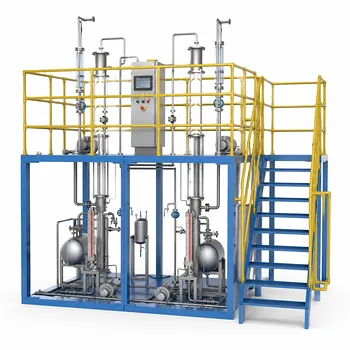
The fundamental reason is clear: the Wilson equation is structurally incapable of predicting the formation of two liquid phases. For any pilot plant operation involving liquid-liquid extraction or multi-phase distillation, the model you choose must capture this phase-splitting behavior, and that distinction makes NRTL the non-negotiable starting point.
Choosing between the NRTL and Wilson models is not a matter of accuracy—it’s a matter of physical possibility. The Wilson equation cannot mathematically describe liquid-liquid immiscibility, rendering it useless for extraction or heterogeneous distillation pilot plants. The NRTL model can, which makes it the foundational choice for any process where a liquid splits into two distinct phases.
The Fundamental Limitation of the Wilson Model
The Wilson equation is an excellent tool, but it has a hard boundary. Understanding its limitation is the first step to seeing why NRTL is essential for your pilot plant.
The Mathematical Inability to Predict a Phase Split
At its core, the Wilson equation is designed for completely miscible systems. Its mathematical structure relies on a local composition concept that assumes a single, continuous liquid phase.
It cannot generate the shape of a Gibbs free energy of mixing curve required to predict two stable liquid phases. In thermodynamic terms, the model cannot calculate liquid-liquid equilibria (LLE). It will always predict a single, homogeneous liquid solution, even for mixtures like oil and water.
The Practical Impact on a Pilot Plant
This limitation is not theoretical. If you are running a liquid-liquid extraction column, the entire operation depends on one solvent phase and one raffinate phase staying separate.
Using the Wilson model to simulate this would fail to predict the phase split entirely. It would miscalculate the concentrations in each phase, making the simulation completely disconnected from the physical reality observed in the pilot plant’s glass columns and decanters.
Why NRTL is the Enabler for Multi-Phase Systems
The NRTL model overcomes the Wilson limitation through a critical structural difference, making it the versatile workhorse for complex separation processes.
The Role of the Non-Randomness Parameter
The NRTL equation introduces a third adjustable parameter per binary pair, often denoted as alpha (α). This non-randomness parameter accounts for the characteristic that in a mixture, the distribution of molecules is not purely random.
Wilson’s local composition concept is embedded, but the alpha parameter provides the mathematical flexibility necessary to describe the highly non-ideal behavior that leads to a phase split. It allows the model to accurately represent the activity coefficients in systems that are only partially miscible.
Modeling Heterogeneous Azeotropes
This capability is critical for pilot plants performing heterogeneous azeotropic distillation. A classic example is the separation of water and butanol.
In this process, the vapor stream condenses into two immiscible liquid phases in a decanter. The NRTL model can simultaneously predict the vapor-liquid equilibrium (VLE) in the column and the liquid-liquid equilibrium (LLE) in the decanter. A single, consistent thermodynamic framework like NRTL is the only way to achieve a reliable, converged simulation of this entire unit operation.
Straightforward Extrapolation to Multicomponent Systems
Like the Wilson equation, NRTL primarily relies on binary interaction parameters. This is a massive practical advantage for pilot plant work.
It means you don't need to conduct a phenomenal number of experiments for a new ternary or quaternary mixture. You can often predict the behavior of a multicomponent extraction process using parameters fitted to data from the constituent binary pairs—like using water-acetone and water-toluene data to model an acetone-water-toluene extraction.
Understanding the Trade-offs
The switch to NRTL is not without cost or complexity. A truly objective view requires you to understand where the model can fall short.
The Price of Complexity and Data
The NRTL model’s strength is also its burden. You must have three parameters (τij, τji, and αij) for each binary pair. Wilson requires only two.
This triples the data requirement for parameter fitting. If reliable binary LLE data isn't available in process simulator databanks, fitting these parameters from experimental data is more labor-intensive. In a resource-limited pilot plant, this can be a real bottleneck.
Sensitivity to Parameter Quality
NRTL simulations are notoriously sensitive to the quality of the non-randomness parameter. A poorly fixed or estimated alpha value can lead to erroneous LLE predictions, such as predicting a phase split where none exists or missing a real one.
The model’s performance is only as good as its parameterization. Blindly trusting default simulator values without checking their source and applicability to your specific concentration and temperature ranges is a common and dangerous pitfall.
Making the Right Choice for Your Pilot Plant Goal
Your model choice must align with the fundamental physical chemistry of your system. There is no universal “best” model, only the right one for the job at hand.
- If your primary focus is modeling a liquid-liquid extraction or heterogeneous distillation: You must use NRTL or UNIQUAC. Wilson is structurally incapable; this is a dead end.
- If your primary focus is a completely miscible vapor-liquid system (e.g., ethanol-water): The Wilson equation is an excellent, simpler choice with a well-established parameter base and can often provide highly accurate VLE predictions.
- If your system involves very large molecular size differences or no experimental data exists: Consider UNIQUAC or the predictive UNIFAC method as an alternative or a starting point, bypassing NRTL’s data-fitting requirements entirely.
The goal in a pilot plant is to connect simulation with physical reality; selecting NRTL is the foundational step that makes this connection possible for your multi-phase, liquid-liquid processes.
Summary Table:
| Feature | Wilson Equation | NRTL Model |
|---|---|---|
| Liquid-Liquid Equilibria (LLE) | Incapable (predicts single phase) | Capable (predicts phase-splitting) |
| Parameters per Binary Pair | 2 parameters | 3 parameters (includes alpha, $\alpha$) |
| Primary Application | Fully miscible VLE systems | Heterogeneous azeotropes & LLE extraction |
| Data Complexity | Lower data fitting requirement | Higher data & sensitivity requirements |
Scale Up Your Chemical Engineering Lab with LABPARK
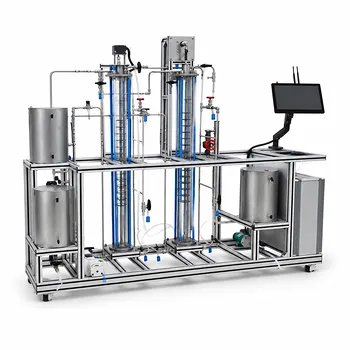
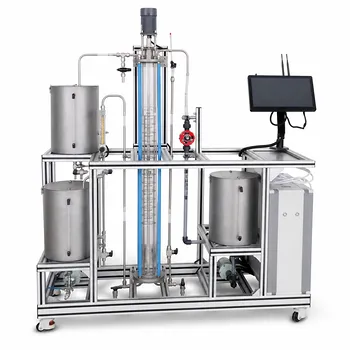
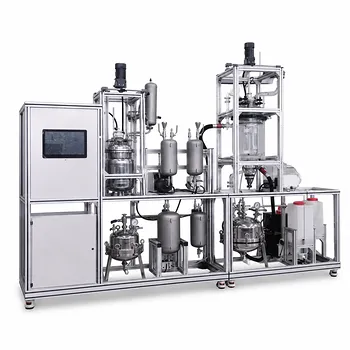
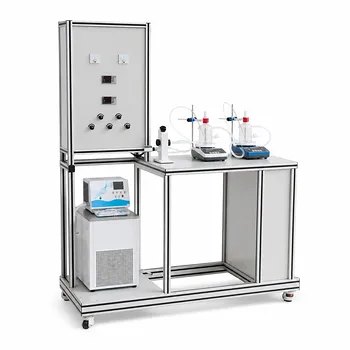
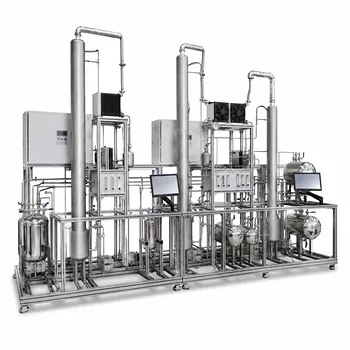
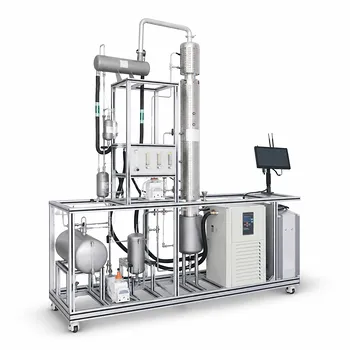
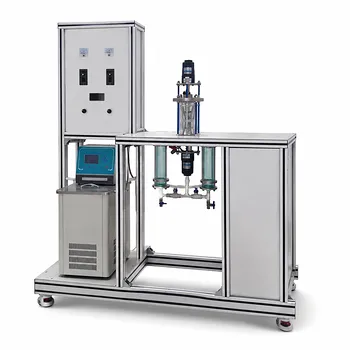
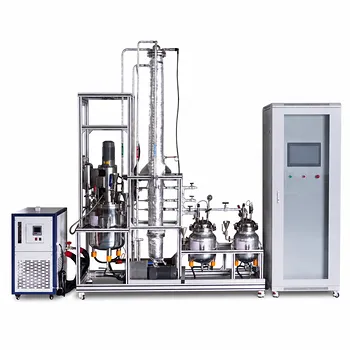
Accurate thermodynamic modeling is only as good as the physical systems validating it. LABPARK designs and manufactures premium Educational and Vocational Unit Operations Pilot Plants for chemical engineering, bioprocess & biotech, and environmental & water treatment. We serve universities, research institutes, and enterprises worldwide, helping you bridge the gap between simulation and real-world process operations.
Whether you need liquid-liquid extraction columns, multi-phase distillation units, or custom process reactors, our equipment delivers precise data to match your thermodynamic parameters.
Ready to elevate your research or training capabilities? Contact LABPARK today to discuss your pilot plant requirements!
Related Products
- Comprehensive Liquid-Liquid Extraction Pilot Plant for Engineering Education
- Educational Rotary Disc Liquid-Liquid Extraction Pilot Plant
- Gallium and Indium Selective Extraction Educational Pilot Plant
- Ternary Liquid-Liquid Equilibrium Educational Pilot Plant
- Multi-Functional Special Distillation Educational Pilot Plant
People Also Ask
- How do pilot plants differentiate physical vs chemical extraction? Enhance Chemical Engineering Training
- In a liquid-liquid extraction pilot plant, how is a ternary-phase diagram utilized to determine solvent feed requirements?
- How are ternary phase diagrams and LLE data applied in extraction experiments? Optimize Pilot Plant Scale-up
- How to Validate BIPs for LLE Pilot Plants? Steps to Align Simulations with Reality
- How Do Selectivity & Distribution Coefficients Influence LLE Pilot Plant Solvent Choice?