Knowledge Environmental and Water Treatment Education Why is the concept of selective ion discharge critical when operating environmental and water treatment pilot plants?
Author avatar

Tech Team · LABPARK

Updated 1 month ago

Why is the concept of selective ion discharge critical when operating environmental and water treatment pilot plants?


Selective ion discharge is not a theoretical curiosity—it’s the operational blueprint that determines success or failure in an electrochemical pilot plant. In water treatment, the specific ions that oxidize or reduce at an electrode dictate exactly which contaminants are removed, how much energy is wasted, and whether your electrodes will foul prematurely. Pilot plants exist to test these reactions under real, variable conditions, making an understanding of selective discharge essential for translating lab results into reliable full-scale systems.

A pilot plant’s value lies in uncovering the mismatch between ideal chemistry and real water complexity. Mastering selective ion discharge transforms that mismatch from a source of failure into a predictable design parameter—letting you target pollutants precisely, avoid destructive side reactions, and control scaling before it controls you.

The Fundamentals of Selective Ion Discharge

Electrochemical treatment relies on directing electricity through water to force chemical changes. But in any real water source, multiple ion species compete to react at the electrodes. Which one “wins” depends on a hierarchy of factors, and getting that hierarchy right is what separates an efficient pilot from a corroded, scaled-up mistake.

How Electrochemical Selectivity Works

In a mixture, ions do not discharge based solely on their concentration. Instead, each ion species has a characteristic discharge potential that depends on its chemical identity and the electrode material. The ion requiring the least energy—accounting for both thermodynamics and kinetic overpotentials—will discharge first.

The classic example is the electrolysis of dilute sulfuric acid. Although sulfate ions are abundant, it is the hydroxyl ions from water that discharge at the anode, producing oxygen. This demonstrates that concentration alone never guarantees discharge—the intrinsic electrochemical behavior of each species dominates.

Factors Influencing Discharge Order

Three intertwined variables control which ions react in your pilot plant:

  • Standard electrode potentials set the foundational energy landscape.
  • Kinetic overpotentials at the electrode surface can flip the order, especially on real electrode materials like stainless steel or graphite.
  • Local ion concentrations shift due to migration, diffusion, and competing reactions, dynamically altering selectivity over time.

Ignoring any of these factors turns pilot testing into guesswork.

The Pilot Plant Imperative: Testing Real-World Complexity

Pilot plants don’t deal with single-salt solutions. They process groundwater, industrial effluent, or landfill leachate loaded with competing anions and cations. Selective discharge is the lens that reveals why your treatment efficiency fluctuates hourly.

Validating Pollutant Removal Efficiency

You may intend to oxidize an organic pollutant at the anode. But if chloride ions are present, they may discharge first, generating chlorine species that then oxidize the pollutant indirectly. While this can be beneficial, it changes removal kinetics and produces disinfection byproducts. A pilot plant must map these pathways under actual flow conditions to ensure consistent compliance.

Preventing Unwanted Side Reactions and Electrode Passivation

When the wrong ion discharges, it rarely does so harmlessly. In electrocoagulation, for example, anodic dissolution of iron or aluminum is the goal. However, if water hardness ions precipitate at the cathode due to a local pH shift from selective hydrogen evolution, electrode passivation occurs. A pilot plant lets you catch this insulating scale early, when adjusting polarity or current density can still save the system.

Optimizing Energy Consumption

Every electron that goes toward discharging a non-target ion is wasted energy. If your pilot shows that a large fraction of current is being consumed by oxygen evolution rather than pollutant oxidation, the current efficiency plummets. Understanding the selectivity order guides you toward electrode coatings and potentials that maximize the desired reaction, slashing operational costs.

The Critical Link Between Ion Discharge and Precipitation

Selective discharge often alters local pH near electrodes dramatically. Hydroxide generation at the cathode can cause calcium or magnesium ions to exceed their solubility product ($K_{sp}$), triggering precipitation. This isn’t a separate problem—it’s a direct consequence of which ions you chose to reduce.

In pilot plants, coupling electrochemical selectivity with precipitation monitoring becomes a powerful diagnostic. When the ion product ($Q_c$) surpasses $K_{sp}$ due to a discharge-driven pH swing, scale forms on sensors, membranes, and electrodes. By identifying the exact discharge reaction causing the pH shift, you can tune current density or water chemistry to keep $Q_c$ safely below the threshold, preventing catastrophic fouling.

Understanding the Trade-offs

Selective ion discharge brings immense control, but it also forces hard choices. No pilot study is complete without mapping these trade-offs.

  • Selectivity vs. Rate: The most selective electrode materials often have lower catalytic activity, requiring larger electrode areas and higher capital cost.
  • Desired Reaction vs. Harmful Byproduct: Promoting chlorine evolution for oxidation may push your treated water over toxicity limits for chlorinated organics.
  • Real-time Control Complexity: Maintaining the perfect selectivity window can demand advanced sensors and automation, increasing pilot plant complexity.

Accepting these tensions early prevents chasing an “ideal” that doesn’t exist in the field.

Making the Right Choice for Your Pilot Plant Goals

No single selectivity strategy fits every pilot. The right approach depends entirely on what you must achieve.

If your primary focus is targeting a specific contaminant (e.g., arsenic or cyanide): Determine the discharge potential of that ion relative to all major background ions in your water matrix, then select an electrode material that widens the gap in its favor.

If your primary focus is minimizing energy costs: Prioritize electrode coatings and current densities that lower the overpotential for your desired reaction, even if absolute selectivity isn’t perfect.

If your primary focus is preventing downtime from scaling and fouling: Map the pH zones created by selective discharge and install real-time ion product monitoring; adjust flow or polarity the moment local conditions approach supersaturation.

Mastering selective ion discharge turns a pilot plant from a troubleshooting nightmare into a predictive tool that writes the manual for the full-scale plant before it’s even built.

Summary Table:

Key Operational Factor Impact on Pilot Plant Performance Mitigation & Control Strategy
Pollutant Removal Competing ions alter reaction kinetics and byproduct formation. Map reaction pathways under real flow conditions.
Electrode Passivation Local pH shifts cause scale precipitation ($Ca^{2+}$, $Mg^{2+}$). Monitor ion product ($Q_c$) and adjust current density/polarity.
Energy Efficiency Non-target ion discharge wastes current and lowers efficiency. Choose electrode materials with favorable overpotentials.

Scale Up Your Research with LABPARK Pilot Plants

Translating complex electrochemical reactions into predictable, full-scale operations requires robust testing equipment. LABPARK offers premium Educational and Vocational Unit Operations Pilot Plants across chemical engineering, bioprocess & biotech, and environmental & water treatment.

Tailored for universities, research institutes, and enterprises, our pilot plants empower you to optimize selective ion discharge, control scaling, and improve energy efficiency.

Contact LABPARK today to find the perfect pilot plant solution for your lab.

Related Products

People Also Ask

Related Products

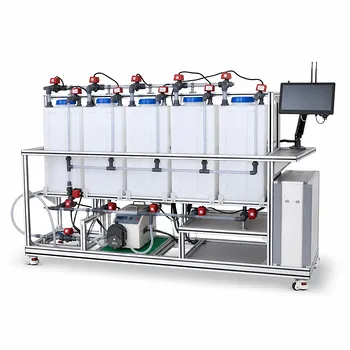
Electrochemical Water Treatment Educational Unit Operations Pilot Plant

Electrochemical Water Treatment Educational Unit Operations Pilot Plant

Enhance engineering education with this pilot-scale electrochemical water treatment plant. Designed for hands-on learning of efficient salt removal, electrolytic reactions, and real-time data acquisition. Features multi-mode control, corrosion-resistant PVC, low-voltage safety, and wireless connectivity for modern teaching labs.

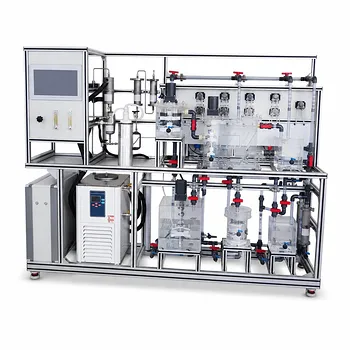
Thermal Desorption Exhaust Gas and Tail Water Treatment Educational Pilot Plant

Thermal Desorption Exhaust Gas and Tail Water Treatment Educational Pilot Plant

Bench-scale educational pilot plant for treating thermal desorption exhaust gas and tail water integrates condensation, Fenton oxidation, precipitation, filtration, and carbon adsorption. Ideal for chemical engineering and environmental labs, teaching unit operations, process control, and real-time data analysis.

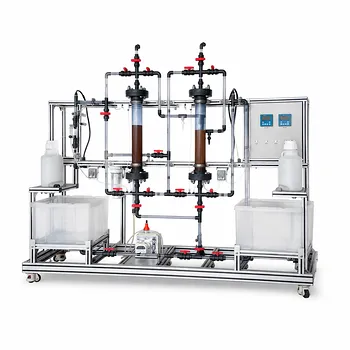
Ion Exchange Water Purification Educational Pilot Plant for Engineering Unit Operations

Ion Exchange Water Purification Educational Pilot Plant for Engineering Unit Operations

This bench-scale ion exchange pilot plant trains engineering students in water purification. Dual transparent columns simulate industrial softening and demineralization. Students observe fluid dynamics, perform resin regeneration, and analyze breakthrough curves. The corrosion-resistant frame ensures durability in unit operations experiments.

Alkaline Membrane Water Electrolysis Educational Pilot Plant Unit Operations Training System

Alkaline Membrane Water Electrolysis Educational Pilot Plant Unit Operations Training System

Hands-on educational pilot plant for alkaline membrane water electrolysis hydrogen production, integrating unit operations training with industrial PLC control, real-time data logging, customizable design, durable 316L stainless steel construction, explosion-proof safety, and modern 5G connectivity for university laboratories.

Water Electrolysis Hydrogen Production and Storage Educational Pilot Plant

Water Electrolysis Hydrogen Production and Storage Educational Pilot Plant

Integrated pilot-scale training system for higher education engineering labs. Features AWE/PEM electrolysis, adjustable DC power, PLC controls, gas-liquid separation, and pressurized hydrogen storage. Hands-on learning in green hydrogen, process control, and safety, ideal for chemical and energy departments.

Electrolytic Hydrogen Production Educational Unit Operations Pilot Plant

Electrolytic Hydrogen Production Educational Unit Operations Pilot Plant

Bench-scale electrolytic hydrogen production pilot plant designed for university engineering labs. Provides hands-on training in water electrolysis, gas-liquid separation, and process safety. Fully customizable system with digital PID control, corrosion-resistant components, and hydrogen gas detector. Ideal for chemical engineering curricula.

Continuous Batch Extractive Distillation Educational Pilot Plant

Continuous Batch Extractive Distillation Educational Pilot Plant

Versatile pilot plant for continuous, batch, and extractive distillation training. High-borosilicate glass column for visualizing hydraulics, 15.6-inch touchscreen with data logging, precise reflux ratio control 1-99, and durable corrosion-resistant frame. Ideal for chemical engineering education and process research.

Multi-Functional Special Distillation Educational Pilot Plant

Multi-Functional Special Distillation Educational Pilot Plant

Versatile multi-functional special distillation pilot plant for chemical engineering education. Supports continuous, vacuum, azeotropic, reactive, extractive distillation. Transparent glass columns enable real-time visual observation of hydrodynamics and separation processes.

100L Continuous Loop Hydrogenation Educational Unit Operations Pilot Plant

100L Continuous Loop Hydrogenation Educational Unit Operations Pilot Plant

This 100L continuous loop hydrogenation pilot plant is designed for chemical engineering education, featuring 316 stainless steel construction, advanced gas-liquid mass transfer components, explosion-proof safety systems, and a 15.6-inch touchscreen with 5G connectivity, cloud data logging, bridging theory and industry.

Constant Pressure Filtration Educational Unit Operations Pilot Plant

Constant Pressure Filtration Educational Unit Operations Pilot Plant

Hands-on educational pilot plant for constant pressure filtration. Classic plate and frame filter press allows students to study kinetics, determine specific cake resistance, perform cake washing and evaluate washing rates. Ideal for chemical engineering curriculum. Mobile, customizable, safety-compliant design.

Multifunctional Membrane Separation Educational Pilot Plant with Ultrafiltration, Nanofiltration, Reverse Osmosis

Multifunctional Membrane Separation Educational Pilot Plant with Ultrafiltration, Nanofiltration, Reverse Osmosis

An integrated laboratory bench-scale membrane separation system for higher education engineering labs combining Ultrafiltration, Nanofiltration, and Reverse Osmosis processes. Features industrial PLC control with touch-screen HMI, transparent piping, and academic assessment software. Ideal for chemical and environmental engineering curricula.

Electrolyte Distillation Purification and Formulation Educational Pilot Plant

Electrolyte Distillation Purification and Formulation Educational Pilot Plant

Integrated bench-to-pilot scale educational pilot plant for electrolyte distillation, purification, and formulation with borosilicate glass construction, PLC automation, touchscreen HMI, and advanced industrial safety features for hands-on chemical process training, ideal for chemical engineering and materials science curricula.

Ultrafiltration Membrane Separation Educational Pilot Plant

Ultrafiltration Membrane Separation Educational Pilot Plant

This ultrafiltration membrane separation educational pilot plant enables undergraduate students to process PVA solutions, study hollow fiber membrane dynamics, and perform quantitative analysis with spectrophotometry for hands-on learning of unit operations and industrial maintenance and membrane cleaning protocols.

Multi Functional Membrane Crystallization Educational Unit Operations Pilot Plant

Multi Functional Membrane Crystallization Educational Unit Operations Pilot Plant

Integrated bench-scale membrane crystallization pilot plant for engineering education. Provides hands-on training in advanced separation technologies, combining membrane distillation crystallization and process intensification. Features variable scaling vessels, industrial-grade flow control, and interactive digital data acquisition. Customizable for university labs.

Multi-Functional Membrane Separation Educational Pilot Plant for Unit Operations Lab

Multi-Functional Membrane Separation Educational Pilot Plant for Unit Operations Lab

The Multi-functional Membrane Separation Educational Unit Operations Pilot Plant is an integrated bench-scale laboratory system designed for teaching undergraduate engineering education. It features Ultrafiltration, Nanofiltration, and Reverse Osmosis modules in a compact, mobile unit for practical hands-on learning.

Natural Product Extraction Unit Operations Training Pilot Plant

Natural Product Extraction Unit Operations Training Pilot Plant

Integrated natural product extraction pilot plant for chemical engineering training bridges theory and industrial practice with modular extraction and evaporation/concentration units, hybrid touchscreen and manual control, realistic process simulation, and self-contained softened water and vacuum utilities.

Fixed-Bed Chemical Reaction and Gas Dust Tar Removal Unit Operations Pilot Plant

Fixed-Bed Chemical Reaction and Gas Dust Tar Removal Unit Operations Pilot Plant

Integrated educational pilot plant for studying catalytic gas-solid reactions and downstream gas purification. Features dual fixed-bed reactor, three-stage heating, and touchscreen control for hands-on engineering training. Ideal for chemical and environmental engineering curricula.

Centrifugal Pump Performance and Orifice Flowmeter Calibration Educational Pilot Plant

Centrifugal Pump Performance and Orifice Flowmeter Calibration Educational Pilot Plant

This versatile educational pilot plant enables engineering students to conduct centrifugal pump performance tests, orifice flowmeter calibration, and fluid mechanics experiments using a transparent flow loop, industrial HMI, and 3D virtual simulation for a comprehensive hands-on learning experience.

Comprehensive Fluid Mechanics Educational Unit Operations Pilot Plant

Comprehensive Fluid Mechanics Educational Unit Operations Pilot Plant

Hands-on fluid mechanics pilot plant for engineering education covering over 13 principles including pipe flow, minor losses, flowmeter calibration, and pump performance with industrial-grade components, smooth and rough piping, venturi and orifice flowmeters, and centrifugal pump testing and analysis.

Ethyl Acetate Synthesis Unit Operations Pilot Plant for Practical Training

Ethyl Acetate Synthesis Unit Operations Pilot Plant for Practical Training

Modular and customizable pilot plant for ethyl acetate synthesis practical training. Integrates esterification reaction, liquid-liquid extraction, neutralization, and sieve-plate distillation unit operations. Bridging theory and real-world industrial processes. Designed for university chemical engineering labs


Leave Your Message