Pilot plant success depends on accurate phase behavior predictions without exhaustive, costly experimentation. The ability to predict ternary vapor-liquid equilibrium (VLE) from binary system parameters is significant because it slashes the number of experimental runs needed to design and safely operate gas-separation processes. Engineers can confidently model multicomponent distillation or absorption columns, optimize operating conditions, and prevent hazardous failures using only readily available binary data, with typical prediction errors as low as 0.003 in mole fraction and 0.16 bar in pressure.
Predicting ternary VLE from binary parameters transforms pilot plant work from a resource-intensive guessing game into a streamlined, safe, and educationally powerful practice. It allows engineers and students alike to map out entire separation processes using minimal data, but its success depends on the type of equilibrium—VLE prediction thrives on this approach, while liquid-liquid equilibrium (LLE) often demands direct experimental verification.
The Resource Drain of Full Experimental Characterization
In a pilot plant, every combination of temperature, pressure, and composition for a multicomponent gas mixture would require a separate, meticulous measurement. For a ternary system like carbon dioxide, ethane, and ethylene, the number of permutations quickly becomes unmanageable.
Collecting that data consumes enormous time, expensive analytical gases, and operator hours. This brute-force approach fundamentally clashes with the pilot plant’s purpose: rapid, cost-effective process validation and scale-up.
The Practical Limit of Laboratory VLE Data
Even with automated high-throughput equipment, full multicomponent VLE data sets are rare. Pilot plant schedules cannot wait for months of thermodynamic measurements.
Engineers need a method that provides reliable phase envelopes today, not next quarter. Relying on binary-derived predictions makes this possible without sacrificing the accuracy needed for equipment sizing and safety assessments.
Binary Parameters as the Building Blocks of Ternary Behavior
Thermodynamic models treat binary interactions as the foundational layer of mixture properties. For VLE, these binary cross-interaction parameters capture the essential non-idealities—the molecular “misfit” between unlike molecules.
When two components are chemically dissimilar, as with polar and non-polar gases, binary interaction parameters (often less than unity) quantify the deviation from ideal mixing. Properly regressed binary data inject this real-world behavior into equations of state, enabling them to predict how a third component will partition itself between liquid and vapor.
How Small Errors Enable Big Decisions
The predictive power is not theoretical. For the carbon dioxide-ethane-ethylene system, ternary VLE deviations from experimental benchmarks are a mere 0.003 mole fraction for composition and 0.16 bar for pressure.
This level of precision means a pilot plant model built on binary data can accurately predict critical lines, compression factors (Z), and the possible appearance of azeotropes at elevated temperatures. Such accuracy allows engineers to design fractionation columns and set reflux ratios without waiting for ternary confirmation runs.
Impact on Pilot Plant Design and Safety
Gas-separation pilot plants operate under rigorous safety constraints, especially when handling high-pressure, potentially supercritical or cryogenic fluids. The ability to predict ternary behavior directly from binary data changes both the design workflow and the operational risk profile.
Preventing Catastrophic Equipment Failures
Inaccurate phase predictions lead to real damage. Unexpected liquid carryover into compressors, pump cavitation from vapor breakout, or inaccurate LNG metering during flow tests all stem from not knowing where the real two-phase region lies.
Using binary parameters to map the critical locus and VLE envelope ensures the pilot plant stays within a safe, subcritical operating window. This eliminates the dangerous guesswork that can arise when standard combining rules fail for highly non-ideal mixtures.
Streamlining the Scale-Up Process
A pilot plant’s core mission is to de-risk the commercial scale. Binary-parameter prediction allows engineers to run design-of-experiment studies on a ternary separation without first characterizing every mixture.
They can simulate and operate a multicomponent distillation column, optimize energy consumption, and validate thermodynamic models under semi-industrial conditions after just a handful of binary runs. This dramatically accelerates the scale-up timeline.
Educational and Training Value
For students and vocational trainees, this strategy is a pedagogical bridge. It connects simplified, calculable models to real, tangible pilot plant operation.
Learners can model a complex separation using only binary data, then physically run the column and compare their predictions—observing real deviations from ideality. This direct connection between binary calculations and macro-scale unit operations cements understanding without overwhelming complexity.
Understanding the Trade-offs: Where Binary Predictions Fail
The predictive success of binary parameters is not universal. Relying on them carries critical caveats that any pilot plant team must respect to avoid misinterpretation and operational surprises.
The Sharp Boundary: VLE vs. LLE
While binary data successfully predicts multicomponent VLE, it often fails for liquid-liquid equilibria (LLE). Multicomponent liquid mixtures involve complex, simultaneous multi-body interactions—hydrogen bonding, solvation shells—that simple binary pairs cannot capture.
For a liquid-liquid extraction pilot plant operating with three or more components, direct experimental verification of the LLE phase diagram remains essential. Using binary-only predictions here risks designing a separation that cannot physically occur.
The Limits of Standard Mixing Rules
Standard combining rules embedded in equations of state are insufficient for strongly asymmetric systems. Even with regressed binary parameters, highly polar or associating mixtures may require more advanced models.
The error margins of 0.003 mole fraction apply to well-behaved systems. Always validate your specific chemistry—if no binary data exists for a key pair, or if the system shows complex hydrogen bonding, a targeted ternary experiment is a necessary insurance policy.
Making the Right Choice for Your Pilot Plant Application
Your strategy for deploying binary parameters depends entirely on your unit operation and your primary objective. Here is how to align your approach with your goals.
- If your primary focus is gas-separation VLE (distillation, absorption): Use regressed binary interaction parameters as your primary design tool. You can model ternary and higher systems with high confidence, reserving ternary experiments only for final process validation.
- If your primary focus is liquid-liquid extraction: Do not rely on binary-only predictions for the multicomponent LLE. Budget for direct experimental measurement of the three-component system early in your pilot plant campaign to avoid fundamental design errors.
- If your primary focus is education or workforce training: Leverage the binary-to-ternary VLE prediction as a core teaching module. It lets students perform sophisticated simulations and hands-on column operation without the resource barrier of generating full multicomponent data sets.
- If your primary focus is high-pressure or critical-zone safety: Use binary-derived critical locus predictions to define safe operating envelopes. This prevents accidental supercritical transitions and protects both equipment and personnel.
Deploying the right predictive strategy for the right equilibrium type turns a pilot plant from a costly testing ground into a sharp, efficient instrument of process scale-up and knowledge.
Summary Table:
| Aspect | Ternary VLE Prediction | Ternary LLE Prediction |
|---|---|---|
| Predictive Reliability | High (error ~0.003 mole fraction, 0.16 bar) | Low (requires direct experimental verification) |
| Primary Application | Distillation, gas absorption, fractionation | Liquid-liquid extraction |
| Resource Savings | Eliminates exhaustive ternary experimental runs | Limited; experimental phase diagrams are required |
| Safety Impact | Accurately defines safe operating pressure envelopes | Prevents phase separation failures in extraction columns |
Scale Up Safely and Educate Effectively with LABPARK
Are you looking to bridge the gap between thermodynamic theory and practical pilot plant operations?
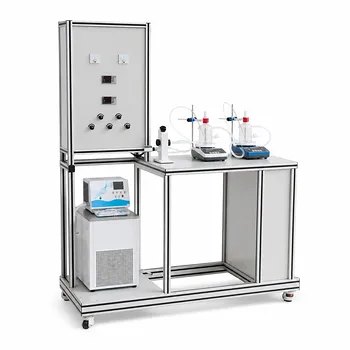
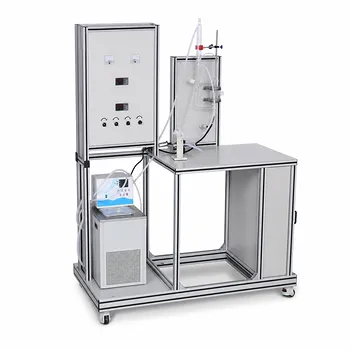
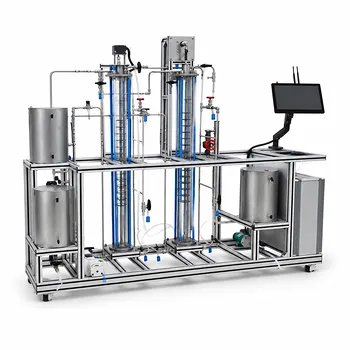
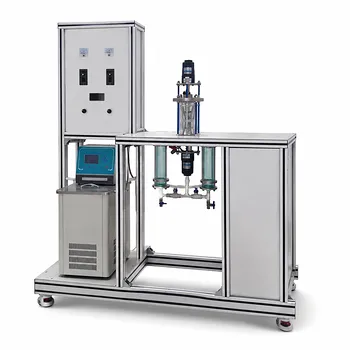
LABPARK provides state-of-the-art Educational and Vocational Unit Operations Pilot Plants for chemical engineering, bioprocess & biotech, and environmental & water treatment. Designed specifically for universities, research institutes, and enterprises, our plants allow you to safely model complex gas-separation processes, validate binary/ternary phase behaviors, and train operators under real-world conditions.
Ready to elevate your research and training capabilities? Contact our technical specialists today to find the perfect pilot plant system for your facility!
Related Products
- Ternary Liquid-Liquid Equilibrium Educational Pilot Plant
- Binary System Vapor Liquid Equilibrium Data Determination Educational Unit Operations Pilot Plant
- Comprehensive Liquid-Liquid Extraction Pilot Plant for Engineering Education
- Liquid-Liquid Mass Transfer Coefficient Determination Educational Pilot Plant
- Multi-Functional Special Distillation Educational Pilot Plant
People Also Ask
- Why is precise temperature control necessary in LLE experiments? Ensure accurate pilot plant data
- How do pilot plants explain ternary phase diagrams? Bridge thermodynamic theory and practice
- How are ternary phase diagrams and LLE data applied in extraction experiments? Optimize Pilot Plant Scale-up
- How Do Selectivity & Distribution Coefficients Influence LLE Pilot Plant Solvent Choice?
- How to Validate BIPs for LLE Pilot Plants? Steps to Align Simulations with Reality