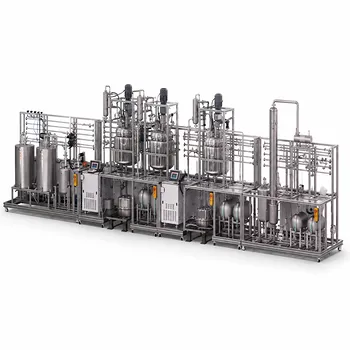
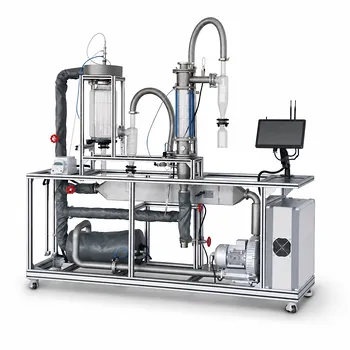
Not testing at the pilot scale is a gamble where the stake is the entire commercial facility. Suitability testing on unit operations pilot plants is the definitive method to verify that a chemical or bioprocess works safely and economically beyond the idealized conditions of a laboratory benchtop.
Because physical forces like mixing, heat removal, and mass transfer do not scale linearly, a reaction that performs perfectly in a beaker can become dangerously uncontrollable or commercially unviable in a 10,000-liter reactor. This intermediate step is the only way to generate the empirical data required to design industrial equipment and document the process control parameters necessary for Good Manufacturing Practice (GMP) regulatory compliance.
The core problem is that physics does not scale linearly. A pilot plant is not just a larger beaker; it is a truth-telling machine that exposes the hidden engineering flaws and economic miscalculations that will break a process at commercial scale. It bridges the gap between molecular discovery and industrial reliability by subjecting the chemistry to real-world fluid dynamics and impurity profiles before significant capital is deployed.
Beyond the Beaker: The Invisible Physics Threatening Your Process
The laboratory benchtop provides a nearly perfect environment intentionally stripped of variables. This makes it fundamentally misleading when predicting behavior in a production vessel, where gradients and non-ideal mixing dominate outcomes.
The Mixing and Heat Transfer Myth
In a small round-bottom flask, mixing is almost instantaneous, and surface-area-to-volume ratio is astronomically high. Heat is easily whisked away with a simple water bath.
Scaling up by simply increasing the volume collapses this dynamic. Mixing times increase exponentially, creating stagnant "dead zones" inside the reactor where reactants sit unreacted or decomposition occurs. Crucially, the ability to remove heat scales with surface area (length²), while the heat generated by the reaction scales with volume (length³). The supplementary references highlight that failing to account for this leads directly to dangerous thermal runaways that simply do not manifest in the lab.
The Impurity Amplification Effect
A process using analytical-grade reagents in R&D often ignores the reality of commercial supply chains. The supplementary content warns that raw materials at scale contain varying impurity profiles and particle size distributions that are entirely absent from lab samples.
What is a minor side-reaction in a beaker can become a catastrophic yield killer at scale. For example, a granular solid that dissolves instantly in a milliliter of solvent might fail to suspend entirely in a large pilot reactor due to insufficient shear from the agitator. You cannot fix this with a simulation; only empirical pilot testing with the exact technical-grade raw materials destined for production can validate your supply chain.
Catalyst Deactivation Under True Stress
Laboratory catalyst testing usually involves a "clean" setup, but suitability testing introduces the grueling stress of industrial reality. This is where catalyst stability is truly measured.
The pilot environment recirculates process streams, accumulating trace poisons and physical fines that mechanically abrade the catalyst structure over time. Running this test isn't just about checking initial activity; it’s about measuring the deactivation rate under long-duration continuous operation, directly impacting the economic model for catalyst replacement frequency.
The Validation Gap Between Curiosity and Compliance
A scientist proves a reaction works; an engineer proves it won't fail. Regulatory bodies like the FDA or EMA are not convinced by a researcher’s notebook—they require demonstrable control.
Proving Safety Through Empirical Data
Safety assessments based on Differential Scanning Calorimetry (DSC) of a few milligrams of material often miss the "what-if" scenarios of an operating plant. The primary reference emphasizes that pilot-scale operation is required to characterize the maximum credible event.
Only by running the process at an intermediate scale can you measure the real adiabatic temperature rise and gas generation rate. This data is non-negotiable input for designing pressure relief systems, quench valves, and interlocks. It moves the process from a theoretical safety argument to a physically verified safety envelope.
Bridging to GMP with Standard Operating Procedures
Regulatory approval hinges not just on product purity, but on proving the process is state-of-the-art controlled. You cannot write a credible standard operating procedure (SOP) for a 5000-reactor using data from a 5-liter glass vessel.
The pilot plant generates the operational ranges (the "proven acceptable ranges" or PARs). It physically demonstrates that if you stir at 100 RPM instead of 95 RPM or cool with -5°C brine instead of 0°C, the critical quality attributes of the product don't change. This constitutes the validation master plan required for compliance filings.
Understanding the Trade-offs
While indispensable, pilot testing is not without its limitations and must be approached with intellectual honesty to avoid a false sense of security.
The "False Positive" of a Linear Scale-Up
The primary reference warns that even pilot data can mislead if the geometry isn't perfectly representative. A miniaturized "pilot" column with an internal diameter of 2 inches cannot faithfully replicate the wall-channeling effects of a 2-meter commercial column.
If the pilot unit lacks geometric similarity, the physics are different. You risk a "successful" pilot run that fails upon factory commissioning because a critical variable (like wall heat transfer contribution) was artificially exaggerated at the small scale.
Economic Sensitivity Blind Spots
A pilot plant proves technical feasibility, but cost is a separate hurdle. The supplementary content notes that the raw data from the pilot—specifically utility consumption and catalyst lifespan—must be fed into a Discounted Cash Flow Rate of Return (DCFRR) model.
The risk is misinterpreting pilot economics as final economics. A pilot plant is typically labor-intensive and lacks the heat integration of a commercial site. An unadjusted cost projection might kill a viable project, or worse, underestimate production costs significantly, ensuring the commercial plant never turns a profit.
Making the Right Choice for Your Scale-Up Journey
The design and rigor of your suitability testing program must match your business risk profile. Apply the following guidance based on your primary objective:
- If your primary focus is speed-to-market for an early-stage asset: Prioritize testing the "show-stopper" physics first—specifically mixing and heat transfer—using a simplified pilot skid. Do not optimize yield immediately; focus solely on proving you can safely handle the energy output without a runaway.
- If your primary focus is capital preservation before facility construction: Treat the pilot plant strictly as a data furnace. Run the reactor 24/7 with recycled mother liquors and actual technical-grade feeds. Focus on measuring corrosion rates on coupons and fouling factors on heat exchangers to right-size your capital equipment.
- If your primary focus is absolute regulatory compliance and GMP data: Demand tight instrumentation on your pilot unit. Validate every cleaning procedure and sterile boundary at this scale; this is your only chance to optimize the SOPs without expensive post-construction retrofitting of the main facility.
- If your primary focus is resolving raw material supply chain variability: Secure samples from your top three vendors. Run identical pilot batches back-to-back, changing only the raw material lot. This isolates sensitivity to impurities and particle size before they can be blamed for a manufacturing deviation later.
The commercial reactor will not forgive what the pilot plant did not predict. By viewing the pilot plant as a tool for aggressive truth-seeking rather than a confirmation box to check, you transform unknown catastrophic risks into calculated operating costs.
Summary Table:
| Key Challenge | Scale-Up Risk | Pilot Testing Solution |
|---|---|---|
| Non-Linear Physics | Thermal runaways & poor mixing | Generates empirical heat & mass transfer data |
| Impurity Amplification | Yield drops & catalyst deactivation | Validates real-world technical-grade materials |
| Regulatory Compliance | Failed audits & lack of PARs | Establishes validated SOPs & safety parameters |
Bring Reliability to Your Scale-Up Journey with LABPARK
Scaling up chemical and bioprocesses requires absolute precision. LABPARK provides premium Educational and Vocational Unit Operations Pilot Plants in chemical engineering, bioprocess & biotech, and environmental & water treatment.
Designed specifically for universities, research institutes, and enterprises, our systems enable you to conduct critical suitability testing, eliminate engineering flaws, and secure GMP compliance before full-scale deployment.
Ready to safeguard your process and optimize your facility? Contact LABPARK today to find the perfect pilot plant solution for your needs.
Related Products
- Bio-fermentation Ethanol Production Practical Training Unit Operations Pilot Plant
- Natural Product Extraction Unit Operations Training Pilot Plant
- Multi Pump Fluid Transport Process Piping Unit Operations Training Pilot Plant
- Multi-Reactor Educational Pilot Plant for Reaction Engineering Unit Operations
- Fixed-Bed Chemical Reaction and Gas Dust Tar Removal Unit Operations Pilot Plant
People Also Ask
- Why Use PTFE & Hastelloy in Chemical Pilot Plants? Prevent Corrosion & Ensure Safety
- Why Compare Predicted and Experimental Excess Enthalpy? Key to Accurate Pilot Plant Scale-up
- Why is the chemical plant startup schedule crucial? De-risk scale-up with pilot plants.
- When to transition from PID to adaptive control in pilot plants? Key process indicators.
- Why must batch and fed-batch fermentation pilot plants be designed to accommodate changing rheological conditions?