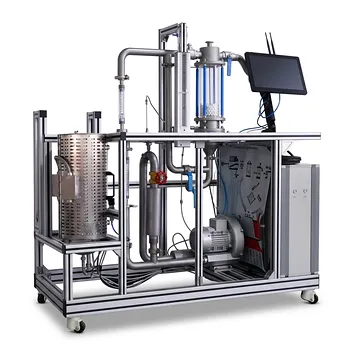
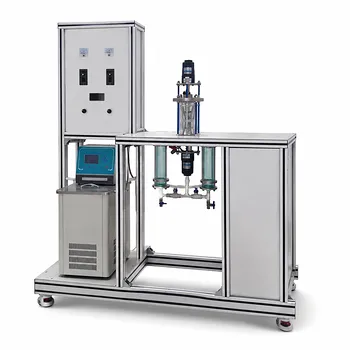
The root cause is a fundamental mismatch between a simple reactive algorithm and the physics of a large, thermally sluggish vessel. Standard PID control fails in fermenter vessels because it only reacts to past errors, while the vessel’s high thermal inertia and long time lags cause severe overshoot, oscillation, and ultimately damage to heat-sensitive biological cultures. The problem is solved by adopting advanced control strategies—such as cascade control, feedforward compensation, and process curve decomposition—orchestrated through dedicated computer control systems that can anticipate and decouple the system’s inherent delays.
A standard PID loop cannot reconcile the rapid biological need for temperature stability with the slow, lag-dominated thermal response of a pilot-scale fermenter. The solution lies not in tuning the PID harder, but in restructuring the control architecture to anticipate heat loads, separate fast and slow dynamics, and model the vessel’s time-varying behavior—turning a battle against inertia into a precisely managed process.
The Thermal Inertia Challenge
Pilot-scale fermenters typically use an external jacket for indirect heating or cooling. This creates a chain of heat transfer resistances and capacitances that introduces significant dead time and a sluggish, high-order response.
Why a Simple PID Hits Its Limits
A standard PID controller adjusts its output based solely on the error between the setpoint and the current temperature. It has no knowledge of the upcoming disturbance or the vessel’s internal lag.
When the controller detects a deviation, it ramps up jacket flow. Because of the thermal mass of the vessel wall and the fluid, the temperature sensor “sees” the change only after a long delay. The PID, receiving no immediate feedback, continues to increase output, often overshooting the setpoint. The corrective action then creates an undershoot, leading to sustained oscillations that are biologically unacceptable.
- Dead Time Dominance: The delay between jacket action and process measurement often surpasses the process time constant, making the loop intrinsically unstable with purely reactive logic.
- Gain Limitations: To avoid oscillation, the PID gain must be drastically reduced, but this makes the controller too slow to reject disturbances like metabolic heat generation.
Biological Consequences of Poor Temperature Control
The need for precision is not a mere engineering preference—it is a biological imperative. Supplementary references highlight the severe consequences of even brief excursions.
Enzyme Denaturation and Metabolic Collapse
Proteins and enzymes, the catalysts of all metabolic reactions, maintain their functional three-dimensional structure only within a narrow thermal window. Exposure to temperatures just a few degrees above the optimum causes irreversible denaturation, destroying their activity and crashing the culture.
Growth Kinetics and the Arrhenius Relationship
Microbial growth rates follow an Arrhenius-type dependence on temperature—rising exponentially below the optimum but dropping catastrophically above it. A standard PID-induced temperature overshoot can rapidly shift the culture from maximal growth to cell death, invalidating experimental results and wasting weeks of preparation.
Engineering Around the Lag: Modern Control Strategies
Pilot plant systems abandon simple, single-loop PID in favor of architectures that account for the vessel’s thermal inertia before an error escalates. The primary reference outlines several proven methods.
Cascade Control: Inner and Outer Loop Mastery
Cascade control splits the problem into two loops. An outer loop (master) monitors the fermenter temperature and sends a setpoint to an inner loop (slave) that controls the jacket temperature or flow rate.
The inner loop reacts to disturbances in the jacket supply (e.g., steam pressure changes) within seconds, before they ever affect the vessel. The outer loop only has to correct slow metabolic drifts. This decoupling dramatically reduces the effective dead time and enables much tighter regulation.
Feedforward Control: Predicting the Heat Load
Unlike PID, feedforward does not wait for an error. It uses a measured disturbance—such as the cooling water inlet temperature, agitation rate, or calculated metabolic heat from exhaust gas analysis—to preemptively adjust the jacket’s heating or cooling capacity.
By anticipating the thermal demand, feedforward cancels out a major disturbance before it creates a measurable temperature deviation. The feedback loop then only has to trim minimal residual errors.
Process Curve Decomposition: Tailoring the Response
This model-based approach characterizes the vessel’s step response into distinct dynamic elements (dead time, multiple time constants). The control algorithm then uses a decomposed model to predict the future trajectory and deliver a “burst” of energy followed by a precisely timed cutback.
Instead of a generic PID curve, the controller follows a calculated path that brings the temperature to setpoint with no overshoot, even for high-inertia vessels.
The Integration Platform: Computer Control Systems
Executing these strategies requires a computational backbone. Modern pilot plants rely on computer control systems comprising PC monitoring stations, dedicated controllers, and distributed I/O modules.
This architecture manages the multi-loop, time-varying nature of the process. It can simultaneously run cascade and feedforward loops, switch between heating and cooling models, log data for regulatory compliance, and allow researchers to modify control parameters without reprogramming hardware.
Understanding the Trade-offs in Advanced Control
While these strategies solve the fundamental PID limitation, they introduce their own set of challenges that must be managed objectively.
Increased Complexity and Commissioning Time
Cascade loops require two sensors and two tuned controllers; feedforward demands accurate disturbance measurements and a validated process model. An improperly tuned cascade can amplify disturbances, and a poor feedforward model can make control worse than a simple PID.
Dependency on Process Knowledge
Techniques like process curve decomposition rely on a stable process model. If the vessel’s heat transfer coefficient changes due to fouling or a different fill volume, the model must be updated. This demands a higher level of instrumentation and operator expertise compared to a standard off-the-shelf PID controller.
Potential for Hidden Instabilities
Multiple interacting loops can create unseen oscillatory modes. Proper decoupling and loop analysis are essential to ensure the outer loop does not fight the inner loop’s dynamics.
Making the Right Choice for Your Pilot Plant Goal
Selecting the control architecture should be driven by the sensitivity of your biological system and the scale of your vessel.
- If your primary focus is high-value, fastidious cultures (e.g., mammalian cells): Prioritize cascade control with a well-tuned jacket loop. The minimal overshoot and fast disturbance rejection justify the additional instrumentation.
- If your primary focus is a variable process with known disturbances (e.g., frequent feed additions): Implement feedforward compensation layered over a robust feedback loop to cancel predictable heat loads before they reach the culture.
- If your primary focus is repeatability across campaigns and scale-down models: Invest in a computer control system that offers model-based control and decomposed step-response tuning, enabling you to transfer successful parameters from small-scale to pilot-scale vessels.
Mastering fermenter temperature control is about understanding the vessel’s thermal inertia not as an obstacle, but as a predictable system that, when properly modeled and decoupled, can be guided with the same precision as a bench-top incubator.
Summary Table:
| Control Strategy | How it Works | Key Benefit for Fermenters | Best Suited For |
|---|---|---|---|
| Standard PID | Reactive feedback based on past temperature errors | Simple setup, but prone to thermal overshoot and lag | Small, low-inertia systems |
| Cascade Control | Master loop (vessel) sets target for slave loop (jacket) | Decouples jacket disturbances and reduces lag | High-value, sensitive cultures |
| Feedforward | Preemptively adjusts output based on measured disturbances | Cancels thermal loads before temperature drifts | Processes with predictable disturbances |
| Process Curve Decomposition | Model-based control predicting temperature trajectories | Smooth target approach with zero overshoot | High-inertia vessels & scale-down models |
Optimize Your Bioprocess Control with LABPARK
Achieving precise temperature control in bioprocess pilot plants requires advanced control architectures and robust hardware integration. LABPARK provides state-of-the-art Educational and Vocational Unit Operations Pilot Plants in chemical engineering, bioprocess & biotech, and environmental & water treatment.
Designed specifically for universities, research institutes, and enterprises, our pilot plants integrate advanced computer control systems to eliminate thermal lag, protect sensitive biological cultures, and deliver reliable data for scale-up.
Ready to elevate your research, teaching, and training capabilities? Contact us today to discover how LABPARK can customize the perfect pilot-scale solution for your facility!
Related Products
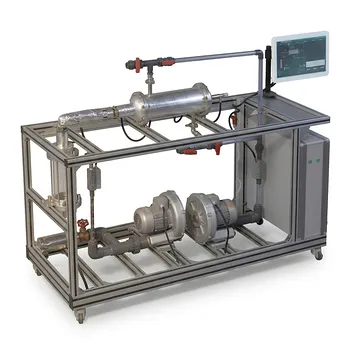
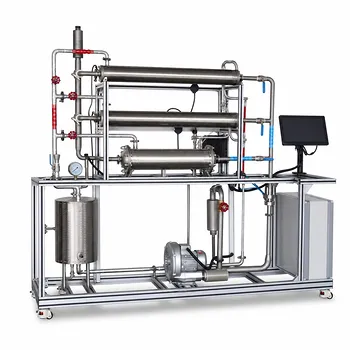
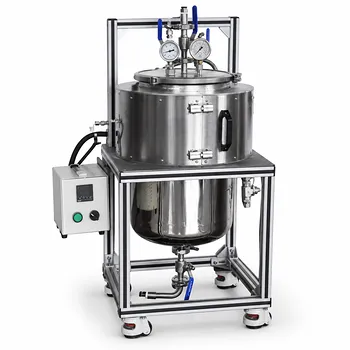
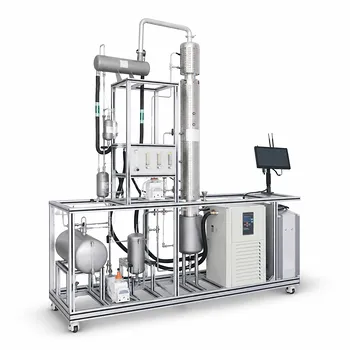
- Bio-fermentation Ethanol Production Practical Training Unit Operations Pilot Plant
- Shell and Tube Heat Exchanger Heat Transfer Coefficient Determination Educational Pilot Plant
- Comprehensive Heat Transfer Coefficient Determination Educational Unit Operations Pilot Plant
- Hot Filtration Educational Unit Operations Pilot Plant Laboratory System
- Multi-Functional Special Distillation Educational Pilot Plant
People Also Ask
- Why Use PTFE & Hastelloy in Chemical Pilot Plants? Prevent Corrosion & Ensure Safety
- Why Compare Predicted and Experimental Excess Enthalpy? Key to Accurate Pilot Plant Scale-up
- Why is the chemical plant startup schedule crucial? De-risk scale-up with pilot plants.
- When to transition from PID to adaptive control in pilot plants? Key process indicators.
- Why must batch and fed-batch fermentation pilot plants be designed to accommodate changing rheological conditions?