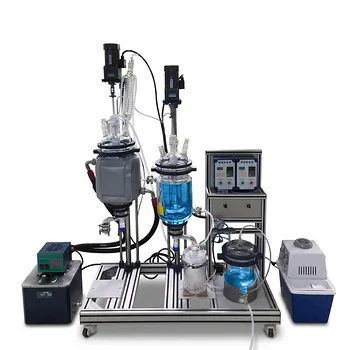
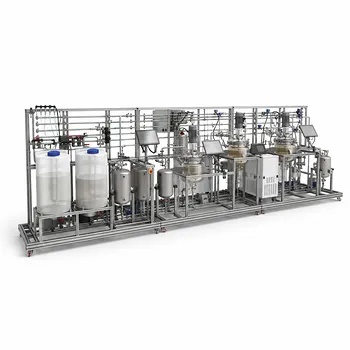
Precise temperature and supersaturation control is the single most critical setpoint in a crystallization pilot plant.
Without it, the experiment yields irreproducible results and crystals of unusable quality. For hydrates like magnesium sulfate, even minor deviations completely change the solid phase you recover and destroy the very data you’re trying to gather.
For hydrate-forming compounds like magnesium sulfate, precise control of both temperature and supersaturation is not a luxury—it’s a fundamental requirement. The temperature defines which solid phase crystallizes, while the degree of supercooling dictates whether you get large, pure crystals or an unusable mass of fines and dendrites.
The Dual Role of Temperature and Supersaturation in Hydrate Crystallization
Supersaturation: The Driving Force That Defines Crystal Quality
Supersaturation is the engine of crystallization. It’s the non‑equilibrium state where a solution holds more dissolved solute than its solubility curve allows at that temperature.
In a pilot plant, you control supersaturation primarily by establishing an under‑cooling (ΔT) —the temperature difference between the saturation condition and the actual operating point.
For magnesium sulfate heptahydrate, the outcome of the entire experiment pivots on this ΔT.
- Low under‑cooling (ΔT < 4°C) yields transparent, high‑quality crystals with minimal secondary nucleation.
- Moderate under‑cooling (4°C ≤ ΔT < 8°C) introduces imperfections through contact nucleation, compromising crystal integrity.
- Excessive under‑cooling (ΔT ≥ 8°C) triggers dendritic or needle‑like growth and massive fragmentation, producing a slurry of broken, hard‑to‑filter crystals.
These regimes show that supersaturation directly maps to product quality—not just yield. In a pilot plant, failing to hold ΔT within the optimal metastable zone turns a crystallization experiment into an uncontrolled precipitation.
Why Temperature Control Is Paramount for Hydrates
Hydrate‑forming compounds like magnesium sulfate don’t just respond to supersaturation—they can change which solid phase exists with a small temperature shift.
A classic parallel is sodium sulfate: crossing its 32.4°C transition temperature swaps the stable form from decahydrate to anhydrous salt. Operating a crystallizer even half a degree on the wrong side gives you a completely different crystal structure, invalidating downstream processing data.
For magnesium sulfate heptahydrate, the stable hydrate is only guaranteed within a specific temperature band. Temperature fluctuations can inadvertently push the system toward an alternative hydrate or an amorphous precipitate.
This means that while supersaturation determines how crystals grow, temperature stability determines which crystal you actually make.
The Synergy: Controlling Supersaturation via Under‑Cooling
Under‑cooling is the practical, measurable stand‑in for supersaturation in a crystallizer. To keep ΔT exactly where you need it—say, below 4°C for high‑quality growth—you must maintain an extraordinarily stable thermal environment.
Modern pilot plants achieve this with high‑precision temperature control jackets and fast‑acting PID loops. These systems eliminate thermal gradients that would otherwise create localized zones of high supersaturation and spontaneous nucleation.
Only with that fidelity can you study the delicate phase transitions and growth kinetics that govern hydrate crystallization.
Understanding the Trade‑offs and Operational Pitfalls
The Metastable Zone: A Narrow Operating Window
The ideal working region lies within the metastable zone—supersaturated enough for growth, but not so high that spontaneous nucleation takes over. The trade‑off is tight.
- Too slow: Operate extremely close to saturation (ΔT near 0) and growth rates become impractically slow for any scale‑up study.
- Too fast: Push ΔT into the 8°C range and the product turns to needles and dust, ruining filterability and purity.
For hydrates, this window is even narrower because you must simultaneously stay within the stable phase field of the desired hydrate. A temperature fluctuation that pushes you out of the metastable zone often also crosses a phase boundary, compounding the damage.
Common Pitfalls: Dust, Impurities, and Fluctuations
Even with perfect bulk ΔT control, secondary nucleation can still wreck a run. Dust particles or trace impurities act as heterogeneous nuclei, triggering massive nucleation at supersaturation levels that would otherwise remain metastable.
This is why pilot‑plant protocols insist on clean solutions, filtered air, and precisely sized seed crystals. A single temperature spike caused by a poorly tuned jacket creates a local cold spot, elevates ΔT momentarily, and seeds the entire vessel with fines.
The takeaway: precise control isn’t just about the setpoint—it’s about eliminating stochastic disruptions that magnify the trade‑offs inherent in hydrate crystallization.
Making the Right Choice for Your Goal
The level of control you enforce must match your experimental objective. Tailor your pilot‑plant strategy accordingly.
- If your primary focus is producing high‑purity, well‑formed crystals for analysis: Maintain ΔT < 4°C for magnesium sulfate heptahydrate and double‑down on temperature stability to remain inside the target hydrate’s stable phase region.
- If your primary focus is scaling up a crystallization process: Map the metastable zone width in your pilot rig first. Then find the highest ΔT that still delivers acceptable crystal quality, because operating near the upper limit will maximize growth rate and throughput at scale.
- If your primary focus is research on hydrate phase transitions: Use high‑precision jacket control to sweep temperature‑concentration space systematically. This lets you nail the exact transition boundaries and supersaturation limits without inadvertently crossing into unintended hydrate forms.
Precise temperature and supersaturation control transforms crystallization from a haphazard precipitation into a finely tuned separation process, essential for any chemical engineer working with hydrates.
Summary Table:
| Under-cooling (ΔT) | Operating Regime | Crystal Quality & Outcome |
|---|---|---|
| Low (< 4°C) | Metastable (Ideal) | Transparent, high-quality crystals; minimal secondary nucleation. |
| Moderate (4°C - 8°C) | Transition | Contact nucleation occurs; compromised crystal integrity. |
| Excessive (≥ 8°C) | Uncontrolled | Dendritic/needle-like growth, high fragmentation, poor filterability. |
Optimize your research and vocational training with high-precision systems. LABPARK provides state-of-the-art Educational and Vocational Unit Operations Pilot Plants in chemical engineering, bioprocess & biotech, and environmental & water treatment for universities, research institutes, and enterprises. Ensure exact thermal control and reliable crystallization scaling in your facility—contact us today to find your tailored pilot plant solution!
Related Products
- Multi Functional Membrane Crystallization Educational Unit Operations Pilot Plant
- Potassium Salt Thermal Dissolution and Crystallization Separation Educational Unit Operations Pilot Plant
- Multi-Functional Special Distillation Educational Pilot Plant
- Ethyl Acetate Synthesis Unit Operations Pilot Plant for Practical Training
- Multi-Modal Distillation Unit Operations Training Pilot Plant
People Also Ask
- Why is precise temperature control critical in crystallization pilot plants? Key to Scale-Up Success
- Control Crystallization Pilot Plant Secondary Nucleation: 4 Key Adjustments
- What key factors should be considered when configuring a crystallization unit operations pilot plant?
- What are the benefits of integrating online PAT tools like ATR-FTIR into crystallization unit operations pilot plants?
- How to use crystallization pilot plant agitation speed to identify diffusion vs reaction growth?