The destructive power of a few degrees per hour.
Precise control of the cooling rate in a pilot-scale crystallizer is critical because it dictates the supersaturation level within the solution. If you cool too aggressively, supersaturation spikes out of the safe metastable zone, which directly triggers either an avalanche of unwanted fine crystals (secondary nucleation) or causes the solute to crash out as a separate liquid phase (oiling out) instead of forming a stable crystalline product.
The cooling rate is your primary lever to balance crystal growth against spontaneous nucleation. Neglect that lever and you trade a narrow, high-quality crystal size distribution for a vessel full of unusable fines or a messy oil-based separation failure—two outcomes that cripple downstream processing and scale-up.
The Fundamental Problem: Supersaturation and the Safe Zone
Every crystallization process dances on a thermodynamic knife edge. Understanding that edge is the first step to preventing process failure.
The Metastable Zone: Your Operating Window
Supersaturation is the driving force that makes crystals grow, but it’s only safe within a narrow band called the metastable zone. Inside this zone, existing crystals can grow gradually, but new nuclei likely won’t form spontaneously. Step outside the zone into the labile region, and the solution becomes thermodynamically unstable, triggering rapid, uncontrolled nucleation.
The width of this zone is defined by supercooling (ΔT)—the gap between the saturation temperature and the actual process temperature. For many systems, like magnesium sulfate heptahydrate, keeping ΔT below 4 °C yields transparent, high-quality crystals. Push ΔT to 8 °C or more, and you get dendritic, needle-like, or fragmented solids that are a nightmare to filter and dry. Precise cooling rate control is what keeps ΔT firmly inside this narrow growth-friendly window.
How Cooling Rate Drives Supersaturation
When you lower the jacket temperature, the bulk solution cools and its equilibrium solubility decreases. The solute doesn’t instantly drop out; instead, the concentration exceeds saturation, building supersaturation. If the cooling rate is slow and matched to the crystal surface area available for growth, the solute is deposited onto existing crystals as fast as it becomes supersaturated, and ΔT stays low.
If you slam on the cooling, the rate at which supersaturation is generated far outpaces the crystal growth rate. Within minutes, the solution enters the labile zone, and the system tries to relieve the thermodynamic stress in the most chaotic way possible—either through a burst of new nuclei or a phase separation.
The Two Destructive Outcomes of Poor Cooling Control
When cooling overpowers the crystal growth kinetics, two distinct failure modes emerge. Both render a pilot batch unrecoverable.
Unwanted Secondary Nucleation: The Cascade of Fines
Secondary nucleation is the dominant source of new crystals in a stirred crystallizer, caused primarily by contact nucleation—collisions between crystals, and between crystals and the impeller or vessel wall. At moderate supersaturation, these collisions produce only a few new particles. But when supersaturation spikes from aggressive cooling, the surface of every crystal becomes exceptionally fragile. Even minor collisions then shatter crystal faces or shear off micro-fragments, seeding an exponential population explosion of fine nuclei.
The result is a bimodal or wide particle size distribution dominated by micron-sized fines. These fines blind filters, prolong isolation times, promote agglomeration, and ruin the flowability needed for downstream formulation. In a pilot plant, this not only wastes a batch but also obscures the true scale-up kinetics.
Oiling Out: When Crystallization Fails Before It Begins
If the solute has a strong tendency to form a concentrated liquid phase before solidifying, rapid cooling can trigger oiling out (liquid-liquid phase separation) instead of crystallization. The supersaturation pushes the system past the solubility curve directly into a region where a second liquid phase—a dense solute-rich oil—precipitates. Once oil droplets form, they are difficult to transform into crystalline material; they often coat vessel surfaces, trap impurities, and produce a sticky, non-flowable mess.
For chiral molecules and pharmaceuticals, oiling out is especially dangerous because it can promote the formation of an unstable polymorph or even an amorphous glass, completely destroying the chemical purity and crystal structure you’re trying to engineer.
Understanding the Trade-offs in Cooling Profile Design
A precise cooling profile isn’t just about avoiding failure—it’s about balancing competing priorities. Being too cautious creates its own set of problems.
- Overly slow cooling can sacrifice productivity. A cycle that stretches from hours to days ties up pilot plant equipment and may even allow slow-growing but thermodynamically stable impurities to incorporate into the crystal lattice, lowering purity.
- Linear cooling ramps are often the enemy. Most solubility curves are nonlinear; a constant cooling rate may be gentle at high temperatures but become dangerously aggressive as the temperature drops and the solubility curve flattens. This mismatch can push the system across a phase transition boundary (like the 32.4 °C decahydrate-to-anhydrous switch for sodium sulfate) and produce an entirely different crystal structure.
- Agitation cannot be considered in isolation. Reducing stirrer speed to limit contact nucleation is good practice, but if the cooling rate isn’t adjusted simultaneously, poor mixing creates localized cold spots near the jacket wall where supersaturation can run wild, causing surface nucleation that still floods the batch with fines.
How Precise Control Prevents Process Failure
Pilot plant success depends on integrating temperature control with crystallizer dynamics. The following methods directly counteract the mechanisms of secondary nucleation and oiling out.
Programmed Cooling Trajectories: Beyond Linear Ramps
Modern pilot plants use finite difference modelling and solubility kinetics to pre-calculate a non-linear cooling curve. The objective is to maintain a nearly constant, low supersaturation throughout the batch, matching the cooling rate to the increasing crystal surface area as the mass grows. Early in the batch, when surface area is low, cooling must be extremely gentle. Later, as crystals provide more area for solute deposition, the ramp can steepen.
This growth-dominated regime keeps ΔT deliberately small, starving the system of the supersaturation spikes that trigger spontaneous nucleation or oiling. Researchers then experimentally validate the modelled profile, gaining confidence that the full-scale process will behave identically.
Agitation and Energy Input as a Cooling Partner
Cooling rate control does not work alone. To minimize secondary nucleation, pilot plants pair gentle temperature ramps with deliberately low agitation energy. Operators select impellers made of softer materials—such as PTFE instead of stainless steel—to reduce collision energy. Stirrer speed is optimised so that suspension is maintained without hammering crystals together.
When collision energy is low, the crystals become far more tolerant of slight process upsets, and the cooling profile becomes the true master of particle size rather than the mechanical environment.
Fines Destruction and Feed Pre-treatment
Even the most elegant cooling profile cannot eliminate every stray nucleus. That’s why pilot plants often incorporate a fines destruction loop: a heated external circuit that continuously withdraws a slurry slipstream, dissolves the smallest crystals, and returns the clarified solution to the vessel. This acts as a safety net, removing the fine particle seeds that would otherwise feed secondary nucleation.
Additionally, pre-heating and filtering the feed solution eliminates external seed nuclei that could prematurely trigger nucleation before cooling begins, ensuring that only the intended seed crystals control the batch.
Making the Right Choice for Your Pilot Plant Goal
The “ideal” cooling rate is not a single number; it’s a design parameter you tune to what matters most for your product.
- If your primary focus is tight crystal size distribution: Implement a non-linear cooling trajectory modelled from your solubility curve, and combine it with a low-energy PTFE impeller and a fines destruction loop to erase any stray fines.
- If your primary focus is avoiding oiling out: Start with an extremely slow initial cooling ramp while using inline process analytical technology (like turbidity or FBRM) to detect the first signs of phase separation, then hold or slightly heat back until nucleation starts cleanly.
- If your primary focus is polymorph or phase control: Treat phase transition temperatures as absolute barriers; program a cooling hold step just above the transition point and never drift across the threshold, even if it means a longer batch.
- If your primary focus is scale-up predictability: Document the exact ΔT trajectory, agitation power per volume, and fines loop residence time so that all key nucleation mechanisms are replicated at production scale without relying on “magic” heat transfer coefficients.
Mastering the cooling rate transforms your pilot plant from a black box that sometimes works into a predictable, data-driven crystallization engine that delivers the same quality from gram-scale trials to full industrial production.
Summary Table:
| Failure Mode | Key Cause | Impact on Batch | Prevention Strategy |
|---|---|---|---|
| Secondary Nucleation | Aggressive cooling / supersaturation spike | High volume of fines, filter blinding | Programmed non-linear cooling & low-shear agitation |
| Oiling Out | Exceeding metastable zone into liquid-liquid phase | Sticky oil droplets, trapped impurities | Inline PAT monitoring & controlled initial cooling holds |
Optimize Your Crystallization Processes with LABPARK
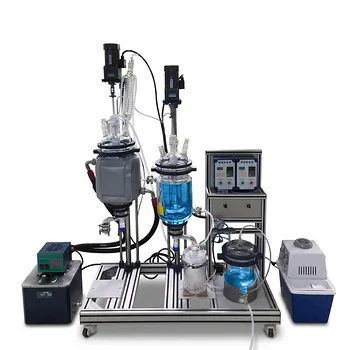
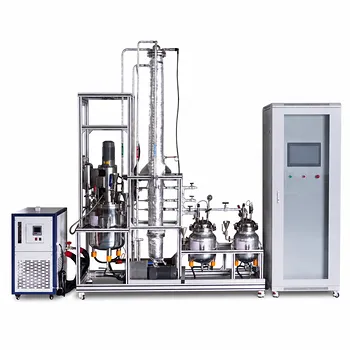
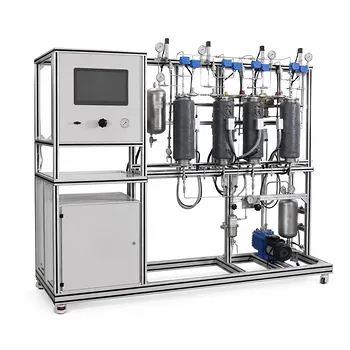
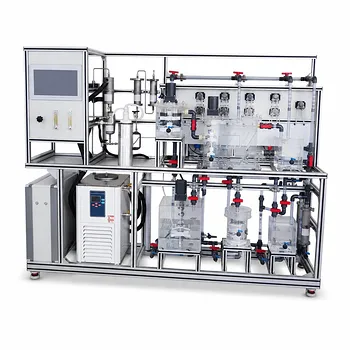
Scaling up chemical processes requires precise thermodynamic control. LABPARK provides state-of-the-art Educational and Vocational Unit Operations Pilot Plants in chemical engineering, bioprocess & biotech, and environmental & water treatment. Designed specifically for universities, research institutes, and enterprises, our pilot plants enable students and researchers to master critical process parameters like cooling rates and crystallization kinetics.
Ready to elevate your lab's capabilities? Contact us today to discuss your pilot plant needs.
Related Products
- Multi Functional Membrane Crystallization Educational Unit Operations Pilot Plant
- Potassium Salt Thermal Dissolution and Crystallization Separation Educational Unit Operations Pilot Plant
- Multi-Functional Special Distillation Educational Pilot Plant
- Hot Filtration Educational Unit Operations Pilot Plant Laboratory System
- Multi-Functional Drying Educational Unit Operations Pilot Plant
People Also Ask
- Control Crystallization Pilot Plant Secondary Nucleation: 4 Key Adjustments
- Why is precise temperature control critical in crystallization pilot plants? Key to Scale-Up Success
- What key factors should be considered when configuring a crystallization unit operations pilot plant?
- What are the benefits of integrating online PAT tools like ATR-FTIR into crystallization unit operations pilot plants?
- How to use crystallization pilot plant agitation speed to identify diffusion vs reaction growth?