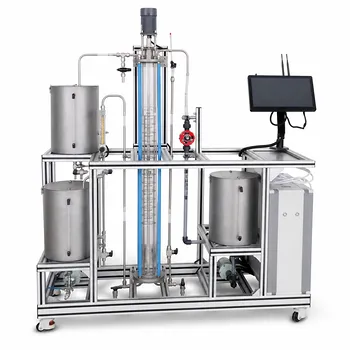
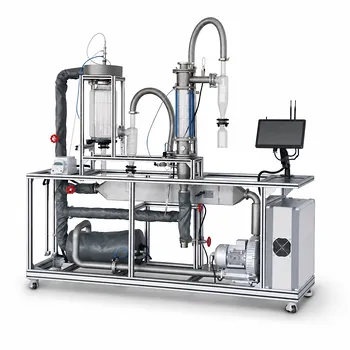
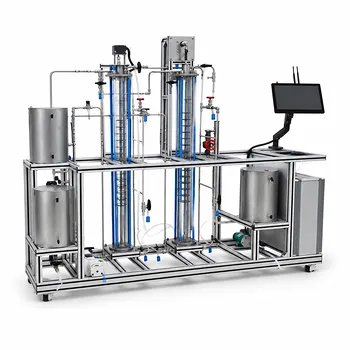
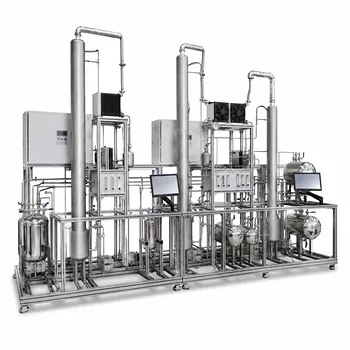
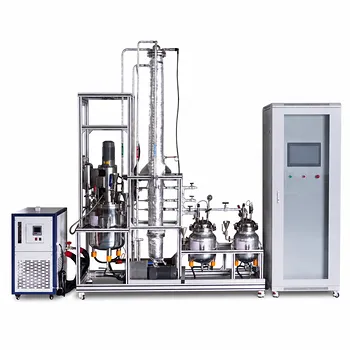
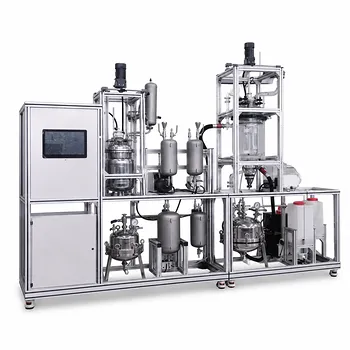
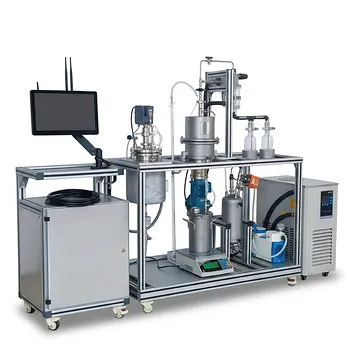
Multi-stage counter-current extraction delivers higher separation efficiency and dramatically lower solvent consumption than cross-current systems. In a pilot plant, this continuous counter-current contact maintains a strong concentration gradient along the entire extraction cascade, pulling more solute into the extract phase with far less fresh solvent. This makes it the configuration of choice for demonstrating scalable, cost-effective, and environmentally responsible separation processes.
The core insight is that counter-current flow maximizes the mass transfer driving force at every stage. By bringing the leanest raffinate into contact with the freshest solvent, it extracts the last traces of solute while producing a concentrated extract—all with a fraction of the solvent needed in cross-current operation. Pilot plants make this principle tangible, turning theoretical models into measurable, real-world performance data.
The Fundamental Advantage of Counter-Current Flow
How Solvent and Feed Orientation Creates Superior Driving Force
In a counter-current setup, the feed and solvent enter from opposite ends. This guarantees that the solute-depleted raffinate meets pure, fresh solvent just before discharge.
The result is a persistently high concentration difference across every theoretical stage. That difference is the engine of mass transfer—it drives solute from the raffinate into the extract far more aggressively than in cross-current mode.
Why Cross-Current Systems Struggle to Compete
Cross-current extraction introduces fresh solvent at each stage. While this can remove solute effectively, it does so by diluting the extract at every turn.
Each stage starts with a fresh solvent front, so the overall concentration driving force drops rapidly. The second and third stages never see the steep concentration gradients that a counter-current column maintains from start to finish.
This structural difference translates directly into efficiency gaps that pilot plant data quantify with striking clarity.
Quantifying the Difference: Efficiency and Solvent Savings
The Numbers That Define Industrial Preference
Published comparisons from unit operations pilot plants reveal the stark contrast. In one study, a three-stage counter-current extraction reached 97.97% separation efficiency under identical solvent consumption, while three-stage cross-current reached only 88.96%.
A single-stage extraction, using the same total solvent, barely achieved 76.47%. These are not marginal improvements—they represent fundamentally different capability thresholds.
How Much Solvent You Actually Save
The solvent savings are even more compelling. A three-stage counter-current column can achieve a target separation with only about 24% of the solvent volume that multiple single-stage cross-current batches would require.
That means transitioning from a series of batch extractions to a single continuous counter-current column can cut solvent usage by roughly 76%. For pilot plants modeling future industrial processes, this directly translates into lower operational costs, smaller waste streams, and reduced environmental impact.
Extract Concentration Matters for Downstream Processing
Cross-current stages produce a large volume of dilute extract. That dilution forces costly downstream concentration steps—evaporation, distillation, or membrane processing.
Counter-current configurations deliver a more concentrated extract from the first stage. The extract exits where it meets the fresh feed, maximizing the solute loading while the raffinate leaves lean.
This cascading effect is exactly what a pilot plant demonstrates when researchers measure concentration profiles at each sampling port and plot the operating line on a ternary phase diagram.
How Pilot Plants Validate These Principles
Turning Theory into Measurable Reality
A well-instrumented multi-stage extraction pilot plant does more than separate phases. It provides real-time data that lets operators verify mass balance equations, calculate N_OR (number of transfer units) and H_OR (height of transfer units), and determine the required number of theoretical stages.
By sampling both phases at every stage, researchers can construct the operating line and equilibrium tie lines on a ternary diagram. The graphical step-off method—analogous to the McCabe-Thiele method for distillation—reveals exactly how many stages are needed and how each operates.
Why Manual Glassware Fails to Capture the Full Picture
Manual separating funnel sequences can theoretically mimic counter-current staging. But they are labor-intensive, slow, and notoriously error-prone.
Continuous pilot plants automate the process and let operators manipulate agitator speed, pulsed frequency, and phase flow rates. This provides hands-on experience with steady-state mass transfer dynamics that static glassware simply cannot reproduce—a critical factor for engineers who will scale these processes to industrial columns.
Demonstrating the Difference Between Leaching Configurations
In solid-liquid extraction, the same principles hold. Pilot plants configured for leaching can switch between cross-current and counter-current modes.
Cross-current leaching mixes underflow solids with fresh solvent repeatedly, producing massive volumes of dilute overflow. Counter-current leaching sends solids and solvent in opposite directions, yielding a rich overflow from the first stage and a thoroughly depleted solid stream at the end.
Comparing these configurations on the same pilot rig makes the economic and environmental arguments for counter-current operation undeniable.
Understanding the Trade-offs and Operational Complexities
The Control Challenge of Counter-Current Operation
Counter-current columns are more sensitive to flow disturbances. Startup and shutdown require careful procedures to avoid flooding, back-mixing, or losing the stable concentration profile.
In a pilot plant, these complexities become a learning opportunity. Operators gain direct experience managing flooding limits, pulsation intensity, and phase inversion—all critical skills for industrial troubleshooting.
When Cross-Current Might Still Play a Role
For very small-scale laboratory screening, cross-current batch extractions can be simpler and faster to set up. When extract concentration is irrelevant and the goal is merely a quick solute recovery check, cross-current may be an acceptable shortcut.
However, any process intended for scale-up must eventually confront the solvent efficiency and concentration realities that counter-current operation solves. Pilot plants therefore predominantly focus on counter-current systems because they represent the industrial baseline.
Making the Right Choice for Your Process Development
Which extraction mode you prioritize in a pilot plant program depends on your development goals. Use these guidelines to align your experimental strategy with what you need to prove.
- If your primary focus is maximizing separation efficiency and minimizing solvent waste: Run multi-stage counter-current extraction. It demonstrates the highest recovery and the lowest solvent usage, providing the data you need for sustainable process design.
- If your primary focus is teaching fundamental mass transfer principles with clear, staged concentration profiles: Use the pilot plant to compare both cross-current and counter-current modes side by side. The measured profiles make the driving-force advantage unmistakable.
- If your primary focus is generating scale-up parameters for industrial columns: Operate counter-current and measure N_OR and H_OR at varying flow rates and agitation levels. This directly informs column height and diameter calculations.
- If your primary focus is reducing downstream purification costs: Counter-current extraction produces a more concentrated extract, directly lowering the energy and capital expense of subsequent separation units. The pilot plant data will justify this in your process economics.
In every dimension that matters for scale-up and real-world operation, counter-current extraction outperforms cross-current systems—and the pilot plant is the definitive proving ground where that superiority becomes tangible and quantifiable.
Summary Table:
| Feature | Counter-Current Extraction | Cross-Current Extraction |
|---|---|---|
| Separation Efficiency | High (e.g., ~98% in 3 stages) | Lower (e.g., ~89% in 3 stages) |
| Solvent Consumption | Very Low (saves up to 76% solvent) | High (requires fresh solvent at each stage) |
| Extract Concentration | High (solute concentrated in first stage) | Low (highly diluted extract streams) |
| Downstream Costs | Lower (less post-separation processing) | Higher (requires extensive evaporation/distillation) |
| Control Complexity | High (requires careful flow & flood control) | Low (simpler to set up and run in batches) |
Bring Industrial-Scale Extraction Principles to Your Lab
Ready to demonstrate scalable, highly efficient separation processes in your curriculum or research?
LABPARK provides advanced Educational and Vocational Unit Operations Pilot Plants in chemical engineering, bioprocess & biotech, and environmental & water treatment. Designed specifically for universities, research institutes, and enterprises, our pilot plants enable hands-on validation of mass transfer dynamics, concentration profiles, and scale-up parameters.
Contact LABPARK today to find the perfect pilot plant solution for your facility!
Related Products
- Continuous Batch Extractive Distillation Educational Pilot Plant
- Natural Product Extraction Unit Operations Training Pilot Plant
- Multi-Functional Special Distillation Educational Pilot Plant
- Educational Rotary Disc Liquid-Liquid Extraction Pilot Plant
- Multi-Stage Stirred Tanks in Series Residence Time Distribution and Mixing Performance Determination Educational Pilot Plant
People Also Ask
- Wilson vs. UNIQUAC: How to Choose the Right Thermodynamic Model for Your Pilot Plant
- How does the feed thermal state influence distillation pilot plant design and utility consumption?
- Why use non-ideal VLE calculations in distillation pilot plants? Ensure accurate scale-up & purity
- How to Configure a Distillation Pilot Plant? Key Steps for Multi-Mode Setup
- How to Integrate Spectroscopy in Distillation Pilot Plants for Advanced Process Control