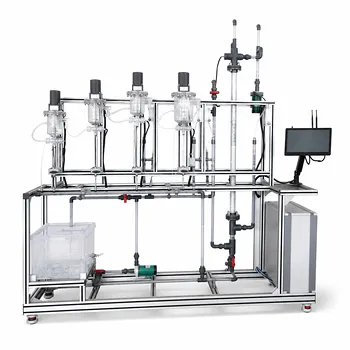
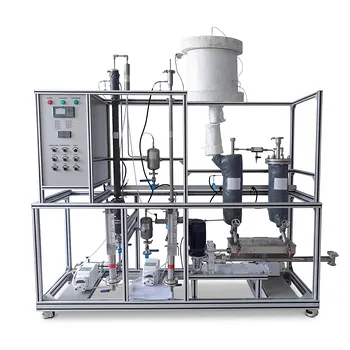
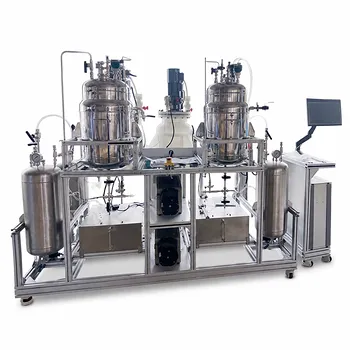
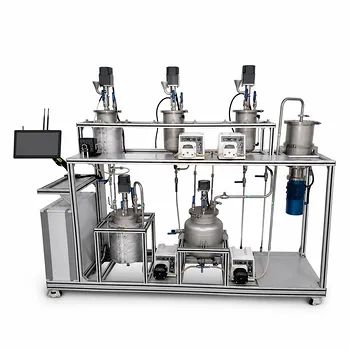
The bottom line: internal process water recycling transforms a pilot plant from a simple experimental apparatus into a realistic model of an environmentally and economically optimized industrial process. In environmental and chemical engineering pilot plants, internal water recycling is critical because it directly demonstrates how to cut wastewater volumes, lowers the long-term burden of external waste treatment, and equips engineers to make data-driven trade-offs between capital investment in recycling units and the operating expense of disposal. By intentionally closing the water loop, you force the mass balance to reflect real-world constraints, enabling accurate calculations of wastewater generation rates, treatment costs, and overall production economics.
Internal water recycling loops serve a dual purpose: they are a hands-on tool for teaching sustainable design and mass balances, and a necessary design feature to evaluate the true cost of waste treatment. Without them, a pilot plant risks underestimating wastewater volumes and overestimating the economic viability of the full-scale process.
The Critical Role of Internal Water Recycling in Pilot Plant Design
An internal water recycling loop is not merely a “green” add-on. It is a design essential that reveals the hidden economics of water usage and waste generation in continuous processes.
Turning a Lab Concept into a Sustainable Process Model
A pilot plant must prove that a process can operate sustainably at scale. Recycling process water (such as wash water, reaction water, or cooling tower blowdown) demonstrates exactly how to minimize discharge volumes before the plant ever leaves the laboratory.
By physically returning treated or untreated water streams back into the process, the pilot plant mimics the closed-loop thinking that modern environmental regulations demand. This goes beyond batch-scale green chemistry experiments—it forces students and researchers to confront the engineering reality of circulating water quality and its effect on the whole system.
Providing a Living Mass Balance for Wastewater Education
An educational pilot plant with a water recycle loop becomes a dynamic teaching tool. Students can collect real-time data, measure flow rates, and calculate wastewater generation rates at multiple points in the loop.
This hands-on mass balance exercise transforms abstract sustainability concepts into quantifiable metrics. They learn to answer critical questions: How much wastewater is avoided? What is the payback of a recycling unit compared to sending every liter to external treatment? These calculations directly address the surface need of understanding economic impact.
Validating the Trade-Off Between Capital and Operating Costs
The primary reference clearly states that in process economics, wastewater treatment costs directly impact overall production expenses. Internal water recycling makes that relationship visible and measurable.
Without recycling, a pilot plant’s economic model simply multiplies a constant wastewater flow by a fixed treatment cost per cubic meter. With recycling, the plant operator must account for the capital cost of recycling equipment—pumps, tanks, membranes, or strippers—against the dramatically reduced volume and cost of final discharge. Running the pilot plant under both modes yields the data needed to optimize this trade-off for the commercial design.
How Recycling Shapes Waste Treatment Economics
The decision to recycle internally doesn’t just change the volume of waste—it alters the entire cost structure and risk profile of the production process.
From Linear Disposal to a Circular Cost Model
In a once-through water system, waste treatment is a linear expense: more production means proportionally more wastewater and higher treatment bills. An internal recycle loop breaks that linear relationship.
By capturing and reusing water inside the process, you shift the cost profile toward fixed capital investment and away from volumetric disposal fees. The pilot plant can compare scenarios: treating and discharging all water externally versus investing in, for example, a reverse osmosis unit that recovers 90% of the stream. This direct economic comparison is what makes the design critical—it prevents wishful thinking by forcing a real cost-benefit analysis.
The Hidden Cost of Ignoring Impurity Buildup
Supplementary references warn of a subtle danger: trace impurities and by-products can accumulate in closed loops, poisoning catalysts or corroding equipment over time. Water recycling is critical because it exposes these long-term effects during piloting, not after the commercial plant is built.
A pilot plant that doesn’t recycle may produce optimistic yields because all water is fresh and free of the dissolved salts, organic acids, or microbial growth that build up in a real closed system. The resulting data would overestimate reactor performance and underestimate the cost of the water treatment needed to keep the loop stable. Incorporating the recycle loop forces you to measure—and budget for—those additional purification steps.
Linking Water Recycling to Overall Waste Minimization Metrics
Waste treatment economics are often expressed through the E-factor (kilograms of waste per kilogram of product). A pilot plant with an internal water recycling loop allows teams to directly measure how recycling reduces the aqueous fraction of that E-factor.
For reactions that generate high-salt aqueous effluents, such as traditional Lewis acid-catalyzed processes, the difference can be staggering—from kilograms of wastewater down to grams per kilogram of product when a catalytic, closed-loop route is used. The pilot plant becomes the proving ground where you collect the data to justify a switch to greener chemistry, and you can calculate the avoided treatment cost in real currency.
Understanding the Trade‑offs and Pitfalls
Internal water recycling is not a magic bullet. Its design must be approached with the same engineering rigor as any unit operation.
Capital Intensity vs. Operational Savings
A recycling system requires pumps, storage, instrumentation, and often additional treatment steps like filtration or pH adjustment. The pilot plant must be used to test whether the reduction in external treatment bills actually pays for this additional equipment within an acceptable time frame.
For small-scale educational pilots, the goal may be demonstration, not payback. But for industrial R&D, the economic equation must close. A well-designed pilot plant enables you to vary the recycling ratio and directly measure the impact on both capital cost amortization and variable treatment expenses.
The Risk of “Purity Over-Engineering” in Educational Settings
Supplementary references note that pure laboratory reagents often mask problems caused by commercial-grade feeds. The same principle applies to water: if the pilot plant always starts with deionized water and the recycling loop is run for only a few hours, students and researchers never observe the gradual degradation of water quality that causes operational headaches in industry.
To be a true learning tool, the pilot plant must be operated long enough to see the effect of accumulated organics or salts, or it must deliberately introduce a simulated “worst case” impurity spike. Without this, the exercise teaches an incomplete lesson about waste treatment costs and the hidden energy or chemical demands of keeping water fit for reuse.
Avoiding the “Zero Liquid Discharge” Trap
Aiming for complete water closure can sound ideal, but in practice it often forces a massive increase in energy or chemical consumption to remove the last traces of contaminants. The pilot plant allows you to find the economic optimum recycle ratio, not just the technical maximum.
By measuring the cost of achieving 80%, 90%, and 99% recycle, you identify the point where the marginal cost of further purification exceeds the savings in external treatment. This is a critical lesson in waste treatment economics that cannot be learned from a spreadsheet alone.
Making the Right Choice for Your Pilot Plant Design
How you design the water recycling system depends entirely on the primary goal of your pilot plant. The same core principle applies: internal loops make the cost of waste treatment tangible.
- If your primary focus is sustainability demonstration and education: Design the loop to be as simple and visible as possible, with flow meters and sampling points at every stage. Prioritize the ability to run clear “with vs. without recycling” mass balances so students can calculate E-factor reductions and treatment cost savings directly.
- If your primary focus is process scale‑up and economic validation: The loop must be instrumented to mimic the intended commercial treatment technology. Plan for extended continuous runs with commercial‑grade feeds to capture the steady‑state cost of impurity control, including any auxiliary chemical or energy inputs needed to maintain water quality.
- If your primary focus is regulatory compliance and waste minimization reporting: Ensure the pilot plant is configured to produce the data required for environmental permits, including flow rates, contaminant loads, and treated water quality before discharge. The internal recycle loop becomes the core evidence that you have minimized waste at the source.
By embedding internal process water recycling into your pilot plant, you move from theoretical sustainability to a hard‑numbered economic and environmental argument—one that prepares you for the real‑world compromises and costs of full‑scale production.
Summary Table:
| Aspect | Once-Through System | Closed-Loop Recycling System |
|---|---|---|
| Cost Structure | Linear volumetric disposal fees | Fixed capital investment + minimal OpEx |
| Impurity Tracking | Fails to detect accumulation risks | Reveals long-term buildup and catalyst effects |
| Mass Balance Accuracy | Low (underestimates waste costs) | High (calculates actual recycle limits) |
| E-Factor Impact | Higher aqueous waste volume | Drastically reduced effluent footprints |
Build Realistic and Sustainable Systems with LABPARK
Are you looking to optimize process economics and demonstrate green engineering principles? LABPARK provides state-of-the-art Educational and Vocational Unit Operations Pilot Plants in chemical engineering, bioprocess & biotech, and environmental & water treatment.
Designed for universities, research institutes, and enterprises, our systems enable hands-on training, accurate scale-up modeling, and real-world waste treatment evaluation.
Contact LABPARK today to custom-design your next pilot plant with integrated water recycling loops.
Related Products
- Ethyl Acetate Synthesis Unit Operations Pilot Plant for Practical Training
- Natural Product Extraction Unit Operations Training Pilot Plant
- Carbon Dioxide Hydrogen Methanol Synthesis Educational Unit Operations Pilot Plant
- Fixed-Bed Chemical Reaction and Gas Dust Tar Removal Unit Operations Pilot Plant
- Fixed Bed Gas Solid Catalytic Reaction Educational Pilot Plant
People Also Ask
- How do pilot plants demonstrate esterification? Visualizing Chemical Engineering Equilibrium
- When to transition from PID to adaptive control in pilot plants? Key process indicators.
- Why is the chemical plant startup schedule crucial? De-risk scale-up with pilot plants.
- Why Use PTFE & Hastelloy in Chemical Pilot Plants? Prevent Corrosion & Ensure Safety
- Why Compare Predicted and Experimental Excess Enthalpy? Key to Accurate Pilot Plant Scale-up