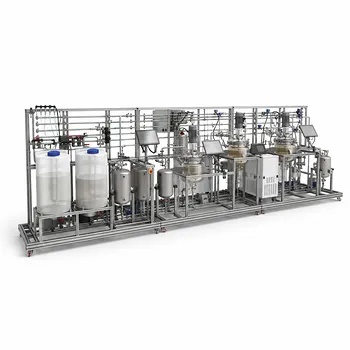
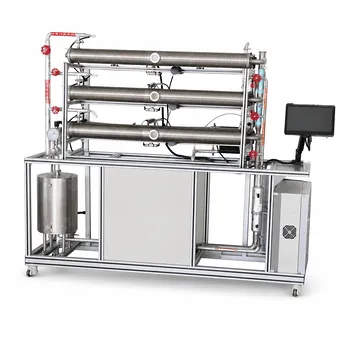
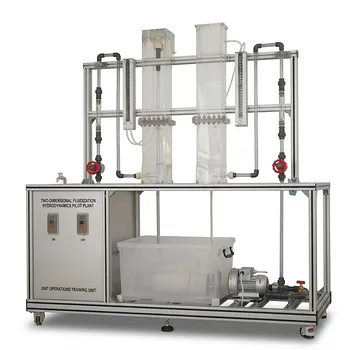
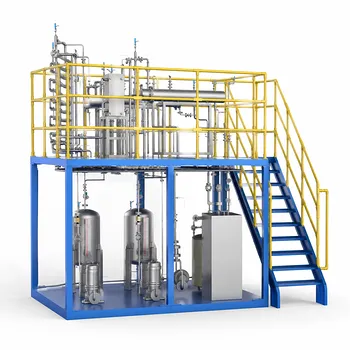
To answer your question directly, pilot plants expose an analytical technology to the very forces that break it. A laboratory bench provides a clean, controlled snapshot, but a unit operations pilot plant immerses the sensor in the continuous, chaotic reality of fluid dynamics, heat transfer, mixing, and mass transport. This direct confrontation reveals whether your measurement can survive and stay accurate when the process is alive, not just when it’s sitting still.
The surface answer is that pilot plants replicate dynamic process conditions—static lab simulations simply cannot. But the deeper need is about building a defensible, scalable solution. Pilot-scale testing generates authentic variability, validates sensor placement, and delivers the hard proof of concept that allows you to invest in full-scale production without gambling on assumptions made at a bench.
The Limits of Laboratory Simulations
The Static Snapshot Problem
A laboratory bench excels at isolating variables, but real processes are never isolated. You can simulate a reaction in a beaker, but you cannot simulate the lag time in a sampling loop, the vibration on a pipe, or the thermal gradients that distort an inline measurement.
Lab simulations often miss the interplay of physical rate limitations. Mass transfer, heat transfer, and mixing are scale-dependent phenomena that remain hidden in a small, well-mixed flask.
The Absence of True Process Noise
In a controlled lab, you deliberately reduce noise to see the signal. On a pilot plant, the noise is the signal you must manage. Flow pulsations, fouling, and fluctuating raw material streams introduce the real-world variability that determines whether an analytical method will drift or fail.
What a Pilot Plant Actually Delivers
A Living Process Environment
A unit operations pilot plant is not just a bigger bench. It represents the continuous, dynamic reality of your future production floor. Pumps create actual flow profiles. Heat exchangers introduce real thermal lags. The sensor sits in a flowing stream, not a static cuvette.
True Feasibility Beyond a Demo
Running the analyzer in this environment generates feasibility data you can trust. This data moves beyond a simple “does the chemistry work?” It tests electrical compatibility, probe fouling rates, and mechanical resilience—all factors that can bankrupt a project if discovered only at production scale.
Preserving Sample Integrity
When you integrate inline or on-line analyzers directly into a pilot plant, you remove the largest source of analytical error: the human. Manual sampling degrades samples and introduces delay. A pilot plant uses real-time feedback to capture instant dynamic changes, providing a pristine stream of live data that accelerates process understanding.
Real-World Dynamics and Sensor Integration
Testing Sensor Placement Under Stress
The physical location of a probe matters more than the instrument’s technical specifications. A pilot plant lets you evaluate where a sensor can actually function—before flow dead zones, gas bubbles, or extreme temperatures at an insertion point turn your data into noise.
Handling Multiphase and Mass Transfer Limitations
Many processes involve gases, liquids, and solids. A bench stirs; a pilot plant disperses. Evaluating a spectrometer in a pilot-scale bioreactor reveals how bubbles scatter light and challenge a calibration, something a magnetically stirred dish never shows.
Building Robust Calibration Models
Generating Necessary Compositional Variation
Calibrating a multivariate instrument like an NIR spectrometer requires a wide range of sample compositions. In a production setting, you rarely get that variation safely. Pilot plants and lab reactors act as controlled chemical playgrounds. You can manipulate temperature, concentration, and flow rates to deliberately span the entire future design space, creating the rich dataset needed for a robust calibration.
Overcoming the On-Line Calibration Bottleneck
Building a model directly on an operating process line is painfully slow because you must wait for natural variation. A pilot plant lets researchers speed-run the calibration process by safely introducing synthetic variations. Once validated in a pilot setting, the model can be transferred to a production location with confidence.
Scaling Up with Confidence
Capturing Scale-Dependent Phenomena
Scaling up introduces complex non-linearities. A multivariate PAT tool, such as a near-infrared spectrometer, captures the complete sample matrix rather than a single univariate property. When you run this tool on a pilot column or reactor, you see the covariance structure of the chemistry change with scale, helping you pinpoint exactly where a “soft” sensor fails and why.
Building a Defensible Design Space
The pilot plant data forms the foundation of your process design space. By understanding how input variability propagates through each unit operation at a representative scale, you define the limits within which your measurement and your process remain reliable. This is impossible to achieve with a handful of bench samples.
Understanding the Trade-offs
The Resource Commitment
Pilot-scale studies require more time, material, and money than a bench test. You are running a miniature factory, which means you need operational personnel, raw materials at pilot quantities (which may be expensive), and the infrastructure to handle waste.
Complexity and Troubleshooting Speed
When an instrument fails on a bench, you can swap it out in minutes. On a pilot plant, troubleshooting is interwoven with process safety and batch integrity. The feedback loop is inherently slower, and you must be disciplined about documentation and root-cause analysis to avoid wasted runs.
Not a Replacement for Basic Chemistry
Pilot-scale testing will not save a technology that fundamentally cannot measure the analyte of interest. The bench still has a critical role in initial feasibility. The pilot plant confirms that the chemistry holds up under the mechanical and physical realities of the process, not that the chemistry exists in the first place.
Making the Right Choice for Your Development Goal
Your approach should depend on where you are in the application lifecycle and what risk you are trying to retire.
- If your primary focus is early feasibility and fundamental chemistry: Use the bench to confirm the analyte can be measured and to build an initial spectral library, but treat those results as a fragile hypothesis.
- If your primary focus is proving the instrument can survive the process: You must move to a pilot plant to test insertion mechanics, flow compatibility, and long-term drift in a dynamic, physically demanding environment.
- If your primary focus is building a scalable, transferable calibration model: A pilot plant reactor is non-negotiable; it is the only safe, controlled way to generate the full compositional space your multivariate model needs to be robust.
- If your primary focus is retiring scale-up risk and defining your design space: Evaluate the entire analytical package on a unit operations pilot plant to see the interaction of mass transfer, heat transfer, and real-time matrix effects before committing capital to full-scale implementation.
Moving from a static bench to a dynamic pilot plant is the single most impactful step you can take to ensure that your analytical solution doesn’t just work in theory, but delivers robust, actionable data when the production line—and your product’s quality—depends on it.
Summary Table:
| Feature | Lab Bench Simulations | Unit Operations Pilot Plants |
|---|---|---|
| Process Dynamics | Static, isolated variables | Continuous, dynamic fluid flow and heat transfer |
| Process Noise & Drift | Minimal/controlled environment | Real-world noise, fouling, and flow pulsations |
| Sensor Placement | Not applicable (beaker/flask) | Evaluates physical constraints and dead zones |
| Calibration Modeling | Narrow composition range | Safe, controlled generation of wide design spaces |
| Scale-up Validation | High risk (scale-dependent gaps) | Low risk (validates physical and chemical dynamics) |
Bridge the Gap Between Bench Chemistry and Industrial Success
Transitioning from laboratory trials to full-scale production requires reliable data that static bench setups simply cannot provide. LABPARK offers premium Educational and Vocational Unit Operations Pilot Plants across chemical engineering, bioprocess & biotech, and environmental & water treatment sectors.
Designed specifically for universities, research institutes, and enterprises, our pilot plants enable you to:
- Validate process analytical technologies (PAT) under realistic operational stress.
- Safely build robust calibration models across a wide design space.
- De-risk scale-up and ensure seamless technology transfer.
Ready to elevate your research, training, or process development? Contact LABPARK today to discuss your pilot plant requirements!
Related Products
- General Purpose Cosmetics Production Unit Operations Training Pilot Plant
- Multi Pump Fluid Transport Process Piping Unit Operations Training Pilot Plant
- Multi-Functional Drying Educational Unit Operations Pilot Plant
- Fixed-Bed Chemical Reaction and Gas Dust Tar Removal Unit Operations Pilot Plant
- 100L Continuous Loop Hydrogenation Educational Unit Operations Pilot Plant
People Also Ask
- How do deviations in estimating latent heat impact pilot plant thermal systems? Avoid hardware mis-sizing.
- Why is the chemical plant startup schedule crucial? De-risk scale-up with pilot plants.
- When to transition from PID to adaptive control in pilot plants? Key process indicators.
- Why Compare Predicted and Experimental Excess Enthalpy? Key to Accurate Pilot Plant Scale-up
- Why Use PTFE & Hastelloy in Chemical Pilot Plants? Prevent Corrosion & Ensure Safety