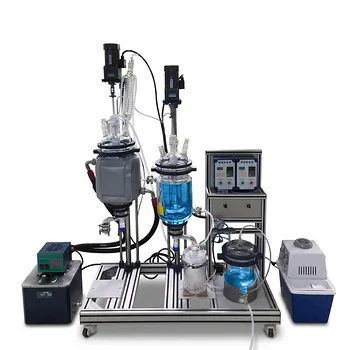
The single most decisive factor in scaling up a crystallization process is not the reactor size—it’s the delicate balance between nucleation and crystal growth. If this competition is not controlled during pilot-plant scale-up, you risk a cascade of problems: excessive fine crystals that clog filters, severe agglomeration, unpredictable polymorphism, and a final product that fails to perform. Mastering this balance is what separates a robust, scalable process from one that collapses at industrial volumes.
Crystallization scale-up fails when the balance tips uncontrollably toward nucleation. The core insight: pilot plants provide the precise environmental control needed to keep supersaturation in a zone that favors growth over nucleation—allowing you to engineer the desired crystal size, form, and purity before committing to full-scale manufacturing.
The Fundamental Competition: Nucleation vs. Growth
Supersaturation: The Shared Driving Force
Both nucleation and crystal growth feed on the same resource: supersaturation—the metastable state where a solution holds more solute than its equilibrium solubility. The moment you cross the solubility curve, the system can either form new nuclei (nucleation) or deposit solute onto existing crystals (growth). The path it takes depends entirely on how you manage that excess driving force.
Uncontrolled, high supersaturation favors nucleation. A sudden spike can trigger a massive, spontaneous burst of new crystals, producing a fine, dusty slurry. Controlled, low supersaturation favors growth. By adding solute slowly or cooling gently, you keep the driving force just above the solubility line, coaxing existing crystals to enlarge without spawning countless new ones.
Why Excessive Nucleation is the Enemy of Scale-up
In a pilot plant, the consequences of runaway nucleation become painfully obvious. First, downstream processing grinds to a halt—fine crystals block filter media, extend drying times, and ruin material flowability. Second, crystal agglomeration often follows; sticky, freshly nucleated surfaces collide and fuse into irregular clumps that trap impurities and degrade dissolution performance. Finally, polymorphic purity is jeopardized. Spontaneous, uncontrolled nucleation can simultaneously spawn undesirable, unstable crystal forms that persist into the final product.
The Benefits of Growth-Dominated Processes
Encouraging growth over nucleation directly solves these problems. Larger, uniform crystals filter and dry faster, reduce batch-to-batch variability, and flow smoothly through downstream equipment. Moreover, a growth-dominated environment exerts polymorph control—you feed the desired crystal form while starving out competing phases. This is not a minor advantage; it is often the key to meeting regulatory specifications for a pharmaceutical solid form.
Why Pilot Plants Are Essential for Mastering This Balance
Replicating and Controlling Supersaturation
A pilot plant is not simply a bigger flask. It gives you the precise temperature-concentration trajectory needed to hold supersaturation in the targeted zone. Feed characteristics and concentration are dialed in to establish the desired starting point. Thermal load management—cooling rates or evaporation rates—then dictates how fast supersaturation builds up. By tracking the solution’s path in real-time, you can avoid the metastable limit where uncontrolled nucleation explodes.
The Hidden Variable: Secondary Nucleation and Shear
Primary nucleation isn’t the only culprit. Secondary nucleation, especially contact nucleation from crystal-impeller and crystal-wall collisions, generates a cloud of micro-crystals that ruin particle size distribution. This mechanism is extraordinarily sensitive to scale-up because fluid shear and mixing dynamics change with vessel geometry.
Pilot plants let you mitigate this by adjusting circulation flow rates, impeller speed, and even impeller material (e.g., switching from stainless steel to PTFE reduces impact energy). You can also implement a fines destruction loop to dissolve micron-sized crystals before they become permanent. Without this hands-on tuning, a perfectly fine lab process can turn into a fine-crystal disaster at scale.
Navigating the Scale-Up Trap: Mixing and Aggregation
Aggregation and agglomeration are scale-dependent phenomena. Crystals that glide past each other in a small beaker may violently collide in a large vessel with higher tip speeds or poorly distributed turbulence. This leads to bimodal size distributions, immobile slurries, and batch-to-batch variability. Pilot plants allow you to test different agitation schemes—constant energy dissipation rate (P/V) , constant tip speed, or just-suspended conditions ($N_{js}$) —to find the shear profile that prevents agglomeration without breaking crystals.
The P/V criterion, scaled using $N_{plant} = N_{lab} \cdot s^{2/3}$, often provides a good starting balance of suspension quality and particle damage. A constant tip speed approach ($N_{plant} = N_{lab} \cdot s$) might fail to suspend solids at large scale. Only pilot-plant experimentation reveals these failure modes before they become a full-scale manufacturing crisis.
Understanding the Trade-offs
Controlling the nucleation-growth competition is not about eliminating nucleation entirely; some nucleation is needed to generate crystal surface area. The real challenge is navigating the trade-offs.
Trade-off 1: Growth rate versus secondary nucleation. Pushing supersaturation higher accelerates growth but also inches closer to the metastable limit where contact nucleation spikes. The sweet spot is process-specific and can only be found with pilot-scale data.
Trade-off 2: Suspension versus attrition. You must keep crystals suspended with enough agitation, but excessive shear from a large impeller can shatter fragile, acicular crystals into fines. The softer impeller option or a redesigned baffle geometry often emerges from pilot trials.
Trade-off 3: Solid-liquid balance. High solid loadings improve productivity but can stall circulation loops. A pilot plant reveals the maximum viable solid fraction before fluidity is lost.
Ignoring these trade-offs and mimicking the lab recipe blindly is the most common path to scale-up failure.
Making the Right Choice for Your Goal
Apply these insights based on what matters most for your scale-up project.
- If your primary focus is maximizing crystal size and purity: Set a flat, low-supersaturation trajectory using slow cooling or controlled antisolvent addition. Validate with pilot-scale P/V mixing and monitor desupersaturation rate. Add a seed bed to decouple nucleation from growth.
- If your primary focus is rapid process development: Start with the P/V scale-up criterion to get in the ballpark of proper mixing, then run a fast supersaturation ramp experiment to identify the point where fines appear. Back off slightly and lock in those parameters as your design space.
- If your primary focus is avoiding scale-up failures: Never assume lab kinetics transfer directly. Use the pilot plant to test at least two different agitation scales (e.g., 10 L and 100 L) and compare crystal size distributions. If particle size shifts dramatically, your mixing is not scale-invariant—adjust impeller geometry or speed until the CSD stabilizes.
You cannot cheat the physics of nucleation and growth, but you can master them. A well-instrumented pilot plant transforms this competition from a mysterious risk into a predictable, engineered step.
Summary Table:
| Parameter / Aspect | Nucleation-Dominated Process | Growth-Dominated Process |
|---|---|---|
| Supersaturation Level | High / Uncontrolled | Low / Controlled |
| Crystal Size & Shape | Fine, dusty, irregular clumps | Large, uniform crystals |
| Downstream Processing | Clogged filters, slow drying | Fast filtration and easy drying |
| Purity & Polymorphism | Trapped impurities, mixed phases | High purity, controlled polymorph |
Accelerate Your Process Scale-Up with LABPARK
Transitioning your crystallization processes from the laboratory to industrial volume requires precise, reliable equipment. LABPARK provides advanced Educational and Vocational Unit Operations Pilot Plants in chemical engineering, bioprocess & biotech, and environmental & water treatment.
Designed specifically for universities, research institutes, and enterprises, our pilot plants allow you to accurately control mixing dynamics, heat transfer, and supersaturation parameters to prevent scale-up failures.
Ready to elevate your research or training capabilities? Contact our technical experts today to find the ideal pilot plant solution for your facility.
Related Products
- Multi Functional Membrane Crystallization Educational Unit Operations Pilot Plant
- Potassium Salt Thermal Dissolution and Crystallization Separation Educational Unit Operations Pilot Plant
- Multi-Functional Special Distillation Educational Pilot Plant
- Ethyl Acetate Synthesis Unit Operations Pilot Plant for Practical Training
- Multi-Modal Distillation Unit Operations Training Pilot Plant
People Also Ask
- Control Crystallization Pilot Plant Secondary Nucleation: 4 Key Adjustments
- Why is precise temperature control critical in crystallization pilot plants? Key to Scale-Up Success
- What key factors should be considered when configuring a crystallization unit operations pilot plant?
- What are the benefits of integrating online PAT tools like ATR-FTIR into crystallization unit operations pilot plants?
- How to use crystallization pilot plant agitation speed to identify diffusion vs reaction growth?