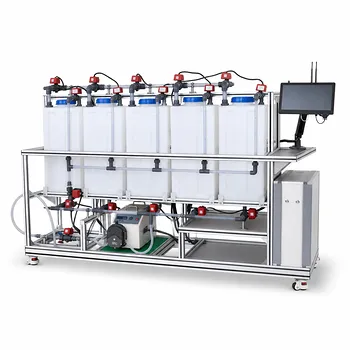
Closed-loop cooling water management is critical because it reduces freshwater consumption and discharge while controlling the corrosion and scaling created by continuous water reuse. In high-thermal-load industrial facilities, warm return water is cooled in a cooling tower and recirculated, requiring far less fresh makeup water than once-through cooling. Water treatment unit operations pilot plants allow engineers to test cooling performance, chemical dosing, evaporation losses, and reuse strategies before applying them at full scale.
Closed-loop cooling improves water efficiency, but recycling concentrates dissolved chemicals and contaminants. Pilot plants provide a controlled way to balance heat removal, water conservation, corrosion protection, scale control, and discharge requirements.
Why Closed-Loop Cooling Requires Careful Management
Once-Through Cooling Is Resource-Intensive
Once-through systems withdraw large volumes of water, pass that water through heat exchangers, and discharge it after a single use. For facilities with high thermal loads, this creates substantial water consumption and wastewater discharge.
The approach can also increase operating costs and create environmental challenges when discharged water carries elevated temperatures or treatment chemicals.
Recirculation Reduces Freshwater Demand
A closed-loop cooling system returns warm process water to a cooling tower. Evaporation removes heat from the circulating water, lowering its bulk temperature before the water returns to the process.
Because the water is reused, the facility requires makeup water mainly to replace evaporation, drift, leaks, and controlled blowdown. This can substantially reduce freshwater withdrawals compared with once-through cooling.
Evaporation Concentrates Dissolved Materials
Evaporation removes water as vapor but leaves most dissolved minerals and treatment chemicals behind. As the same water cycles repeatedly, the concentration of these substances increases.
The system therefore needs controlled blowdown and carefully managed makeup water. Without this balance, dissolved solids can reach levels that impair heat transfer and damage equipment.
What Happens When Cooling Water Is Poorly Controlled
Corrosion Damages Equipment
Concentrated water chemistry can promote corrosion in pipes, heat exchangers, pumps, and cooling tower components. Corrosion can cause leaks, reduce equipment life, and introduce metal ions into the circulating water.
Treatment programs commonly use corrosion-control chemicals, but their effectiveness depends on water chemistry, dosage, temperature, residence time, and system materials.
Scale Reduces Heat Transfer
Scale forms when dissolved minerals precipitate on heat-transfer surfaces and internal piping. Even a relatively thin deposit can act as an insulating layer, forcing the system to operate less efficiently.
As heat transfer declines, the facility may need more energy, higher flow rates, or more frequent cleaning to maintain the required cooling performance.
Excessive Blowdown Wastes Water
Blowdown removes concentrated water from the system to limit dissolved solids. However, excessive blowdown increases freshwater consumption and produces more wastewater for treatment or disposal.
The operating objective is not simply to maximize recycling. It is to identify the highest practical concentration level that preserves heat-transfer performance and protects equipment.
How Pilot Plants Optimize Cooling Water Management
They Reproduce Key Cooling Tower Operations
A water treatment unit operations pilot plant can simulate the circulation of warm return water through a cooling tower or related cooling process. Engineers can observe how heat removal changes with flow, temperature, evaporation, and operating conditions.
This scaled system provides a practical bridge between laboratory measurements and industrial implementation.
They Establish Operating Baselines
Before changing a full-scale treatment program, researchers can measure baseline behavior under controlled conditions. Relevant observations include temperature reduction, evaporation loss, concentration changes, and water-quality trends.
These measurements help distinguish whether a performance problem results from insufficient cooling capacity, excessive concentration, poor chemical control, or another operating factor.
They Test Chemical Dosing
Pilot plants allow engineers to evaluate different dosages and treatment strategies for corrosion and scale control. Testing can show whether a proposed program protects equipment without adding unnecessary chemical expense or increasing downstream treatment requirements.
Dosing can be varied while monitoring indicators such as mineral concentration, corrosion behavior, deposit formation, and heat-transfer performance.
They Optimize Blowdown and Makeup Rates
The pilot system can be operated at different cycles of concentration by adjusting makeup water and blowdown. Researchers can then assess how increased recycling affects water chemistry and cooling performance.
This helps identify an operating window that minimizes freshwater use while keeping dissolved solids below levels associated with scaling, corrosion, or unacceptable equipment performance.
They Support Water Reuse Strategies
Pilot plants can also evaluate whether treated wastewater is suitable for use as cooling-tower makeup. This is especially relevant in water-intensive industrial facilities where process effluent or other treated sources may supplement freshwater.
Before reuse is adopted, engineers must verify treatment performance, chemical compatibility, recovery rates, and the ability of the water to meet the cooling system's quality requirements.
Measuring Pilot-Plant Performance
Thermal Performance
Temperature reduction across the cooling process indicates whether the pilot system is removing heat effectively. Flow rate and inlet temperature should be varied because industrial cooling loads are rarely constant.
The results can identify conditions under which cooling capacity declines or energy and water requirements become excessive.
Water Consumption and Recovery
Researchers should quantify evaporation, drift, blowdown, leakage, makeup demand, and any recovered water. These measurements show whether the proposed operating strategy actually reduces total water consumption.
Recovery rate is useful only when considered alongside water quality and the treatment effort required to achieve that recovery.
Chemical and Physical Water Quality
Important measurements may include dissolved-solids concentration, pH, hardness, alkalinity, suspended solids, and relevant contaminant levels. These parameters help explain the risk of scale, corrosion, and fouling.
Monitoring should be performed across changing operating conditions rather than at a single steady-state point.
Deposit and Corrosion Behavior
Pilot testing can reveal whether deposits form on heat-transfer surfaces or whether exposed materials show signs of corrosion. These observations are more meaningful than chemical analysis alone because they connect water chemistry to actual equipment behavior.
The selected monitoring approach should reflect the materials and failure mechanisms expected in the full-scale facility.
Treatment and Reuse Performance
Where pilot plants include broader water-treatment modules, engineers can test filtration, chemical oxidation, biological treatment, or other processes before cooling-tower reuse. The objective is to determine whether the treated stream is stable and compatible with recirculating cooling operations.
The same pilot-scale approach can evaluate biological performance through measures such as BOD removal, sludge settling, organic loading, and reactor response when wastewater treatment is part of the reuse plan.
Understanding the Trade-offs
Higher Recycling Increases Concentration Risk
Operating at higher cycles of concentration generally reduces blowdown and makeup demand. It also increases the concentration of minerals and contaminants, which can intensify scale, corrosion, fouling, and biological-control challenges.
The best operating point depends on the water source, cooling equipment, materials, treatment program, and discharge constraints.
More Chemicals Do Not Guarantee Better Control
Increasing chemical dosage may not solve a problem caused by unsuitable water chemistry, poor mixing, inadequate blowdown, or excessive heat-transfer-surface temperature. Overdosing can increase cost and complicate wastewater treatment.
Pilot testing is valuable because it helps identify the cause of deterioration instead of treating symptoms blindly.
Pilot Results Have Scaling Limits
A pilot plant cannot reproduce every feature of a full-scale cooling system. Differences in hydraulics, surface area, residence time, atmospheric conditions, materials, and microbial behavior can affect the final outcome.
Pilot results should therefore be interpreted with engineering scale-up methods and validated through a controlled full-scale trial.
Water Reuse Requires More Than a Recovery Target
A high recovery percentage is not automatically a successful outcome. Reused water must remain compatible with heat exchangers, cooling towers, treatment chemicals, regulatory requirements, and discharge controls.
The complete water balance matters more than a single recovery metric.
Making the Right Choice for Your Goal
A pilot plant should be operated under representative thermal and water-quality conditions, with results evaluated against both performance and lifecycle cost.
- If your primary focus is freshwater reduction: Optimize evaporation, makeup, blowdown, and cycles of concentration together rather than maximizing recirculation alone.
- If your primary focus is equipment reliability: Use pilot testing to select corrosion and scale controls that match the system's water chemistry and construction materials.
- If your primary focus is wastewater reuse: Characterize treated effluent, test treatment and recovery rates, and confirm that the reused water remains compatible with cooling operations.
- If your primary focus is process design or education: Use the pilot plant to connect cooling-tower behavior, chemical dosing, water balances, and treatment kinetics with full-scale engineering decisions.
Effective closed-loop cooling management comes from balancing water conservation with the chemistry, thermal performance, and equipment protection required for reliable industrial operation.
Summary Table:
| Focus area | How pilot plants help | Key outcome |
|---|---|---|
| Thermal performance | Test flow rates, temperatures, evaporation, and heat removal | Reliable cooling capacity |
| Water conservation | Optimize makeup water, blowdown, and cycles of concentration | Lower freshwater demand |
| Equipment protection | Evaluate corrosion and scale-control programs | Longer equipment life |
| Chemical dosing | Compare treatment types and dosages under controlled conditions | Lower chemical costs |
| Wastewater reuse | Test filtration, oxidation, biological treatment, and recovery | Compatible cooling-tower makeup water |
| Scale-up planning | Validate results under representative operating conditions | More confident full-scale design |
Ready to improve cooling performance while reducing freshwater use and wastewater discharge? Contact LABPARK to discuss an Educational or Vocational Unit Operations Pilot Plant tailored to your needs. LABPARK supports universities, research institutes, and industrial enterprises with pilot-scale solutions for chemical engineering, bioprocess and biotechnology, and environmental and water treatment. Our systems help you evaluate cooling performance, chemical dosing, corrosion and scale control, blowdown optimization, water reuse, and treatment compatibility before committing to full-scale implementation.
Related Products
- Electrochemical Water Treatment Educational Unit Operations Pilot Plant
- Thermal Desorption Exhaust Gas and Tail Water Treatment Educational Pilot Plant
- Hot Filtration Educational Unit Operations Pilot Plant Laboratory System
- Ion Exchange Water Purification Educational Pilot Plant for Engineering Unit Operations
- Water Electrolysis Hydrogen Production and Storage Educational Pilot Plant
People Also Ask
- What design features do educational electrochemical pilot plants utilize to manage gas liberation and water loss?
- How can unit operations pilot plants show lead-acid concentration vs state of charge? Real-time monitoring guide.
- How do educational electrochemical pilot plants scale up electrolysis? Master industrial engineering.
- How to Estimate Sulfate in Water Treatment Pilot Plant Deposits: Gravimetric Guide
- How can foaming be managed during steam generation experiments in water treatment unit operations pilot plants? Tips