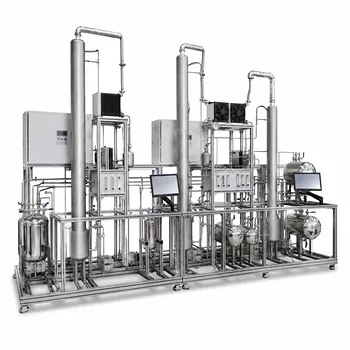
What separates a skilled extraction operator from a novice is rarely memorization of standard procedures—it’s the deep instinct for when a system is about to lose its integrity. Analyzing liquid-liquid phase stability criteria is essential in pilot-plant training because it teaches operators to recognize the thermodynamic boundaries that prevent the two phases from coalescing into a single miscible liquid. Without this understanding, a small change in temperature or concentration can cause an abrupt, invisible collapse of the extraction environment, turning a training exercise into a costly demonstration of process failure.
The true purpose of phase stability analysis in operator training is not to produce perfect simulations, but to build predictive judgment. When trainees learn why a ternary system can suddenly homogenize, they stop simply following recipes and start actively safeguarding the separation, making every variable adjustment a conscious decision rather than a blind guess.
The Invisible Precondition for Extraction
Extraction only works when two liquid phases can stubbornly coexist. This sounds trivial, yet it is the very foundation that operator training must secure. Unlike a pump or a valve, phase stability is invisible and can vanish without a single mechanical alarm sounding.
Why the Two-Phase Condition Is a Thermodynamic Tightrope
In a real pilot plant, a trainer can show how increasing the solvent temperature to “speed up mass transfer” can push the system into a single-phase region. The binodal curve on a ternary phase diagram is not just a classroom abstraction—it is the hard boundary between a successful run and a completely homogeneous, unseparatable mixture. Training must ingrain that the operating point must stay well inside the miscibility gap, not merely near it.
The Danger of the Unstable Region
When process variables drift close to the thermodynamic stability limit (the spinodal region), the two phases no longer have a strong energetic reason to stay separate. A tiny perturbation—a few degrees of temperature, a slightly off-spec feed concentration—can trigger spontaneous phase homogenization. For a trainee, seeing a clear, two-layer mixer suddenly turn into a single murky liquid on a pilot scale burns that lesson deeper than any textbook equation. The primary reference’s warning about operating near “where stability criteria vanish” is exactly this real-world risk.
Why Operator Training Demands Phase Stability Literacy
If the goal of training is to produce operators who can troubleshoot, scale up, and run safely, then phase stability is not a supplementary topic—it is the central diagnostic lens. It connects theoretical thermodynamics to immediate, tactile consequences on the pilot plant floor.
Connecting Theory to Tactile Action
When a trainee manually adjusts a back-pressure regulator or a heating jacket and then samples the raffinate, the resulting shift on a ternary diagram links a hand motion to a movement of the operating point relative to the binodal curve. This closes the gap between abstract stability criteria (like the condition that the second derivative of Gibbs free energy of mixing be positive) and the physical sight of two clear liquid layers. It turns “calculating theoretical stages” into a concrete check: Are we even in a two-phase region to begin with?
Preventing the Most Destructive Training Outcome: Zero Separation
A common failure in pilot-plant education is a run that produces no raffinate purity because the phases merged so early. Without phase stability understanding, the trainee’s takeaway might be “the equipment is faulty” or “the solvent is weak.” With it, they immediately ask: “Did we cross the critical solution temperature? Did the feed composition push us outside the solubility envelope?” That shift in diagnosis—from blaming hardware to interrogating thermodynamics—is the hallmark of a genuinely competent extraction operator.
Building an Intuition for Variable Sensitivity
Ternary diagrams are not static pictures; they shrink and swell with pressure, temperature, and solute loading. By intentionally walking a pilot plant to the edge of phase stability, trainees learn which variables are the most treacherous. They discover, for example, that cooling a partially miscible system might widen the two-phase region, while a small impurity can act as a mutual solvent and collapse it. This sensitivity training is impossible to instill from a slide deck alone.
The Practical Toolkit: Diagrams, Sampling, and Real-Time Validation
Training must equip operators with the habit of constantly verifying stability, not just assuming it because the solvent and feed are flowing. The pilot plant becomes a live laboratory for validating the thermodynamic map.
The Ternary Diagram as a Dashboard, Not a Poster
Before a run, the team plots the feed and solvent on a ternary diagram and checks the tie-line that passes through their mixture point. During the run, they sample both outlet streams and plot the actual extract and raffinate compositions. If those points drift toward the plait point (where the tie-line shrinks to zero), stability is collapsing. The operator is trained to intervene—adjust temperature, change the solvent-to-feed ratio—based on where the system is heading, not just where it is.
Monitoring Critical Solution Temperatures
For many industrially relevant solvents, the binary pairs involved have an upper or lower critical solution temperature. A pilot plant with a precise temperature control loop allows the trainer to deliberately bring the system just above the cloud point and then cool it back down. Operators experience firsthand the reversibility of phase splitting and learn to treat temperature as a stability throttle, not just a kinetic enhancer. They also learn the most dangerous trap: operating near a critical point to maximize distribution coefficients, where a slight drop in temperature can cause a catastrophic merger.
Understanding the Limitations and Trade-offs
Phase stability analysis is powerful, but treating it as an infallible safety net creates a new kind of vulnerability. A trustworthy training program must highlight exactly where thermodynamics loses its predictive edge in a pilot-plant setting.
When Real Kinetics Fool the Stability Criterion
A system that is thermodynamically unstable and should phase-separate may resist doing so for minutes or hours if emulsification, slow coalescence, or extremely small density differences dominate. Trainees who only look at a phase diagram may prematurely conclude a run is stable when, in reality, they are in a metastable region waiting to crash. The training must blend stability criteria with practical settling tests, using centrifugal spin tubes or real-time turbidity probes to expose the hidden kinetics.
The Trap of Pure-Component Data
Most ternary diagrams in training manuals are built for pure solvents and reagents. Real streams in bioprocess or chemical pilot plants contain fermentation byproducts, salts, or surfactants that dramatically shrink the miscibility gap. An operator who trusts a textbook binodal curve without verifying it on site is an operator walking blind. Effective training forces a habit of simple lab-scale cloud-point titrations before trusting any diagram, making “measure first” part of the stability culture.
Making Phase Stability the Core of Actionable Training
The end goal is not to produce thermodynamicists, but to produce operators who instinctively protect the two-phase condition as if it were the heartbeat of their extraction process. Every protocol should embed stability checks.
- If your primary focus is preventing catastrophic run failures: Design a “worst-case” training scenario where the instructor deliberately heats the settler to approach the critical solution temperature, then asks the trainee to recover the run. The lesson of never operating near the stability cliff will never be forgotten.
- If your primary focus is optimizing solvent-to-feed ratios: Use triangular diagrams to show how the mixture point moves relative to the binodal curve as the ratio changes, teaching that economics stop where the tie-line disappears. Stability boundaries define the feasible window for any cost optimization.
- If your primary focus is scaling up from pilot to production: Train operators to re-validate the phase stability envelope every time the feed composition shifts, using rapid small-scale cloud-point tests. Instill that a process that worked at 10 liters can fail at 10,000 if an unaccounted impurity knocks the system out of the two-phase region.
A pilot plant is a controlled factory of mistakes. Phase stability analysis is what converts every one of those mistakes from a mystery into a deeply learned physical law.
Summary Table:
| Key Concept | Thermodynamic Boundary | Operator Control & Practical Action |
|---|---|---|
| Binodal Curve | Boundary between successful two-phase extraction and single-phase miscibility. | Plot operating points on ternary diagrams; maintain feed ratio inside the gap. |
| Spinodal Region | Limit where thermodynamic stability criteria vanish completely. | Avoid operating near the edge; minor temperature drifts trigger instant homogenization. |
| Critical Solution Temp | Point where phase separation reversibly collapses or initiates. | Use precise temperature control loops to manage the cloud point safely. |
| Real-world Kinetics & Impurities | Slow coalescence and impurities that shrink the theoretical miscibility gap. | Perform rapid bench-scale cloud-point titrations; use settling tests to verify kinetics. |
Equip Your Operators with Real-World Extraction Expertise
Mastering liquid-liquid extraction requires hands-on experience with real thermodynamic boundaries. LABPARK provides state-of-the-art Educational and Vocational Unit Operations Pilot Plants in chemical engineering, bioprocess & biotech, and environmental & water treatment.
Designed specifically for universities, research institutes, and enterprises, our pilot plants enable trainees to safely navigate phase boundaries, troubleshoot process variables, and prevent critical separation failures in a controlled environment.
Ready to elevate your training and research capabilities? Contact LABPARK today to find the perfect pilot plant solution for your facility.
Related Products
- Educational Rotary Disc Liquid-Liquid Extraction Pilot Plant
- Comprehensive Liquid-Liquid Extraction Pilot Plant for Engineering Education
- Gallium and Indium Selective Extraction Educational Pilot Plant
- Ternary Liquid-Liquid Equilibrium Educational Pilot Plant
- Liquid-Liquid Mass Transfer Coefficient Determination Educational Pilot Plant
People Also Ask
- How do density and IFT affect liquid-liquid extraction pilot plants? Optimize Column Performance
- How are ternary phase diagrams and LLE data applied in extraction experiments? Optimize Pilot Plant Scale-up
- In a liquid-liquid extraction pilot plant, how is a ternary-phase diagram utilized to determine solvent feed requirements?
- How Do Selectivity & Distribution Coefficients Influence LLE Pilot Plant Solvent Choice?
- How to Validate BIPs for LLE Pilot Plants? Steps to Align Simulations with Reality