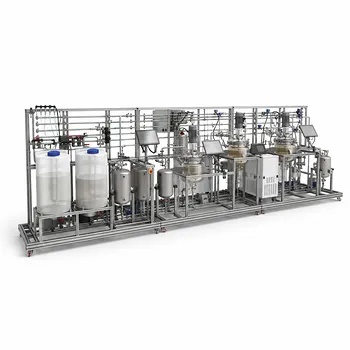
The unit operations pilot plant is your non-negotiable bridge between discovery and profit. It is the essential intermediate step that de-risks the transition from a laboratory formula to a commercial manufacturing process by uncovering the physical and economic realities that are invisible at the bench scale.
Moving directly from glassware to a 10,000-gallon reactor is a gamble with catastrophic potential. The core need a pilot plant addresses is risk mitigation: it provides the empirical data required to validate engineering models, define operational specifications, and ensure that a process is not just chemically possible, but physically, safely, and economically viable at scale.
Beyond Simple Enlargement: The Nonlinear Nature of Scale-Up
The fundamental reason a pilot plant is essential is that chemical processes do not scale linearly. You cannot simply build a bigger beaker and expect the same result.
The Physics of Failure at Scale
In a laboratory flask, gravity and surface tension often dominate, making mixing and heating seem simple. At commercial scale, the physics change dramatically.
Heat generated by a reaction increases with the cube of the vessel’s dimensions (volume), but the surface area available to remove that heat only increases with the square. This creates a dangerous potential for thermal runaway that does not exist in the lab. Mixing behavior, fluid dynamics, and residence time distribution all shift in ways that theoretical models alone cannot predict with certainty.
When a Good Formula Becomes a Bad Process
A lab-scale synthesis might proceed perfectly, but the pilot plant often reveals that a "good" formula is a process disaster waiting to happen.
Extended heating or cooling times at scale can degrade a heat-sensitive product. Long transfer times between vessels can allow reactive intermediates to decompose. Impurities from solvent recycling, which are trivial to remove in a lab rotovap, can accumulate to catalytic poisons in a continuous commercial loop. The pilot plant exposes these hidden failure modes.
The Pilot Plant as a Data Engine for Risk Mitigation
Its true value is as an empirical data generation tool that validates the theoretical models you are betting your capital on.
Validating the Digital Twin
You can simulate a process with elegant mass and energy balances, but a simulation is only as accurate as its assumptions. A pilot plant provides the physical truth to refine those models.
By collecting real-world data on material inputs, operating conditions, and step durations, you can confirm that your equipment-sizing calculations are correct. This ensures a reactor is large enough to contain a foaming precipitation event without overfilling, yet can still maintain the minimum operating volume for its agitator. It turns a theoretical design into a verified one.
Proving Catalyst Viability Under Fire
A catalyst that performs brilliantly on a pure lab reagent can fail instantly when exposed to real-world feedstocks. Pilot plants are critical for catalyst selection because they replicate the harsh environment of a commercial plant.
This includes the impact of recycling unreacted materials and the accumulation of trace impurities. You can accurately evaluate long-term deactivation rates and regeneration cycles, a task that is simply impossible in a one-pass bench reactor. This single step can determine the entire economic feasibility of a project.
Establishing Credible Economics
The final output of a pilot plant run is not just a product sample; it's a verified cost model. You will measure true raw material yields, quantify waste and by-product handling requirements, and determine actual utility consumption.
This empirical cost data either confirms the profitability forecast or kills the project before tens of millions of dollars are committed to a plant that would never be competitive.
Understanding the Trade-offs
A pilot plant is an essential tool, but it is not a magic wand, and its value must be weighed against its cost and time requirements.
- Time and Speed-to-Market: Running a pilot campaign can take months, which is in direct tension with the industry pressure to achieve "right-first-time" scale-up on compressed timelines.
- Cost of Failure is Still Real: While far cheaper than a failed commercial plant, designing, building, and operating a pilot plant is a significant capital expenditure.
- The Scaled-Down Fallacy: Not everything can be scaled down perfectly. A pilot plant’s high surface-area-to-volume ratio can still hide certain mixing or heat transfer issues that would only appear at a larger demonstration scale. The pilot plant data is critical, but the step to full scale still requires engineering judgment.
How to Apply This to Your Project
The necessity of a pilot plant is absolute, but its specific role depends on your primary risk.
- If your primary focus is an exothermic or hazardous reaction: The pilot plant is your safety imperative. Focus on heat transfer and mixing data to define the safe operating envelope and required redundancy for the commercial reactor.
- If your primary focus is a tight production cost target: The pilot plant is your economic validator. Your goal is to run a mass-balanced campaign over multiple cycles to confirm yield, track impurity buildup in recycle streams, and generate an unforgivingly realistic list of raw material and waste costs.
- If your primary focus is the performance of a novel catalyst: Long-duration pilot runs under realistic recycle and impurity conditions are non-negotiable to establish true catalyst lifetime and prevent a predictable plant failure.
- If your primary focus is training a workforce: The pilot plant becomes an educational bridge, giving engineers and operators hands-on experience with transient behaviors like startup and shutdown that they can never learn from glassware or a simulator screen.
The pilot plant is where a promising laboratory discovery is forged into a reliable industrial asset; skip it, and you are merely conducting a very expensive experiment with a full-scale plant.
Summary Table:
| Scale-Up Challenge | Pilot Plant Solution | Key Value Delivered |
|---|---|---|
| Nonlinear Physics | Tests real-world heat and fluid dynamics | Prevents thermal runaway and process failures |
| Unverified Models | Collects empirical data for digital twins | Optimizes equipment sizing and configurations |
| Catalyst Degradation | Replicates recycle streams and impurities | Determines true catalyst lifespan and viability |
| Uncertain Economics | Measures raw yield and utility consumption | Establishes verified cost models before major investment |
Bridge the Gap from Lab to Launch with LABPARK
Transitioning from benchtop chemistry to full-scale production requires reliable physical data. LABPARK designs and manufactures high-performance Educational and Vocational Unit Operations Pilot Plants across chemical engineering, bioprocess & biotech, and environmental & water treatment sectors.
We empower universities, research institutes, and enterprises to:
- Minimize Scale-Up Risks: Validate your theoretical designs under realistic operating conditions.
- Ensure Operational Safety: Establish safe envelopes for exothermic and complex reactions.
- Optimize Project Economics: Secure accurate cost models and process yields before investing in commercial plants.
Ready to elevate your research or training facility? Contact LABPARK today to explore our customizable pilot plant solutions!
Related Products
- General Purpose Cosmetics Production Unit Operations Training Pilot Plant
- Multi Pump Fluid Transport Process Piping Unit Operations Training Pilot Plant
- Multi-Functional Drying Educational Unit Operations Pilot Plant
- Fixed-Bed Chemical Reaction and Gas Dust Tar Removal Unit Operations Pilot Plant
- 100L Continuous Loop Hydrogenation Educational Unit Operations Pilot Plant
People Also Ask
- How do deviations in estimating latent heat impact pilot plant thermal systems? Avoid hardware mis-sizing.
- Why is the chemical plant startup schedule crucial? De-risk scale-up with pilot plants.
- When to transition from PID to adaptive control in pilot plants? Key process indicators.
- Why Compare Predicted and Experimental Excess Enthalpy? Key to Accurate Pilot Plant Scale-up
- How to study gasification in pilot plants? Compare exit gas composition & efficiency