The answer lies in the chemistry of a fleeting gas. A rapid, two-step titration is required because dissolved carbon dioxide (CO₂) is continuously escaping from the water sample into the atmosphere during analysis. The standard acid-base reaction with hydroxide is chemically slow, so a conventional dropwise titration allows significant CO₂ loss before the endpoint is reached, yielding falsely low results. The two-step procedure circumvents this by first estimating the alkali demand and then instantly neutralizing all the CO₂ in a fresh sample, converting it to non-volatile bicarbonate before any meaningful degassing can occur.
Dissolved CO₂ behaves like a ticking clock in an open beaker—every second of slow titration allows more gas to be lost. The two-step approach is not a refinement of the standard method; it is a fundamental necessity to trap the analyte before it disappears, turning a fugitive gas into a stable, titratable ion in one rapid motion.
The Instability of Dissolved Carbon Dioxide
To understand why speed is non-negotiable, you must first confront the two chemical challenges at play: a sluggish reaction and a constant physical loss.
The Slow Reaction Between CO₂ and Hydroxide
The titration relies on the reaction CO₂ + OH⁻ → HCO₃⁻. At a molecular level, this neutralization is not instantaneous. It proceeds at a finite rate, meaning that each drop of sodium hydroxide added needs time to find and react with dissolved CO₂ molecules.
In a traditional titration near the endpoint, the local concentration of hydroxide can be low, further slowing the reaction kinetics. This creates a dangerous lag—you keep adding titrant based on a color change that hasn't yet caught up to the chemistry.
The Continuous Atmospheric Loss
Simultaneously, CO₂ is a dissolved gas that seeks equilibrium with the air above the sample. In typical pilot plant waters, the partial pressure of CO₂ is often higher than atmospheric, so the gas constantly diffuses out of solution.
Stirring, which is essential for mixing, accelerates this degassing. Every swirl that helps the hydroxide react also helps CO₂ molecules escape. This dual dynamic makes the titration a race against time: the reagent must capture CO₂ faster than it can flee the liquid.
How the Two-Step Procedure Solves the Problem
This procedure does not try to fix the slow chemistry; instead, it engineers around it by minimizing the time window where unreacted CO₂ is exposed.
Step 1: The Scout Titration
You begin by titrating a sample at a normal pace to a phenolphthalein endpoint. Because CO₂ loss is occurring throughout, this first result is almost certainly an underestimation of the true dissolved CO₂ concentration.
However, this step gives you a critical piece of intelligence: the approximate volume of standard alkali required. It’s a reconnaissance mission, not a precision measurement. You accept its inaccuracy because it informs the decisive second act.
Step 2: The Rapid Fixation
Now you draw a fresh, undisturbed sample of the same water. Instead of adding the titrant drop by drop, you add the entire predetermined volume of alkali all at once. To the water.
This bulk addition immediately creates a high local concentration of hydroxide ions. The sheer surplus of OH⁻ effectively overwhelms the slow reaction kinetics, driving a near-instantaneous conversion of CO₂ into non-volatile bicarbonate (HCO₃⁻) . Once the CO₂ has been chemically locked into bicarbonate, it can no longer escape to the atmosphere. You can then complete the titration to the precise phenolphthalein endpoint without fear of ongoing loss.
Understanding the Limitations
No analytical technique is flawless. Recognizing the trade-offs of this method is just as important as mastering its steps.
The Risk of a Significant Overshoot
The scout titration defines the fast addition volume. If that first run was grossly inaccurate due to heavy degassing or a misjudged endpoint, you may add far too much or too little alkali in the rapid step. Over-adding NaOH will require back-titration with acid, adding complexity and potential error. The method’s accuracy hinges entirely on a reasonable first estimate.
Sample Handling Is Still a Critical Factor
The rapid fixation step stops loss during the titration, but it cannot reclaim CO₂ already lost before the analysis begins. If you collect the sample and leave it sitting in an open container, or agitate it excessively, a significant fraction of CO₂ will be gone before any chemistry is applied. This procedure corrects for analytical artifacts, not for poor sampling technique. The measurement remains only as good as the representativeness of the freshly drawn water.
Making the Right Choice for Your Pilot Plant Goal
The two-step procedure is a targeted solution for a specific analytical liability. How you implement it should align with what you need from the data.
- If your primary focus is analytical accuracy for process decisions: Use the two-step method without compromise. The 30 extra seconds it takes prevents a chronic underestimation that could lead to incorrect scaling predictions and futile chemical dosing.
- If your primary focus is operator speed for routine, trending-only checks: The single, direct titration may be a calculated trade-off, provided you understand the result is a relative index, not an absolute concentration. However, for any data used to model chemical equilibrium or size equipment, the rapid two-step method is non-negotiable.
- If your primary focus is field robustness with minimal equipment: Train operators to perform the scout titration swiftly and add the bulk alkali with confidence. The biggest source of error is hesitation—a slow pour during the rapid step defeats its entire purpose.
Mastering this technique transforms CO₂ measurement from a frustratingly volatile guess into a repeatable, trustworthy data point that reliably reflects your pilot plant's water chemistry.
Summary Table:
| Step | Action | Main Purpose | Key Consideration |
|---|---|---|---|
| 1. Scout Titration | Titrate sample at normal pace to endpoint | Estimate approximate alkali volume needed | Underestimates CO2 due to constant gas loss |
| 2. Rapid Fixation | Add bulk alkali volume instantly to fresh sample | Lock CO2 into stable bicarbonate before loss | Risk of overshoot if first estimate is incorrect |
Optimize Your Water Treatment & Chemical Engineering Labs
Ensure precise analytical results and hands-on training with LABPARK. We provide state-of-the-art Educational and Vocational Unit Operations Pilot Plants in chemical engineering, bioprocess & biotech, and environmental & water treatment for universities, research institutes, and enterprises.
Ready to elevate your research and training capabilities? Contact LABPARK today to discover how our custom pilot plant solutions can benefit your institution!
Related Products
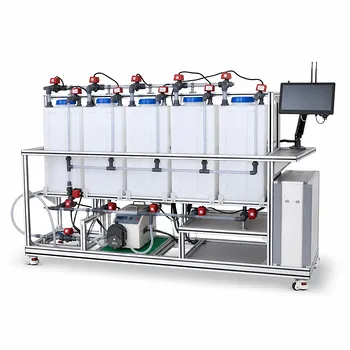
- Electrochemical Water Treatment Educational Unit Operations Pilot Plant
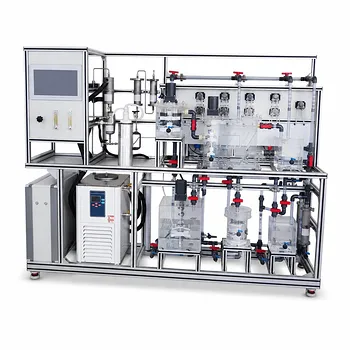
- Thermal Desorption Exhaust Gas and Tail Water Treatment Educational Pilot Plant
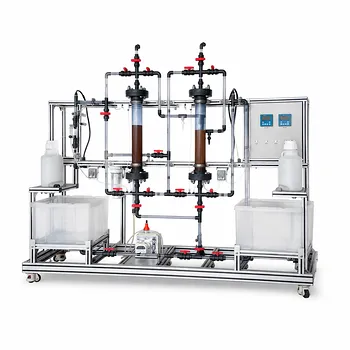
- Ion Exchange Water Purification Educational Pilot Plant for Engineering Unit Operations
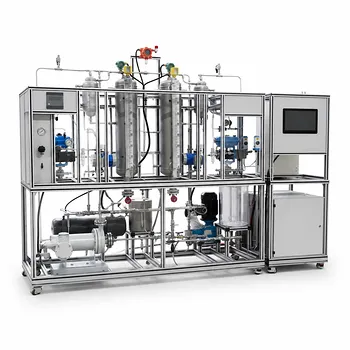
- Alkaline Membrane Water Electrolysis Educational Pilot Plant Unit Operations Training System
- Water Electrolysis Hydrogen Production and Storage Educational Pilot Plant
People Also Ask
- What limits simultaneous Reynolds and Froude similarity? Master pilot plant scaling laws.
- How do anodic & cathodic inhibitors protect heat exchangers? Optimize Your Water Treatment Pilot Plant
- How is iron concentration monitored to evaluate corrosion and filtration efficiency in water treatment pilot plants?
- How is P, M, and B alkalinity applied in pilot plants? Prevent Boiler Scaling & Corrosion
- What buffers and pre-treatments eliminate hardness titration interferences in pilot plants? Expert Guide