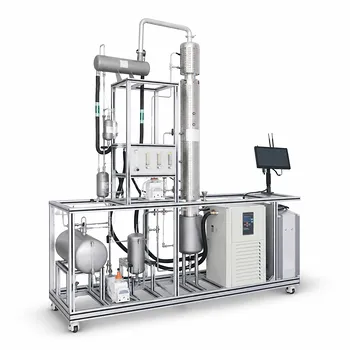
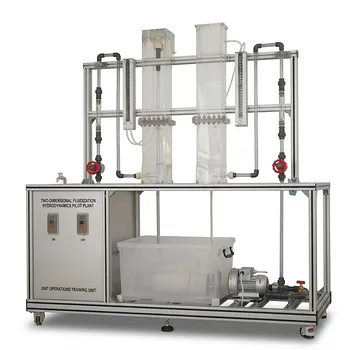
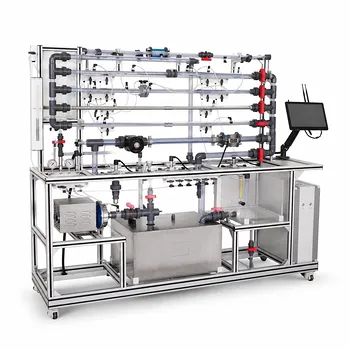
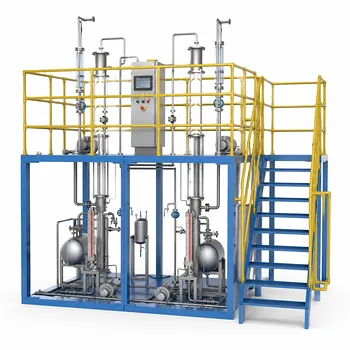
By fundamentally bypassing the thermodynamic limitations of vapor-liquid equilibrium, a pervaporation unit operations pilot plant offers a uniquely powerful and practical platform for teaching and researching separations. Unlike traditional distillation, which hits an insurmountable barrier with azeotropic or close-boiling mixtures like ethanol and water, pervaporation uses a selective membrane to achieve separation based on chemical affinity and permeation rates. This enables the single-step production of near-absolute ethanol without hazardous entrainers, using 30-40% less energy, making it the gold standard for demonstrating modern, sustainable separation science.
Traditional distillation is bound by fixed boiling points and mixture thermodynamics—it cannot separate an azeotrope without introducing complex chemical additives. Pervaporation annihilates this limitation by acting as a molecular filter, where separation is governed by how components dissolve into and diffuse through a tailored membrane. For teaching and research, this translates to a cleaner, safer, more tunable, and conceptually richer platform that directly embodies the principles of green chemical engineering.
The Invisible Wall: Why Traditional Distillation Fails in the Classroom
The Tyranny of Vapor-Liquid Equilibrium
Distillation separates components based on differences in their boiling points. However, when an azeotrope forms—like the 95.6% ethanol/water mixture—the vapor has the exact same composition as the liquid.
At this point, no further boiling-point-based separation is possible. The vapor-liquid equilibrium (VLE) curve pinches to a convergence, and you can add all the theoretical trays you want; the mixture will not part further. This is a thermodynamic dead-end.
The Entrainer Trap: A Complex, Messy Solution
The industrial workaround is azeotropic distillation, which adds a third chemical "entrainer" to break the azeotrope. For a pilot plant, this introduces a cascade of problems.
You must now handle, monitor, recover, and dispose of this hazardous entrainer. This requires complex downstream purification, continuous analytical monitoring, and high minimum operating capacities to be economically viable. For a teaching lab, it turns a lesson in separation into a messy lesson in chemical hazard management, obscuring the core physics.
Breaking the Cycle: The Pervaporation Advantage
Separation by Affinity, Not Boiling Point
A pervaporation unit completely sidesteps the VLE straitjacket. It uses a dense, non-porous membrane that acts as a selective barrier.
Separation is driven by the difference in chemical potential across the membrane. The process is a three-step sequence: first, the target component is preferentially sorbed onto the membrane surface; second, it diffuses selectively through the membrane matrix; third, it desorbs as a vapor on the permeate side. For ethanol dehydration, a hydrophilic polyvinyl alcohol (PVA) membrane lets water race through while holding ethanol back, achieving over 99.8% purity in a single pass.
Physics You Can Touch and Tune
For researchers, this mechanism is a goldmine of controllable variables. There is no mysterious entrainer interaction—just solubility and diffusivity.
Students can physically study and model each step. They can alter the membrane material, temperature, feed concentration, and downstream vacuum to see the direct impact on flux and selectivity. This transforms an abstract thermodynamic limit into a tangible, tunable transport problem, deeply cementing the principles of mass transfer.
The Practical Case for a Pilot-Scale System
Inherent Safety and Green Chemistry
By eliminating the need for chemical entrainers, a pervaporation pilot plant removes a whole class of chemical, fire, and disposal hazards. The operation is purely physical.
You can demonstrate a closed-loop solvent recovery system. Only the permeating component is vaporized, and because the unit operates at moderate or ambient temperatures, it is exceptionally safe for heat-sensitive compounds and reduces the carbon footprint. This aligns perfectly with modern green chemistry curricula and industrial sustainability goals.
The Modular, Compact Workhorse
A pervaporation pilot plant is not a towering, glass-laden column. It is a compact, skid-mounted system that can sit in a fume hood or a small lab space.
Its modular nature allows for rapid reconfiguration. You can easily couple it with a distillation column to create a hybrid separation sequence. A classic research project uses distillation to pre-concentrate the ethanol to its azeotrope, then feeds the distillate into the pervaporation unit to polish it to anhydrous product. This demonstrates process intensification in a way a single distillation column never could.
Economical at the Scale of a Teaching Lab
Entrainer distillation simply does not scale down to a classroom. You need a high minimum throughput to make the entrainer recovery loop stable and economic.
Pervaporation thrives at exactly this scale. It is economically viable for processing the small solvent volumes typical of a pilot facility, recovering 90-97% of the solvent on-site without the need to ship hazardous waste off-site. This allows students to run a genuine, industrially relevant separation process with the same equipment they might see in a pharmaceutical or fine chemical plant.
Understanding the Trade-offs: Where Pervaporation Isn't Perfect
No unit operation is a panacea, and a truly objective technical advisor must highlight the limitations. Ignorance of these pitfalls leads to frustration in research and an incomplete education.
The Slow Rate of Permeation
Membrane separation is driven by diffusion, which is inherently a slow process. For high-throughput applications, the required membrane area can be large.
Students must grapple with the flux-selectivity trade-off. A highly selective membrane often has low flux, requiring a larger system to achieve a desired capacity. This forces a critical engineering discussion about capital cost versus operating savings that distillation’s simple tray count often masks.
Fouling and Membrane Lifetime
Real-world feed streams contain more than just ethanol and water. Trace organics, salts, or solids can foul the membrane surface, reducing performance over time.
Pilot plants must incorporate proper pre-filtration and cleaning protocols. Teaching students to manage and diagnose membrane fouling transforms a simple laboratory demonstration into a true unit operations experience, preparing them for the realities of industrial membrane systems.
Concentration Polarization
As the more permeable component is removed, a boundary layer can build up at the membrane surface, reducing the effective driving force. This is a classic mass-transfer limitation.
It demands a focus on fluid dynamics and module design. Unlike a distillation tray where efficiency is largely a function of contacting, a pervaporation unit's performance is intimately linked to the flow velocity and channel geometry. This adds a rich layer of fluid mechanics to the teaching of separations.
Making the Right Choice for Your Learning or Research Goal
A pervaporation pilot plant is not just a piece of equipment; it is a philosophical statement about how you approach separation science. The right choice depends on your primary objective.
- If your primary focus is teaching the absolute fundamentals of thermodynamic limitations and creative process design: Choose pervaporation. It forces students to confront the failure of VLE and understand how to engineer a solution based on transport phenomena, not just heat physics.
- If your primary focus is demonstrating green chemistry and sustainable engineering: Choose pervaporation. The elimination of hazardous entrainers, lower energy consumption, and compact platform make it a clear, tangible example of a modern, environmentally conscious process.
- If your primary focus is researching modular, hybrid, or on-site solvent recovery processes: Choose pervaporation. Its ability to operate at small scales, couple perfectly with other units, and recover high-purity solvents from azeotropic waste streams is unmatched by traditional distillation.
- If your primary focus is high-throughput bulk separation of a non-azeotropic, thermally robust mixture: Traditional distillation may still be the simpler, more economical choice. However, for the specific challenge of training engineers to solve the hard separation problems of today, pervaporation is the superior pedagogical and research platform.
By shifting the teaching of separations from an impasse to an interactive, tunable membrane process, you equip the next generation of engineers with the tools to solve problems, not just describe them.
Summary Table:
| Feature | Pervaporation Pilot Plant | Traditional Distillation |
|---|---|---|
| Separation Driver | Chemical affinity & membrane permeation | Vapor-Liquid Equilibrium (VLE / boiling points) |
| Azeotrope Handling | Easily separates in a single pass (99.8%+) | Blocked by thermodynamic VLE limit |
| Chemical Safety | Green & physical (no entrainers needed) | Requires hazardous entrainers & complex recovery |
| Energy & Footprint | 30-40% less energy; compact modular skid | High energy input; tall column footprint |
Elevate Your Chemical Engineering Lab with LABPARK
Are you looking to modernize your teaching curriculum or scale up your separation research? LABPARK designs and manufactures premium Educational and Vocational Unit Operations Pilot Plants tailored for universities, research institutes, and enterprises.
Whether you specialize in chemical engineering, bioprocess & biotech, or environmental & water treatment, our modular pervaporation and distillation systems provide students and researchers with hands-on, safe, and highly tunable training platforms.
Ready to upgrade your laboratory capabilities? Contact our technical experts today to discuss your custom pilot plant requirements!
Related Products
- Multi Pump Fluid Transport Process Piping Unit Operations Training Pilot Plant
- Multimodal Absorption and Desorption Pilot Plant for Unit Operations Training
- Rising and Falling Film Evaporation Educational Unit Operations Pilot Plant
- Supercritical High-Gravity Flash Evaporation Educational Unit Operations Pilot Plant
- Natural Product Extraction Unit Operations Training Pilot Plant
People Also Ask
- Why distinguish Newtonian & non-Newtonian fluids in pilot plants? Prevent design errors.
- Why is the chemical plant startup schedule crucial? De-risk scale-up with pilot plants.
- When to transition from PID to adaptive control in pilot plants? Key process indicators.
- How to study gasification in pilot plants? Compare exit gas composition & efficiency
- Why Compare Predicted and Experimental Excess Enthalpy? Key to Accurate Pilot Plant Scale-up