The melting point of a substance is not a fixed vertical line on a phase diagram—it’s a sliding curve that bends left or right depending on a simple molecular truth. Water and carbon dioxide do exactly the opposite thing when you squeeze them because their solid and liquid forms have reversed density relationships. For water, increasing pressure lowers the melting point. For carbon dioxide, increasing pressure raises it. This reversal stems from the fact that ice expands upon freezing, while solid CO₂ contracts, a difference that can make or break your thermal unit operation.
In any high-pressure pilot plant, whether you’re crystallizing a product or preventing a freeze-up, the direction of the solid–liquid phase boundary is not a minor detail—it is the single most important thermodynamic property governing whether pressure stabilizes the solid or the liquid phase. The Clapeyron equation assigns a sign to this slope, and that sign flips for water versus carbon dioxide because melting water contracts while melting CO₂ expands.
The Thermodynamic Engine Behind Pressure–Melting Behavior
The Clapeyron Equation – The One Rule That Links Pressure and Temperature
Every two-phase coexistence line obeys the Clapeyron equation:
dp/dT = ΔH / (T ΔV)
dp/dT is the slope of the phase boundary. ΔH is the latent heat of the transition (always positive for melting). T is the absolute temperature (always positive). Therefore, the sign of the slope is solely determined by the sign of the volume change, ΔV = V_liquid – V_solid.
If melting causes expansion (ΔV > 0), the slope is positive.
If melting causes contraction (ΔV < 0), the slope is negative.
Everything you observe in your pilot plant—from a frozen line thawing under load to a crystallizer seizing up—can be traced back to this single equation.
For Water, Melting Packs the Molecules Tighter (Negative ΔV)
Ice has a rigid, hexagonal crystal structure that holds water molecules farther apart than they are in the liquid. When ice melts, the crystal lattice collapses, and the molecules actually settle closer together.
- Volume contraction: Liquid water is about 9% denser than ice at 0°C.
- Negative ΔV:
V_liquid < V_solid, so the volume change upon melting is negative. - Negative slope:
dp/dTis negative. Applied pressure helps the material reach the denser phase.
In practice, this means the melting point goes down as you increase pressure. If your high-pressure extraction vessel contains residual water, a sudden pressure spike can melt ice that was perfectly stable moments before.
For Carbon Dioxide, Melting Pushes Molecules Apart (Positive ΔV)
Solid CO₂ has a more ordered, compact arrangement than its liquid. Melting disrupts this packing and demands more room.
- Volume expansion: Liquid CO₂ is less dense than its solid at the melting point.
- Positive ΔV:
V_liquid > V_solidgives a positive volume change. - Positive slope:
dp/dTis positive. Pressure opposes the transition to the less-dense liquid.
This is why the melting point rises with pressure. In a CO₂-based pilot system, a pressurization step can accidentally freeze the working fluid if you do not account for the upward shift in melting point.
Why This Matters in Your Pilot Plant
Avoiding Frozen Lines in High-Pressure Water Systems
Many thermal unit operations handle water or aqueous solutions at high pressure. If your process operates near 0°C, a pressure increase will not freeze the water—it will melt any ice present.
- If you rely on ice formation for purification or concentration, pushing the pressure too high can collapse your crystal bed.
- Conversely, if you want to prevent plugging, a slight pressurization can act as a safeguard against freeze-ups, but only for water. This strategy would backfire with CO₂.
Crystallization and Purification Under Pressure
When you use crystallization as a separation technique, pressure becomes a subtle control knob that rotates the melting curve in a direction specific to your material.
- For water-like substances: feeding pressure lowers the freezing point, potentially re-dissolving your product crystals and ruining yield.
- For CO₂-like substances: increasing pressure raises the freezing point, which can enhance solid formation but also risks an unforeseen solid plug if temperature drops only slightly.
Designing Safe CO₂ Handling Systems
Solid carbon dioxide (dry ice) is often used for cooling in pilot-scale operations. At atmospheric pressure, dry ice does not melt—it sublimes directly into gas because its triple point pressure is a high 5.17 × 10⁵ Pa.
- If you pressurize a CO₂ system above the triple point, liquid CO₂ becomes stable, and now the melting curve has a positive slope.
- A subsequent temperature drop can cause rapid solidification, blocking lines.
Designing a CO₂ loop without mapping the melting curve is like driving at night without headlights—you will hit something you cannot see.
Understanding the Trade‑offs and Pitfalls
The Danger of Assuming “More Pressure Equals More Liquid”
A natural intuition is that pressure squeezes everything into a liquid, but the solid–liquid boundary does not follow a universal direction.
- Water: more pressure stabilizes the liquid; the solid becomes rarer.
- CO₂: more pressure stabilizes the solid; the liquid can freeze under load.
Applying a one-size-fits-all mental model will lead to sudden, costly phase changes that your instrumentation may not anticipate.
The Complexity of Mixed Systems
Many real pilot-plant streams are not pure water or pure CO₂. Solutes, anti‑freeze agents, and dissolved gases all shift the melting point and can alter the sign of ΔV in concentrated solutions.
- Even if water dominates, dissolved CO₂ or salts can change both the density relationship and the latent heat, requiring recalibration.
- Relying on phase diagrams for pure components without accounting for composition is a common source of operational failure.
Making the Right Choice for Your Process Goal
Your response to pressure’s effect on melting point must be tailored to the material and the objective.
- If your primary focus is preventing ice-related blockages in aqueous lines: A modest pressure increase can actually help melt ice, buying you time; but do not over-pressurize, as other components may be sensitive.
- If your primary focus is maximizing crystal yield from a CO₂-like melt: Apply pressure to raise the melting point and push the fluid closer to solidification, but control temperature tightly to avoid a frozen shutdown.
- If your primary focus is operating a freeze‑drying or sublimation unit: Keep chamber pressure well below the triple point pressure, remembering that water’s triple point is at a very low pressure (611 Pa), while CO₂’s triple point is above atmospheric pressure, dictating completely different vacuum and temperature requirements.
When you view pressure as a directional force on your material’s melting point, you stop fighting phase changes and start guiding them. The Clapeyron equation is your map—use it to steer your pilot plant away from operational surprise and toward precise, predictable control.
Summary Table:
| Parameter | Water (H2O) | Carbon Dioxide (CO2) |
|---|---|---|
| Volume Change (ΔV) | Negative (ΔV < 0) | Positive (ΔV > 0) |
| Density Relationship | Liquid is denser than solid | Solid is denser than liquid |
| Melting Point & Pressure | Decreases as pressure rises | Increases as pressure rises |
| Pilot Plant Impact | Pressurization melts ice | Pressurization can cause freezing |
Master Thermal Unit Operations with LABPARK
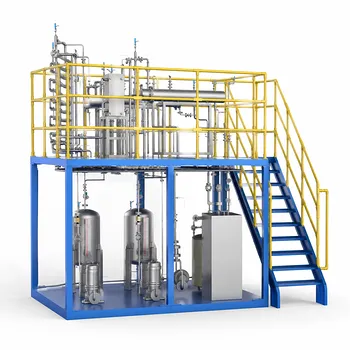
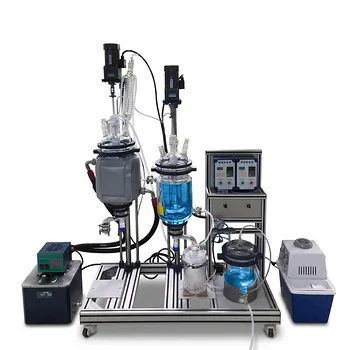
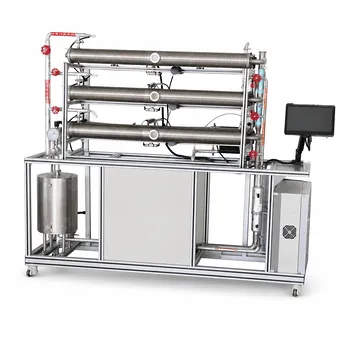
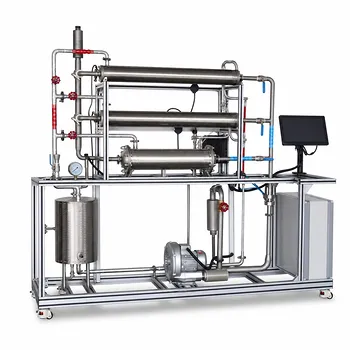
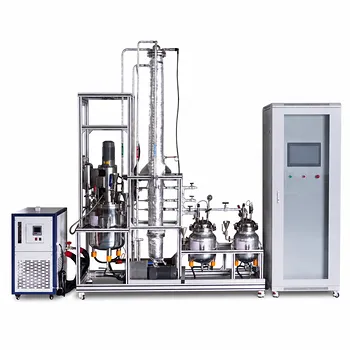
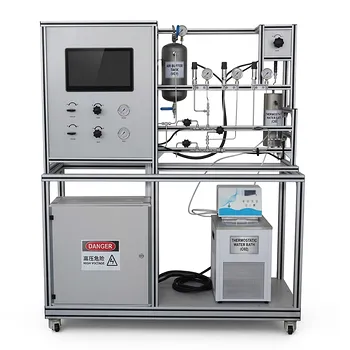
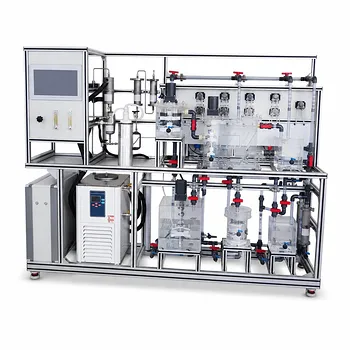
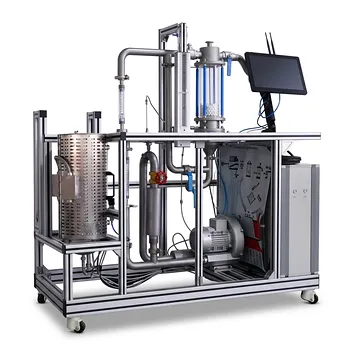
Managing complex phase behaviors like pressure-induced melting requires precise, reliable equipment. LABPARK provides state-of-the-art Educational and Vocational Unit Operations Pilot Plants in chemical engineering, bioprocess & biotech, and environmental & water treatment.
Designed for universities, research institutes, and enterprises, our pilot plants ensure hands-on accuracy and robust thermodynamic control.
Ready to elevate your research or training capabilities? Contact LABPARK today to find the perfect pilot plant solution for your facility!
Related Products
- Comprehensive Multi-Modal Heat Transfer Unit Operations Pilot Plant for Engineering Training
- Dual Mode Heat Transfer Pilot Plant for Unit Operations Training
- Potassium Salt Thermal Dissolution and Crystallization Separation Educational Unit Operations Pilot Plant
- Hot Filtration Educational Unit Operations Pilot Plant Laboratory System
- Three-Tube Heat Transfer Educational Pilot Plant for Unit Operations Training
People Also Ask
- When is ε-NTU preferred over LMTD in pilot plants? Predict heat exchanger performance without iteration.
- Why is emissivity critical in heat transfer pilot plants? Bridge the Gap Between Theory & Industrial Design
- How can a heat transfer pilot plant demonstrate waste heat recovery? Learn to optimize industrial thermal systems.
- How to configure heat transfer pilot plants for pinch analysis? Teach energy recovery.
- How does thermal conductivity affect pilot plant performance? Optimize heat transfer & accuracy