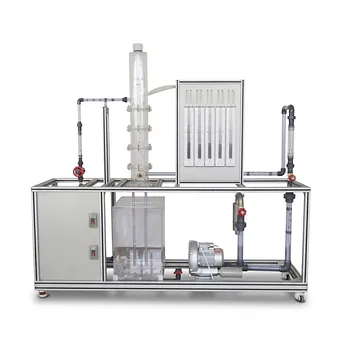
Packed columns are non-negotiable for vacuum distillation pilot plants handling heat-sensitive materials because they minimize the pressure drop across the column. This is the primary defense against thermal degradation. Under vacuum, even a small increase in pressure at the column bottom dramatically raises the boiling point, risking decomposition. Paired with this, the vessel itself must be structurally reinforced to withstand external atmospheric pressure, preventing a catastrophic implosion.
Protecting heat-sensitive compounds in a vacuum distillation pilot plant hinges on two integrated design choices: a low-pressure-drop packed column to preserve the vacuum at the bottom, and robust mechanical construction to resist atmospheric collapse. Without both, you either degrade the product or compromise safety.
The Deep Need: Protecting Heat-Sensitive Compounds
The core challenge with heat-sensitive materials is that high temperatures cause thermal degradation, unwanted side reactions, or decomposition. Distillation relies on boiling, so the instinct is to lower the boiling point by reducing operating pressure. Vacuum distillation achieves exactly this — it shifts the entire vapor-liquid equilibrium, allowing separation at temperatures far below the atmospheric boiling points.
However, vacuum operation introduces a cascade of second-order effects. The vapor density drops, which increases the volumetric flow rate for the same mass throughput. This directly impacts column diameter and pressure drop behavior. More critically, the pressure drop across the column internals becomes the dominant factor controlling the temperature at the bottom of the column.
How a Small Pressure Drop Causes a Large Temperature Rise
Under vacuum, the relationship between pressure and boiling point is highly nonlinear. A pressure drop of just 10–20 mmHg can translate into a boiling point increase of 10–30°C, depending on the compound. If a tray column generates a high pressure drop per stage, the cumulative effect quickly raises the bottom pressure — and thus the bottom temperature — into the danger zone where degradation accelerates.
This is why minimizing pressure drop is not a preference; it is the controlling variable for product integrity.
Why Packed Columns Are the Preferred Choice
Packed columns provide continuous contact between vapor and liquid, replacing discrete trays with a bed of packing material. This geometry inherently offers a far lower pressure drop per theoretical stage of separation compared to a trayed column. In a vacuum pilot plant, that means you can achieve the same separation efficiency while maintaining a much lower bottom pressure and therefore a lower bottom temperature.
Trayed Columns: The High-Pressure-Drop Alternative
Trayed columns are excellent for visual learning and stage-by-stage contact. However, each tray introduces a pressure drop due to the vapor flowing through liquid on the plate, often on the order of 3–5 mmHg per tray. For a separation requiring 20 theoretical stages, the total column pressure drop can be substantial. Under vacuum, that cumulative drop pushes the bottom temperature up significantly, directly counteracting the purpose of vacuum distillation.
Packed columns, by contrast, use an open structure where vapor flows through the voids of the packing. The resistance is much lower. A structured packing, in particular, can deliver a pressure drop of less than 0.1 mmHg per theoretical stage, preserving the vacuum profile across the entire column.
The Role of Structured Packing for Maximum Efficiency
Within the category of packed columns, structured packing is especially suited to vacuum services. It arranges the packing elements in a highly ordered, corrugated geometry. This design offers three critical advantages for heat-sensitive separations:
- Extremely low pressure drop: The ordered flow channels provide a direct path for vapor, minimizing resistance.
- High surface-area-to-volume ratio: This maximizes mass transfer efficiency in a smaller column volume, crucial when operating at low vapor densities.
- High capacity and turn-down: Structured packing handles the increased volumetric flows caused by reduced pressure better than random packing, delaying flooding.
For a pilot plant, using structured packing allows researchers to clearly demonstrate process intensification — achieving more separation in less space, with lower energy input, and at lower temperatures.
Structural Considerations: Withstanding External Pressure
A vacuum column is a pressure vessel operating in reverse. The internal pressure is far below atmospheric, meaning the ambient air exerts a compressive force on the column shell from the outside. If the column wall is not thick enough or properly stiffened, it will buckle and implode.
This is a pure mechanical safety requirement, but it is non-negotiable. For a pilot plant, it often means thicker walls, external stiffening rings, or both. The design must follow pressure vessel codes, and the cost of these reinforcements is part of the trade-off for vacuum operation.
Vacuum Generation and System Integrity
Beyond the column itself, the entire pilot plant must maintain a leak-tight environment. Specialized vacuum pumps or ejector systems are essential to achieve and hold the target pressure. Any air ingress destroys the vacuum, raises the pressure, and immediately endangers the product. Additionally, if the process fluids are flammable, air leakage can create an explosive mixture inside the column, adding a critical safety layer to the design.
Understanding the Trade-offs
While packed columns are essential, this design path is not without downsides.
- Higher equipment cost: Thicker vessel walls, vacuum-rated pumps, and high-performance structured packing all increase the initial investment.
- Complex operation: Vacuum systems require careful monitoring for leaks and pressure control. Start-up and shutdown sequences must avoid pressure shocks.
- Limited visual access: Unlike tray columns, you cannot see the vapor-liquid interaction through sight glasses in most packed columns, which reduces the direct educational visualization of stage-by-stage contact.
- Packing maldistribution risk: Poor liquid distribution in packed beds can lead to channeling, reducing separation efficiency. In a pilot plant setting, proper distributor design and packing installation become critical teaching points.
When Steam Distillation Might Be a Viable Alternative
For certain heat-sensitive, high-boiling compounds immiscible with water, steam distillation offers a lower-cost alternative. It introduces live steam to reduce the partial pressure of volatile components, enabling separation at lower temperatures without thick-walled vacuum vessels. However, it’s applicable only when the product is water-immiscible and cannot be used in closed-loop, high-purity vacuum separations. For a pilot plant focused on unit operations training, a steam distillation setup simplifies construction while still demonstrating thermodynamic principles.
Applying This to Your Pilot Plant Selection
Your choice of column configuration should align directly with your primary goal for the pilot plant.
- If your primary focus is protecting heat-sensitive materials at scale: Prioritize a vacuum column with structured packing. The low pressure drop is your best guarantee of product integrity, and the investment in thicker walls is a safety requirement, not an option.
- If your primary focus is comprehensive education in mass transfer: Choose a unit that allows interchangeability or includes both a trayed column and a packed column. Use the trayed unit to visualize flooding, weeping, and stage efficiency, and the packed column to demonstrate pressure drop profiles, HETP calculations, and the benefits of continuous contact.
- If your primary focus is minimizing capital cost and complexity for a simple teaching demonstrator: Consider steam distillation if your target mixture is compatible. Otherwise, a vacuum column with random packing may offer a balance between lower pressure drop and visual learning, while still requiring the vacuum-rated construction.
- If your primary focus is research on new separations: Insist on structured packing and precise vacuum control. The superior relative volatility at lower temperatures (due to the vacuum) improves separation efficiency, and the high turndown ratio of structured packing supports a wider range of experimental conditions.
By understanding that pressure drop is the hidden temperature controller in vacuum distillation, you can make informed, safety-conscious, and efficiency-driven decisions for your pilot plant that truly protect what matters: your heat-sensitive product.
Summary Table:
| Column Type | Pressure Drop / Stage | Heat-Sensitivity Suitability | Best For |
|---|---|---|---|
| Structured Packed | Extremely Low (<0.1 mmHg) | Excellent (Prevents thermal degradation) | Vacuum distillation, research, & scaling |
| Trayed | High (3–5 mmHg) | Poor (Risks bottom temperature rise) | Visual education & stage-by-stage teaching |
Optimize Your Unit Operations Training & Research with LABPARK
Are you looking to equip your lab with high-performance distillation systems? LABPARK provides premium Educational and Vocational Unit Operations Pilot Plants in chemical engineering, bioprocess & biotech, and environmental & water treatment. Designed specifically for universities, research institutes, and enterprises, our systems ensure precise process control, safety-compliant vacuum construction, and flexible column configurations to match your teaching and research goals.
Empower your students and researchers with hands-on, industry-ready experience. Contact LABPARK today to customize the perfect pilot plant for your institution!
Related Products
- Multi-Functional Special Distillation Educational Pilot Plant
- Continuous Sieve-Plate Distillation Pilot Plant for Unit Operations Laboratory Education
- Packed Bed Absorption Educational Unit Operations Pilot Plant
- Continuous Batch Extractive Distillation Educational Pilot Plant
- Absorption and Desorption Educational Unit Operations Pilot Plant
People Also Ask
- How does operating pressure influence Methylal/Methanol VLE? Discover its impact on distillation
- Why does simple distillation yield higher efficiency than flash distillation? Key thermodynamic differences.
- How Batch vs Continuous Configuration Affects Distillation Pilot Plant Versatility & Footprint
- How does double temperature difference control improve distillation pilot plants? Stabilize purity.
- Why is thermodynamic consistency testing critical? Validate pilot plant VLE data to avoid costly design errors.