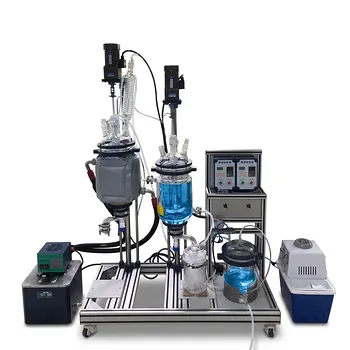
When a pilot plant reactor must survive a 1,000°C abrasive slurry of catalyst particles in boiling nitric acid, standard stainless steel can fail in hours. Interstitial compounds like Titanium Nitride (TiN) and Tungsten Carbide (WC) are critical because they fuse metallic toughness with ceramic-grade hardness and chemical inertness. They enable reactor linings, impeller blades, and valve surfaces to withstand the simultaneous, brutal assault of extreme temperature, corrosion, and wear that defines the frontier of chemical engineering scale‑up.
Pilot plants are built to push processes to the breaking point — and that breaking point is usually the material itself. Interstitial compounds fill a unique performance gap: they conduct heat and electricity like metals, yet resist erosion like ceramics and repel chemical attack like noble metals. In the most punishing unit operations, coatings or solid components of TiN and WC are not a upgrade; they are a prerequisite for process safety, experimental integrity, and long‑term operability.
The Unique Chemistry of Interstitial Compounds
How Small Atoms Create Extreme Properties
Transition metals react at high temperatures with small‑atom non‑metals — nitrogen, carbon, boron. The tiny atoms slip into the interstices, the gaps in the metal’s crystal lattice, without disrupting its fundamental structure. This is not a surface treatment; the whole material is reforged at the atomic level.
The result is a compound that still behaves like a metal — it retains metallic luster and electrical conductivity — but with a profoundly upgraded mechanical and chemical profile.
The Performance Leap
Three property shifts make these compounds indispensable:
- Extreme hardness: The confined interstitial atoms act like microscopic anvils, resisting dislocation movement and making the material exceptionally difficult to scratch or deform plastically.
- High‑temperature tolerance: The strong covalent character of the interstitial bonds prevents softening or creep at temperatures that would anneal ordinary tool steels.
- Superior corrosion resistance: A stable, tightly bound surface layer resists oxidation and attack by aggressive chemical species, even in hot, acidic, or chloride‑rich environments.
The Extreme Demands of Chemical Engineering Pilot Plants
High‑Temperature Aggression and Catalytic Environments
Pilot‑scale catalytic crackers, reformers, and fixed‑bed reactors operate under elevated temperatures and pressures in the presence of hydrogen or corrosive agents. The reactor wall faces a fierce combination of thermal stress and chemical attack. Under these conditions, ordinary carbon steel experiences accelerated oxidation, carburization, and loss of structural integrity; alloy steels offer better resistance but can still suffer from surface degradation and hydrogen embrittlement. Interstitial‑compound linings like TiN act as a chemically inert, thermally stable barrier that maintains reactor integrity run after run.
Corrosive Chemical Attack from Mixed Acids
Many pilot campaigns explore chemistries involving highly corrosive acids — aqua regia, mixed HF/HNO₃, boiling sulfuric acid. These media rapidly pit and dissolve austenitic stainless steels, especially at grain boundaries. The dense, electrically conductive nature of interstitial compounds such as TiN resists the chloride‑driven pitting mechanisms that destroy passive oxide films on stainless steel, preventing catastrophic leaks and contamination of the process stream.
Abrasive Wear from Slurries and Particulates
Moving particle‑laden streams — catalyst powders, mineral slurries, crystallization precipitates — act like liquid sandpaper. Impeller blades, pump casings, and valve seats endure continuous low‑angle erosion that can chew through a standard steel component in a matter of days. Tungsten carbide (WC), with its ceramic‑level hardness, is uniquely capable of shrugging off this abrasive assault, maintaining tight clearances and eliminating metal debris that would otherwise foul the product or bias experimental results.
Where Interstitial Compounds Prove Critical
Reactor Linings and Impeller Blades
In a stirred‑tank reactor handling a corrosive, high‑temperature slurry, the impeller is simultaneously subjected to wear, corrosion, and dynamic stress. A TiN or WC coating on a tough substrate (such as duplex stainless steel) decouples surface requirements from bulk requirements: the coating stops wear and chemical attack, while the substrate absorbs impact and provides overall ductility. Similarly, reactor linings of interstitial compounds protect the pressure‑bearing shell from process‑side degradation.
Valve Trim and Sealing Surfaces
Pilot plant valves see the full spectrum of abuse — throttling of high‑pressure flashing liquids, seating against solid particles, and exposure to acid cleaning cycles. Interstitial compound trim (often cemented WC) maintains a leak‑tight seat long after traditional metal‑to‑metal seals would have been gouged and eroded, ensuring safe isolation and precise flow control, which are critical for accurate kinetic data collection.
Understanding the Trade‑offs: When Hardness Isn’t Enough
The Brittleness Challenge
The very structural rigidity that gives interstitial compounds their hardness makes them inherently brittle. A monolithic TiN component would shatter under a moderate impact or bending load. Pure WC, while incredibly stiff, exhibits almost no plastic deformation before fracture. In an environment where thermal shocks, slugging flows, or tool drops occur, this brittleness can be a fatal weakness.
The Pragmatic Solution: Architectures, Not Single Materials
Pilot plant engineers rarely use these materials in bulk form. Instead, they deploy them as thin‑film coatings or cemented composites:
- Coatings (PVD, CVD): A few microns of TiN deposited on a tough, ductile metal body can provide centuries of wear resistance without sacrificing the underlying part’s ability to bend or absorb energy.
- Cemented carbides: WC particles bonded with a ductile cobalt or nickel matrix retain most of the hardness while gaining enough fracture toughness to survive real‑world operating stresses.
This layered design philosophy — combining a hard, inert exterior with a resilient interior — is the cornerstone of successful pilot plant material selection.
Making the Right Choice for Your Pilot Plant’s Extreme Conditions
The decision to incorporate interstitial compounds must be driven by the specific hazards your process presents.
- If your primary focus is resisting hot, mixed‑acid corrosion: Prioritize TiN coatings on chemically resistant substrates like Hastelloy or titanium. The coating seals off the base metal against the aggressive fluid, dramatically extending component life.
- If your primary focus is defeating abrasive slurry erosion: Select WC‑based impellers, valve trim, and pipe liners. The hardness directly translates to negligible wear rates, protecting both the equipment and your product purity.
- If your primary focus is high‑temperature process integrity and contamination control: Use TiN or other interstitial linings in reactor hot zones to prevent surface scaling, carburization, and the release of metallic contaminants that kill catalyst selectivity.
- If your primary focus is cryogenic or low‑temperature safety: Interstitial compounds are largely irrelevant here. Your concern shifts to avoiding the ductile‑to‑brittle transition. Use austenitic stainless steels or aluminum alloys with FCC crystal structures that remain tough down to extremely low temperatures — a completely different material selection logic.
Ultimately, interstitial compounds are the silent enablers of modern pilot‑scale research. They allow you to run the process you need, under the conditions you need, without the equipment itself becoming the bottleneck — turning material science into a strategic advantage for safer, faster, and more reliable scale‑up.
Summary Table:
| Material | Key Strengths | Primary Pilot Plant Application |
|---|---|---|
| Titanium Nitride (TiN) | High-temperature stability, corrosion resistance | Reactor linings, catalytic reformers, acid environments |
| Tungsten Carbide (WC) | Extreme hardness, erosion resistance | Impeller blades, valve trim, slurry pump components |
| Standard Stainless Steel | High ductility, impact absorption, low cost | Base substrates, non-abrasive piping, structural frames |
Need to ensure your pilot plant survives extreme chemical processes? LABPARK provides state-of-the-art Educational and Vocational Unit Operations Pilot Plants in chemical engineering, bioprocess & biotech, and environmental & water treatment. Designed for universities, research institutes, and enterprises, our systems integrate advanced material science to guarantee long-term durability and safety. Contact our technical experts today to customize your high-performance pilot plant solution!
Related Products
- Ethyl Acetate Synthesis Unit Operations Pilot Plant for Practical Training
- Green Anhydrous Ethanol Refining Practical Training Pilot Plant
- Multi-Functional Special Distillation Educational Pilot Plant
- Aspirin API Synthesis Unit Operations Training Pilot Plant
- Methanol Synthesis and Catalyst Performance Evaluation Educational Unit Operations Pilot Plant
People Also Ask
- How do pilot plants demonstrate esterification? Visualizing Chemical Engineering Equilibrium
- Why are particle density, bulk density & voidage critical in pilot plants? Master Bed Fluid Dynamics
- When to transition from PID to adaptive control in pilot plants? Key process indicators.
- Why is the chemical plant startup schedule crucial? De-risk scale-up with pilot plants.
- Why Use PTFE & Hastelloy in Chemical Pilot Plants? Prevent Corrosion & Ensure Safety