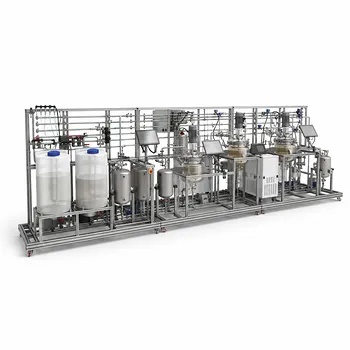
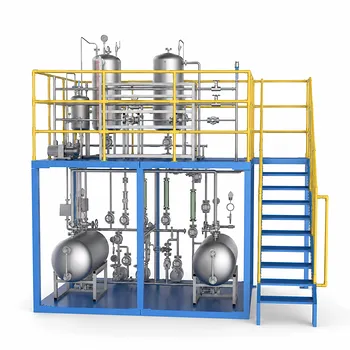
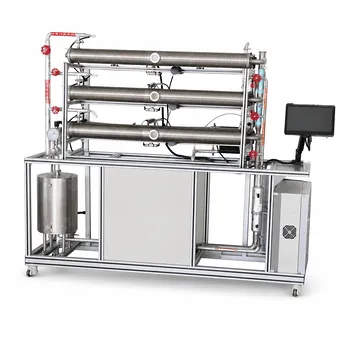
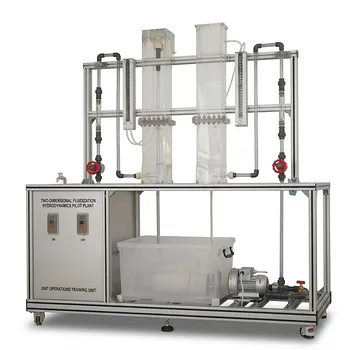
Knowledge Chemical Engineering Education How does pilot plant R&D strategy differ for bulk vs. specialty chemicals? Strategic scale-up guide.
Author avatar

Tech Team · LABPARK

Updated 1 week ago

How does pilot plant R&D strategy differ for bulk vs. specialty chemicals? Strategic scale-up guide.


For bulk chemicals, the R&D strategy is a relentless pursuit of operational efficiency; for specialty products, it’s a race to deliver the perfect molecule to market—fast. When utilizing a unit operations pilot plant, the divergence is stark. Bulk chemical programs use the pilot plant to stress-test continuous processes, driving down energy and raw-material costs. Specialty chemical R&D, conversely, treats the same equipment as a flexible synthesis toolkit to refine product quality and shorten development timelines.

The fundamental difference lies in the primary objective: bulk chemical piloting is process-centric, optimizing for cost and scale, whereas specialty piloting is product-centric, optimizing for performance and speed. A single pilot plant can serve both, but only if its configuration is consciously adapted to these opposing priorities.

The Core Strategic Divide: Process vs. Product

The mission of your pilot plant is completely reshaped by the market you serve. The type of product dictates not only what you test, but how you design your experimental program.

Bulk Chemicals: Optimizing the Continuous Machine

Bulk chemical R&D is a war on manufacturing costs. Product lifecycles are long, specifications are well-defined, and the competitive edge comes from producing a known molecule more economically than anyone else.

In the pilot plant, the focus shifts to minimizing variable cost and environmental footprint. You’ll validate feedstock transitions (e.g., from fossil to bio-based), push for higher yields in continuous-flow reactors, and capture waste heat. The goal is to generate data that builds an unassailable techno-economic model before capital is committed.

Specialty & Consumer Products: Perfecting the Molecule and the Clock

Specialty products—pharmaceuticals, advanced polymers, cosmetics—live or die by their functional properties and speed to patent. The pilot plant becomes a rapid prototyping environment.

You are not fine-tuning a decades-long process; you are screening synthesis routes in batch reactors to identify the one that delivers the highest purity, the most desirable polymorph, or the fastest reaction time. The pilot plant must be reconfigurable on the fly to mimic a laboratory hood on a larger scale.

How Pilot Plant Configuration Mirrors Strategy

A well-designed industrial or academic pilot plant isn't static. It should physically mirror the operational philosophy of the target industry: continuous, integrated skids for bulk chemicals, and segregated, flexible modules for specialties.

The Continuous Skeleton for Bulk Studies

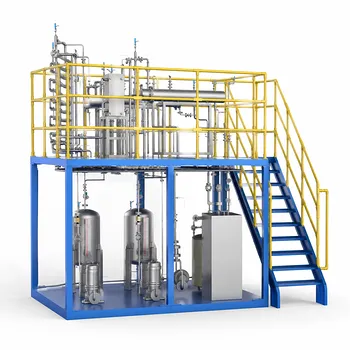
For commodity chemicals, the most valuable pilot plants feature tightly integrated unit operations in series. Think distillation columns coupled with continuous stirred-tank reactors (CSTRs) and inline analytics.

This configuration forces you to automate process control to a high degree. The R&D effort centers on tackling the transient behaviors (startup, shutdown, disturbance rejection) that define the real operability of a mega-scale plant.

The Modular Toolbox for Specialty Synthesis

Specialty R&D demands the opposite: a plug-and-play collection of unit ops. You might use a glass-lined batch reactor one week, then swap it for a high-pressure autoclave the next.

This flexibility is non-negotiable. Because you study many potential synthesis pathways with complex recycle loops, the plant must let you reroute flows easily. Rigid piping and fixed capital are the enemies of product innovation here.

Understanding the Trade-offs

Treating a pilot plant as a Swiss Army knife for both modes carries inherent conflicts. Ignoring these trade-offs leads to compromised data and missed deadlines.

  • Flexibility vs. Optimization Fidelity: A flexible batch unit can simulate a few hours of a continuous process, but it obscures the impact of long-run equipment fouling or catalyst deactivation that matters for bulk chemicals.
  • Speed vs. Repeatability: Rapid batch campaigns for specialty products generate messy, high-variability data sets. This is acceptable for ranking synthesis routes but insufficient for the precise kinetic models required to design a 100,000-ton/year continuous reactor.
  • Instrumentation Density: Bulk pilot plants require an obsessive number of temperature, pressure, and flow sensors to build an energy balance. Specialty pilots prioritize advanced analytical probes (FTIR, Raman) to track molecular evolution in real-time. Rarely does a single setup excel at both without a significant budget.

Tailoring Your Pilot Plant Approach to Your Goal

Your R&D strategy must be defined before you touch a valve. Decide what success looks like, then configure accordingly.

  • If your primary focus is manufacturing cost reduction for a commodity: Direct all pilot resources toward long-duration, continuous runs. Use statistical process control to identify the absolute minimum utilities and labor overhead.
  • If your primary focus is bringing a new functional molecule to market before a competitor: Sacrifice scale-up precision for speed. Run a high-throughput screening design in batch mode, focusing exclusively on product quality attributes and purity.
  • If your primary focus is academic or workforce training: Demand a pilot plant that can be mechanically converted from a continuous reactor-distillation train to a sequence of batch reaction and purification stations. This teaches the strategic shift experientially.

The pilot plant is not just a small factory; it is a physical hypothesis test. Align its operational mode with your strategic endgame, and you transform it from a mere cost center into the ultimate risk-reduction tool.

Summary Table:

Feature Bulk Chemicals R&D Specialty Products R&D
Primary Objective Process-centric (Cost & Scale) Product-centric (Performance & Speed)
System Configuration Continuous, integrated skids Modular, flexible batch setups
Key Metric Yield, utility usage, cost Product purity, molecular specs
Instrumentation High density (sensors, flowmeters) Analytical probes (FTIR, Raman)

Accelerate Your R&D and Training with LABPARK

Whether you need to optimize high-efficiency continuous processes for bulk chemicals or rapidly scale specialty molecules, having the right hardware is critical. LABPARK provides state-of-the-art Educational and Vocational Unit Operations Pilot Plants in chemical engineering, bioprocess & biotech, and environmental & water treatment.

We help universities, research institutes, and enterprises bridge the gap between lab research and industrial scale-up with highly adaptable, safe, and robust pilot systems. Ready to elevate your research, training, and process development capabilities?

👉 Contact LABPARK Today to Find the Right Pilot Plant for Your Needs

Related Products

People Also Ask

Related Products

General Purpose Cosmetics Production Unit Operations Training Pilot Plant

General Purpose Cosmetics Production Unit Operations Training Pilot Plant

Integrated pilot-scale cosmetics production training plant for chemical engineering education featuring utility supply emulsification blending and filtration modules with dual touchscreen manual control customizable mobile design ideal for practical hands-on unit operations and advanced process control learning.

Multi Pump Fluid Transport Process Piping Unit Operations Training Pilot Plant

Multi Pump Fluid Transport Process Piping Unit Operations Training Pilot Plant

Industrial-scale multi-pump pilot plant for unit operations training in fluid transport and process piping, featuring real-material and semi-physical simulation modes, comprehensive pump and flowmeter calibration, and safety-enhanced two-tier platform, bridging academic theory and industrial practice for chemical engineering education.

Multi-Functional Drying Educational Unit Operations Pilot Plant

Multi-Functional Drying Educational Unit Operations Pilot Plant

Versatile multi-functional drying educational unit operations pilot plant integrating tunnel, fluidized bed, and spray drying. Enables hands-on study of drying curves, psychrometry, and gas-solid separation for chemical engineering curriculum in higher education labs.

Fixed-Bed Chemical Reaction and Gas Dust Tar Removal Unit Operations Pilot Plant

Fixed-Bed Chemical Reaction and Gas Dust Tar Removal Unit Operations Pilot Plant

Integrated educational pilot plant for studying catalytic gas-solid reactions and downstream gas purification. Features dual fixed-bed reactor, three-stage heating, and touchscreen control for hands-on engineering training. Ideal for chemical and environmental engineering curricula.

100L Continuous Loop Hydrogenation Educational Unit Operations Pilot Plant

100L Continuous Loop Hydrogenation Educational Unit Operations Pilot Plant

This 100L continuous loop hydrogenation pilot plant is designed for chemical engineering education, featuring 316 stainless steel construction, advanced gas-liquid mass transfer components, explosion-proof safety systems, and a 15.6-inch touchscreen with 5G connectivity, cloud data logging, bridging theory and industry.

Multi-Reactor Educational Pilot Plant for Reaction Engineering Unit Operations

Multi-Reactor Educational Pilot Plant for Reaction Engineering Unit Operations

Integrated bench-scale educational pilot plant for chemical engineering teaching featuring fixed bed fluidized bed and stirred tank reactors with web-based digital twin controls and safety interlocks for hands-on unit operations and reaction engineering comparative studies in one compact system.

Natural Product Extraction Unit Operations Training Pilot Plant

Natural Product Extraction Unit Operations Training Pilot Plant

Integrated natural product extraction pilot plant for chemical engineering training bridges theory and industrial practice with modular extraction and evaporation/concentration units, hybrid touchscreen and manual control, realistic process simulation, and self-contained softened water and vacuum utilities.

Ethyl Acetate Synthesis Unit Operations Pilot Plant for Practical Training

Ethyl Acetate Synthesis Unit Operations Pilot Plant for Practical Training

Modular and customizable pilot plant for ethyl acetate synthesis practical training. Integrates esterification reaction, liquid-liquid extraction, neutralization, and sieve-plate distillation unit operations. Bridging theory and real-world industrial processes. Designed for university chemical engineering labs

Multimodal Absorption and Desorption Pilot Plant for Unit Operations Training

Multimodal Absorption and Desorption Pilot Plant for Unit Operations Training

Multimodal absorption and desorption pilot plant for higher education labs. Bridges theory and industrial practice with transparent packed columns, three operational modes (real-material, simulated, semi-physical), and SCADA control. Students explore mass transfer, column hydraulics, and process control. Customizable.

Dual-Mode Rectification Pilot Plant for Practical Training Unit Operations

Dual-Mode Rectification Pilot Plant for Practical Training Unit Operations

Industrial-scale dual-mode rectification pilot plant for chemical engineering practical training. Features real-material and simulated-material operation modes, sieve-plate column with sight glasses for visual observation of hydrodynamics, and customizable SCADA control for safe, hands-on learning of unit operations and mass transfer.

Three-Tube Heat Transfer Educational Pilot Plant for Unit Operations Training

Three-Tube Heat Transfer Educational Pilot Plant for Unit Operations Training

Three-tube heat transfer pilot plant for studying convective heat transfer enhancement and condensation. Allows comparison of smooth, corrugated, turbulent tubes, verifying empirical correlations. Ideal for chemical engineering education with safety and closed-loop steam recovery.

Methanol Synthesis and Catalyst Performance Evaluation Educational Unit Operations Pilot Plant

Methanol Synthesis and Catalyst Performance Evaluation Educational Unit Operations Pilot Plant

Bench-scale methanol synthesis and catalyst evaluation educational pilot plant for chemical engineering labs to study catalytic kinetics, high-pressure operations, process control, and unit operations under realistic conditions with industrial safety features, precision gas delivery, data acquisition, and intelligent monitoring.

Two-Dimensional Fluidization Hydrodynamics Educational Pilot Plant for Unit Operations Training

Two-Dimensional Fluidization Hydrodynamics Educational Pilot Plant for Unit Operations Training

Explore gas-solid and liquid-solid fluidization hydrodynamics with our transparent 2D educational pilot plant. Ideal for chemical engineering unit operations labs, it demonstrates fixed to fluidized bed regimes, measures pressure drop, and integrates QR-code digital learning for enhanced student training.

Electrolytic Hydrogen Production Educational Unit Operations Pilot Plant

Electrolytic Hydrogen Production Educational Unit Operations Pilot Plant

Bench-scale electrolytic hydrogen production pilot plant designed for university engineering labs. Provides hands-on training in water electrolysis, gas-liquid separation, and process safety. Fully customizable system with digital PID control, corrosion-resistant components, and hydrogen gas detector. Ideal for chemical engineering curricula.

Bio-fermentation Ethanol Production Practical Training Unit Operations Pilot Plant

Bio-fermentation Ethanol Production Practical Training Unit Operations Pilot Plant

Bio-fermentation ethanol production pilot plant for hands-on training in unit operations: fermentation, solid-liquid filtration, membrane separation, and distillation. Bridges theory with industrial practice using industrial-grade components, customizable for university labs. Hybrid automated and manual control for comprehensive learning.

Comprehensive Multi-Modal Heat Transfer Unit Operations Pilot Plant for Engineering Training

Comprehensive Multi-Modal Heat Transfer Unit Operations Pilot Plant for Engineering Training

Comprehensive multi-modal heat transfer unit operations pilot plant for engineering training. Features four heat exchanger types, multi-media switching, and three operating modes. Hands-on experience in safety, optimization, and process control. Industrial-grade design with real-time data acquisition for chemical engineering labs.

Polymerization Granulation and Pellet Processing Educational Unit Operations Pilot Plant

Polymerization Granulation and Pellet Processing Educational Unit Operations Pilot Plant

Integrated pilot plant for teaching polymer processing from polymerization to pelletizing. Includes 30L reactor, hydrolyzer, extruder-granulator, vibration dryer, crusher, and sieve. Atmospheric pressure operation for safety, corrosion-resistant SS, customizable for chemical and polymer engineering education. Ideal for university labs.

Multi-Modal Distillation Unit Operations Training Pilot Plant

Multi-Modal Distillation Unit Operations Training Pilot Plant

Multi-modal distillation pilot plant for practical unit operations training in chemical engineering education. Features real, analog, and semi-physical simulation modes, industrial construction, customizable for university labs. Hands-on fractionation columns, SCADA control, safety systems. Includes sight glasses, sampling ports, closed-loop recycling.

Educational Unit Operations Pilot Plant for Intraparticle Diffusion Effective Factor Measurement

Educational Unit Operations Pilot Plant for Intraparticle Diffusion Effective Factor Measurement

Designed for chemical engineering university labs, this pilot plant allows hands-on determination of catalyst particle intraparticle diffusion effective factors and gas-solid reaction kinetics using a fixed-bed tubular reactor with industrial touchscreen control, bridging theory and practical reactor design.

Comprehensive Fluid Mechanics Educational Unit Operations Pilot Plant

Comprehensive Fluid Mechanics Educational Unit Operations Pilot Plant

Hands-on fluid mechanics pilot plant for engineering education covering over 13 principles including pipe flow, minor losses, flowmeter calibration, and pump performance with industrial-grade components, smooth and rough piping, venturi and orifice flowmeters, and centrifugal pump testing and analysis.


Leave Your Message