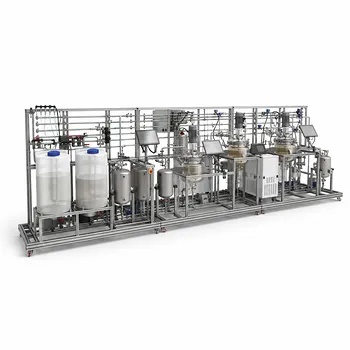
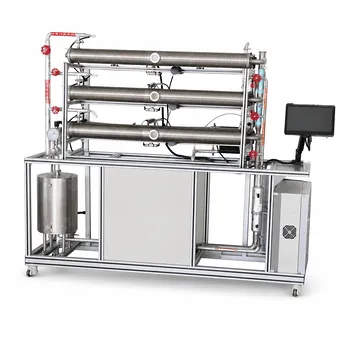
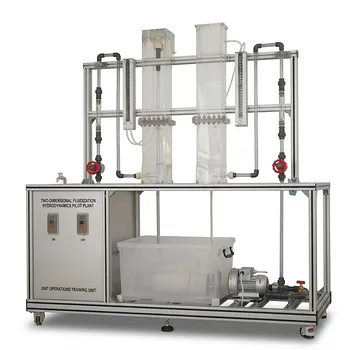
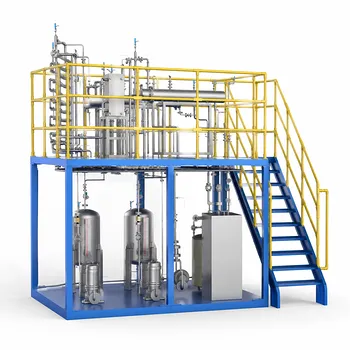
If you’re relying on UNIFAC to estimate vapor-liquid equilibrium (VLE) data, the unit operations pilot plant is not an optional step—it’s your empirical reality check. These group contribution methods give you a fast, cost-effective starting point when experimental data is missing. But a pilot plant physically generates the pressure–temperature–composition (P-T-x-y) data, separation efficiencies, and hydraulic behaviors that confirm whether those predictions hold true in a real flowing system, often revealing model-breaking complexities like unexpected azeotropes or trace impurity effects.
While UNIFAC and similar methods transform molecules into functional groups to predict activity coefficients, they remain generalized approximations. A unit operations pilot plant bridges the gap between these theoretical predictions and a trustworthy process design by delivering the irreducible real-world data needed to calibrate, correct, and confidently scale up.
The Predictable Gap: Why UNIFAC Alone Isn’t Enough
Group contribution methods are built to be universal, but that universality comes with blind spots. The pilot plant exists because the real mixture inside your future column doesn’t care about theoretical functional-group additivity.
The Assumptions of Group Contribution Methods
UNIFAC breaks each molecule into its functional groups and sums their interactions to estimate activity coefficients. It separates activity into a combinatorial part (accounting for size and shape) and a residual part (accounting for energetic interactions). This framework works on the assumption that group interactions are transferable and independent of neighboring groups.
That assumption is the method’s greatest strength—and its fundamental fragility. It means UNIFAC can make predictions for thousands of mixtures without needing mixture-specific parameters. But it also means the model is blind to proximity effects, isomer differences, and strong molecular associations that a properly instrumented pilot plant distillation or gas absorption unit will immediately expose.
Where Predictive Models Fall Short
Pure predictive models rarely capture the full picture. Complex behaviors like temperature-dependent interaction parameters, behavior near critical regions, or the presence of polar compounds (especially water) can cause significant deviations from the estimated VLE.
Even more critically, these calculations assume a clean system. They ignore the process impurities, degradation products, or unexpected side-reactions that inevitably show up in a real pilot plant run. When you physically operate a fractional distillation column on a mixture containing an unnoticed heavy end or a trace surfactant, the measured composition profiles and pressure drops will tell a very different story from the simulator’s output.
The Pilot Plant as a Validation Engine
A unit operations pilot plant doesn’t just confirm a prediction—it generates the authoritative data set that turns a speculative design into an insurable one. It measures what the model cannot foresee.
Generating Critical Experimental Data
The pilot plant’s direct role is to produce high-quality empirical VLE data where it matters most: on your specific process mixture. By operating a real distillation column, extractive distillation setup, or a dynamic VLE still, researchers and engineers capture real-time measurements of temperature, pressure, and phase composition at various operating conditions.
This allows you to build actual x-y or T-x-y diagrams from physical samples. Overlaying the UNIFAC-predicted equilibrium curve with the experimentally obtained points instantly reveals the magnitude of the model’s deviation, identifies the presence of unexpected azeotropes, and quantifies the actual relative volatility you can expect during scale-up.
From Simulation to Physical Reality
Beyond pure thermodynamics, the pilot plant validates the hydraulic and kinetic reality of the separation. The predicted number of theoretical stages means nothing if the actual column operated under those conditions floods or experiences severe weeping.
Running real separations in semi-batch or continuous modes confirms the dynamic behavior of solvent mixtures, validates mass transfer efficiencies, and ensures that equipment-sizing calculations (based on estimated densities and surface tensions) prevent overfilling while maintaining the minimum operating volume. This is the bridge that converts a computational activity coefficient into a reliable, measurable product purity.
Understanding the Trade-offs
Validation through pilot plants is not free, and the relationship between prediction and experiment requires careful interpretation. Ignoring the cost-benefit dynamics or misusing the resulting data can create a false sense of security.
- Resource intensity vs. risk reduction: Running a pilot plant campaign demands significant material, energy, and engineering time. For extremely standard, well-parameterized systems, the extra cost may exceed the value of a minor tweak in stage count. For high-value or safety-critical separations involving novel solvents or heat-sensitive materials, the pilot plant is the cheapest insurance policy you can buy.
- The “validated point” trap: A pilot run validates the model at a specific operating window. Extrapolating that validation far beyond the tested temperature, pressure, or feed composition range reintroduces the very uncertainty you sought to eliminate. The data confirms performance on the conditions you tested, not on every condition you can imagine.
- Over-calibration risk: If you tune a model’s interaction parameters to perfectly match pilot plant data without understanding the underlying physics (e.g., fitting out an impurity effect with a pure-component parameter), you create a fragile model that will break during scale-up when the impurity profile changes. The goal is physical insight, not a perfect curve fit.
Bridging the Scale: From Lab to Full-Scale Production
The ultimate role of the pilot plant in validating UNIFAC predictions is to de-risk the investment of capital and safety that goes into an industrial facility. Process simulators equipped with group contribution methods are invaluable for rapid screening and preliminary sizing. But a full-scale distillation column is not a simulator variable—it’s a multi-million-dollar asset.
The peer-reviewed, empirical data gathered from a pilot unit justifies the design margins, prevents catastrophic under-design (like a column that cannot meet product spec), and eliminates expensive over-design. It provides the physical evidence that your selected solvent for extractive distillation really does break that azeotrope, and that the heat-integrated scheme you’ve drawn on paper will actually handle the hydraulic load without choking. The pilot plant is the final arbiter that transforms a smart theoretical prediction into a bankable process.
How to Apply This to Your Validation Strategy
Choosing when and how to validate UNIFAC predictions with a pilot plant depends on your project’s risk profile and what you stand to lose from an inaccurate simulation.
- If your primary focus is early-stage conceptual design: Use UNIFAC and Modified UNIFAC to rapidly screen hundreds of solvent candidates and operating conditions. Reserve pilot plant time for the single most promising separation scheme that emerges, using it as a gate before committing detailed engineering resources.
- If your primary focus is validating a high-risk or novel separation: Operate the pilot plant to directly measure P-T-x-y data for your exact multi-component mixture. Compare the empirical equilibrium curve with the UNIFAC prediction to quantify the safety margin you need to build into your column design.
- If your primary focus is successful industrial scale-up: Do not treat the pilot plant merely as a VLE data generator. Use it to validate the full hydraulic model—measuring real pressure drops, flooding points, and mass transfer efficiencies—because the most accurate VLE curve is useless if the column cannot operate.
- If your primary focus is academic understanding or teaching: Run controlled pilot-scale experiments to demonstrate why group contribution methods sometimes fail. Having students measure the real temperature profile and compare it to the ASOG or UNIFAC simulation teaches the indispensable lesson that models are representations, not realities.
The smartest approach uses the speed of group contribution methods to ask “what if?” and the fidelity of the unit operations pilot plant to answer “is it true?” When you integrate both, you move from hoping your separation will work to knowing it will.
Summary Table:
| Aspect | UNIFAC (Predictive Models) | Unit Operations Pilot Plants |
|---|---|---|
| Core Basis | Theoretical functional-group additivity | Empirical, real-world physical testing |
| Main Strengths | Fast, low-cost screening of solvent candidates | Captures actual P-T-x-y data, hydraulics & impurities |
| Key Limitations | Blind to proximity effects & trace impurities | Resource-intensive (requires time & materials) |
| Primary Role | Preliminary design & conceptual screening | Final validation, risk reduction & scale-up insurance |
Bridge the Gap Between Simulation and Reality with LABPARK
Are you looking to validate thermodynamic models or train the next generation of engineers with real-world physical data? LABPARK designs and manufactures high-quality Educational and Vocational Unit Operations Pilot Plants tailored for universities, research institutes, and enterprises.
Our advanced pilot systems span key disciplines, including:
- Chemical Engineering (Distillation, VLE validation, gas absorption, and extraction)
- Bioprocess & Biotech
- Environmental & Water Treatment
Contact LABPARK today to discuss how our pilot plants can support your research, validation, and training goals!
Related Products
- General Purpose Cosmetics Production Unit Operations Training Pilot Plant
- Multi Pump Fluid Transport Process Piping Unit Operations Training Pilot Plant
- Multi-Functional Drying Educational Unit Operations Pilot Plant
- Fixed-Bed Chemical Reaction and Gas Dust Tar Removal Unit Operations Pilot Plant
- 100L Continuous Loop Hydrogenation Educational Unit Operations Pilot Plant
People Also Ask
- How do deviations in estimating latent heat impact pilot plant thermal systems? Avoid hardware mis-sizing.
- Why is the chemical plant startup schedule crucial? De-risk scale-up with pilot plants.
- When to transition from PID to adaptive control in pilot plants? Key process indicators.
- Why Compare Predicted and Experimental Excess Enthalpy? Key to Accurate Pilot Plant Scale-up
- How to study gasification in pilot plants? Compare exit gas composition & efficiency