Calibrating a process analyzer directly on a production line is a recipe for frustration and failure. It is universally recommended to perform the initial calibration in a laboratory reactor or pilot plant because a live production process simply cannot provide the wide, controlled variation in sample composition needed to build a robust multivariate model. Lab-scale and pilot-scale systems allow you to safely manipulate process variables—temperature, mixing, concentration ranges—to generate that essential data. Only after the calibration model is developed and validated in this controlled setting can it be confidently transferred to the unforgiving, static conditions of a production environment.
The core insight is that a robust, trustable calibration hinges on spectral variation that spans the entire expected composition range. Production environments are designed for consistency, not exploration. A pilot plant becomes your dedicated learning laboratory, letting you de-risk the method, train personnel on multivariate complexities, and generate the diverse dataset that makes on-line PAT feasible.
The Fundamental Calibration Challenge: Why Production Falls Short
On-line calibrations in production are inherently limited. They fail to deliver the controlled, systematic variation that multivariate models demand.
The “Variation Gap” in Real Production
Production processes operate within tight specifications. You will almost always encounter the same narrow range of product composition, with only minor, unintentional drift.
This means you cannot deliberately introduce the compositional extremes—high moisture, low active ingredient, varying particle sizes—that teach the model to distinguish signal from noise. Waiting for such variation to occur naturally can take months or years, stalling your entire PAT project.
Why Univariate Thinking Fails Multivariate Tools
Traditional engineers are trained on univariate sensors (a single pH or temperature value). A near-infrared (NIR) or Raman spectrum, however, is a vector of hundreds of correlated variables.
A robust chemometric model must be trained to see the analyte of interest and ignore changes in other matrix components, temperature, or particle size. This requires a dataset where those interfering factors are intentionally varied. You cannot design such an experiment inside a production environment without risking off-spec product and significant financial loss.
Why Pilot Plants Are the Ideal Training Ground
Pilot-scale and laboratory reactor setups solve the variation problem while serving as a realistic, hands-on classroom. They bridge the gap between theoretical spectral interpretation and real process dynamics.
Generating the “Design Space” Safely
In a pilot plant, you can systematically execute a Design of Experiments (DoE) that pushes process parameters to their edges. You can spike moisture, adjust mixing speeds, or use different raw material lots without any commercial risk.
This allows students to see how spectra react to each change and build a calibration model that defines a true processing window. They learn that a valid model is not one that fits a narrow set of data, but one that remains accurate under all foreseeable process conditions.
Confronting Real Process Dynamics
Rotating a sample in a beaker is not the same as monitoring a flowing stream with bubbles, fouling, and temperature gradients. Pilot plants introduce realistic fluid dynamics, heat transfer, and particle segregation.
Training here teaches researchers to evaluate sensor placement, sampling interface fouling, and physical interferences that no benchtop simulation can replicate. This hands-on exposure is what prevents expensive failures when the technology moves to full scale.
Embedding the Full PAT Workflow
Effective training is not just about pressing “calibrate” in software. It encompasses hardware qualification, method verification (speed, accuracy, precision), and ongoing model maintenance.
A pilot plant allows trainees to cycle through this entire loop: from installing the probe, to building the model, to validating it against a reference method, and finally implementing a feedback control strategy. They directly experience how real-time Critical Quality Attribute (CQA) monitoring transforms a reactive lab test into proactive process control.
The Hidden Costs of Skipping the Pilot Phase
Choosing to calibrate only on the final production line is not a shortcut; it is a common root cause of project failure. The consequences extend beyond a poorly performing model.
The Steep Learning Curve Traps
When a novice is thrown directly into a production environment, the pressure to deliver a working analyzer quickly overrides the need to learn foundational principles.
They may produce a model that appears to work on historical data but fails immediately when a new raw material lot appears. Without the pilot plant experience of diagnosing why the model failed, the team lacks the diagnostic skill to fix it, leading to disillusionment and abandoned technology.
Compromised Proof of Concept
A feasibility study conducted on a pilot plant provides ironclad proof that the analyzer can measure the CQA under realistic unit operation conditions. Direct on-line trials skip this evidence, forcing you to make high-stakes procurement and engineering decisions based on hope.
The data generated in a pilot plant is what justifies the capital investment, proves the sensor’s robustness to the production team, and forms the basis of a defensible, regulatory-ready calibration strategy.
Understanding the Trade-offs
While the pilot plant approach is the gold standard for initial training and calibration development, it is not without its own challenges. Being aware of them is critical for success.
The Model Transfer Challenge
The calibration model built on a pilot-scale dryer will not be plug-and-play identical on a production-scale dryer. Differences in optical path length, vibrational stress, or stray light can introduce biases.
However, this challenge is a core learning objective. It teaches personnel the skills of bias correction, slope adjustment, and spectral standardization—competencies essential for any long-term PAT program. A model developed in production from scratch completely bypasses this valuable learning step and hides the fundamental calibration weaknesses.
The Risk of a “Toy Problem” Mindset
A poorly designed pilot-plant experiment that only uses pristine, lab-grade materials can yield an over-optimistic calibration that fails in a factory with real raw material variability.
The training must, therefore, include representative industrial-grade raw materials and intentional challenge experiments (e.g., fouling, pressure fluctuations). The goal is to build resilience into the model, not just a perfect academic prediction. This pitfall reinforces why the pilot plant is the ideal place to fail and learn, not the production floor.
Making the Right Choice for Your Training Goal
The decision to use a pilot plant or lab reactor is not about convenience; it's about aligning your educational strategy with the true demands of process analytical chemistry.
- If your primary focus is building foundational competency in chemometrics: Use a laboratory reactor to teach DoE principles and spectral interpretation in a distraction-free environment, then escalate to a pilot plant to add real-world complexity.
- If your primary focus is de-risking a specific PAT deployment: Invest the upfront time in a dedicated pilot-plant calibration that uses actual production-grade materials. This generates the essential proof of concept and the scalable model you need before touching the production line.
- If your primary focus is training operators and engineers to maintain the system long-term: The pilot plant is essential. It is the only place you can safely simulate sensor failures, drift events, and maintenance routines without the pressure of production deadlines.
The rule is simple: calibrate where you can control variation, learn where you can afford to fail, and only then deploy where you must succeed.
Summary Table:
| Feature | Lab/Pilot Plant Calibration | Production Line Calibration |
|---|---|---|
| Composition Variation | Wide & controlled (via DoE) | Narrow & restricted |
| Process Risk | Zero financial or product loss | High risk of off-spec batches |
| Personnel Training | Safe environment to fail & learn | High-pressure, low tolerance |
| Model Robustness | High (captures variables/interferences) | Low (prone to failure on drift) |
Elevate Your PAT Training and Research with LABPARK
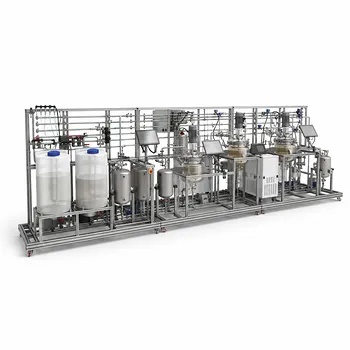
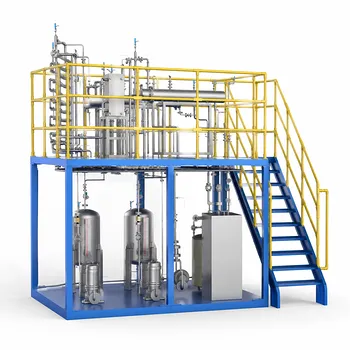
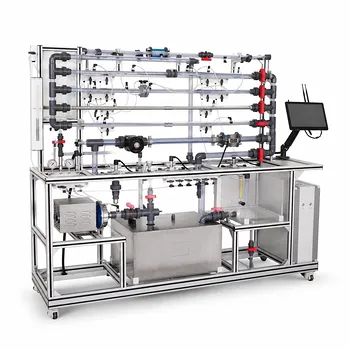
Building robust calibration models requires hands-on experience in a controlled environment. LABPARK provides state-of-the-art Educational and Vocational Unit Operations Pilot Plants in chemical engineering, bioprocess & biotech, and environmental & water treatment. Designed specifically for universities, research institutes, and enterprises, our pilot plants allow you to safely run Design of Experiments (DoE), simulate process dynamics, and train next-generation engineers without production risks.
Ready to bridge the gap between lab theory and industrial scale? Contact LABPARK today to find the perfect pilot plant solution for your facility!
Related Products
- General Purpose Cosmetics Production Unit Operations Training Pilot Plant
- Multi Pump Fluid Transport Process Piping Unit Operations Training Pilot Plant
- Multi-Functional Drying Educational Unit Operations Pilot Plant
- Fixed-Bed Chemical Reaction and Gas Dust Tar Removal Unit Operations Pilot Plant
- 100L Continuous Loop Hydrogenation Educational Unit Operations Pilot Plant
People Also Ask
- How do deviations in estimating latent heat impact pilot plant thermal systems? Avoid hardware mis-sizing.
- Why is the chemical plant startup schedule crucial? De-risk scale-up with pilot plants.
- When to transition from PID to adaptive control in pilot plants? Key process indicators.
- Why Compare Predicted and Experimental Excess Enthalpy? Key to Accurate Pilot Plant Scale-up
- Why Use PTFE & Hastelloy in Chemical Pilot Plants? Prevent Corrosion & Ensure Safety