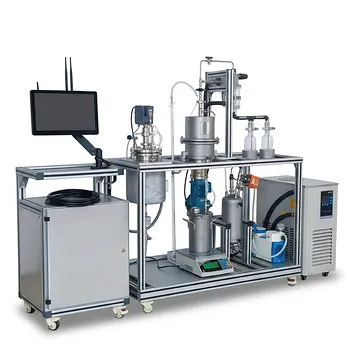
Here’s the cold, hard truth: The primary challenge isn't complex math; it's a fundamental data vacuum. For highly nonideal systems, reliable experimental data is scarce and agonizingly slow to collect using traditional methods. Educational pilot plants directly solve this by providing an instrumented, hands-on platform to rapidly generate your own high-quality empirical data, allowing you to measure the real-world phase behavior that theoretical models fail to predict.
The real bottleneck in designing for nonideal mixtures like azeotropes is bridging the gap between elegant but often failing thermodynamic models and physical reality. Educational pilot plants teach the crucial skill of generating and critically validating experimental vapor-liquid equilibrium (VLE) data, transforming a theoretical guessing game into a practical engineering solution.
The Data Vacuum at the Heart of Nonideal Systems
Before you can design a column, you must know how the chemicals behave together. For highly nonideal systems, this is the core struggle.
The Scarcity of Multicomponent Data
Standard hydrocarbon VLE data is well-documented, but reality is rarely so simple. Data for ternary, quaternary, and multicomponent mixtures is critically scarce.
Throw in a highly polar solvent like a glycol, and the problem amplifies. For complex mixtures, standard predictive equations can fail to estimate equilibrium states within an order of magnitude. If you're working with hydrocarbons above C10, reliable data is virtually nonexistent.
The Crippling Slowness of Traditional Methods
Gathering this missing data isn't just hard; it's slow. Classical experimental methods to map a full phase equilibrium diagram are incredibly time-consuming.
Project schedules in the real world don't tolerate this. You need a way to break this bottleneck. You need a way to move at the speed of your project, not the speed of a decades-old experimental apparatus.
The Inadequacy of Thermodynamic Models
When data is missing, you turn to models. But for nonideal systems, this is a minefield of estimations and assumptions.
Why Raoult's Law Breaks Down
Ideal behavior, as described by Raoult's Law, is the exception, not the rule. Most real-world systems, like ethanol-water, are governed by molecular interactions that create deviations.
To model this, you inject an activity coefficient ($\gamma$) into the equilibrium equation ($p_i = p_i^0 x_i \gamma_i$). But where does that $\gamma$ come from? You often must fall back on estimation methods like UNIFAC, which lack a firm theoretical basis for complex, non-hydrocarbon mixtures. You are building a design on a foundation of estimates.
The Hallmarks of an Azeotrope
These activity coefficients are what lead to azeotropes. An azeotrope forms when the relative volatility of the components equals 1, pinning the vapor and liquid compositions together.
Positive deviations from Raoult's Law create minimum-boiling azeotropes, like ethanol and water. Ethanol boils at 351.7 K, water at 373 K, yet their azeotrope boils at 351.1 K—lower than either pure component. Negative deviations create maximum-boiling azeotropes, like hydrogen chloride and water. HCl boils at 188 K, water at 373 K, but their azeotrope boils at a stubbornly high 381.6 K.
In both cases, simple distillation hits a wall. To get past it with methods like extractive distillation, you must accurately predict this azeotropic point to choose a feasible entrainer and set operating conditions. A model based on a shaky UNIFAC estimation is a poor guide.
How Pilot Plants Bridge the Gap Between Theory and Reality
This is where the educational pilot plant becomes an indispensable tool. It transforms you from a model-user into a data-creator.
A Platform for Rapid Empirical Discovery
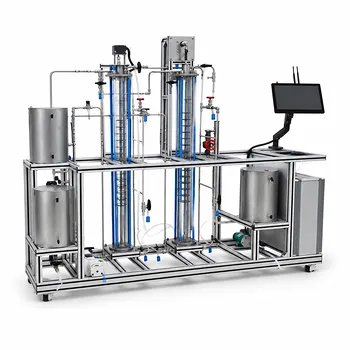
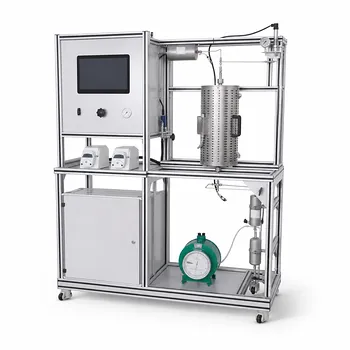
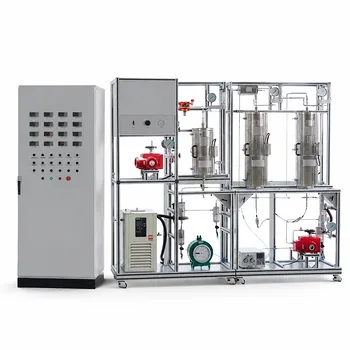
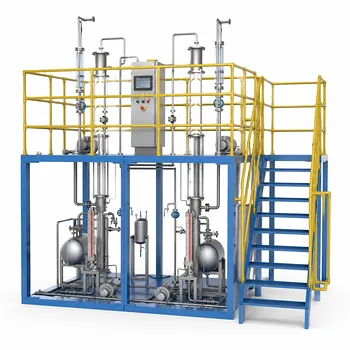
A pilot plant is a compact, safe, and highly instrumented version of an industrial process. Its core purpose is to let you quickly measure real physical parameters.
Instead of trusting a model, you run the experiment. You measure the actual temperature profile along the column, the precise pressures, and most importantly, the phase compositions. This is how you generate the high-quality empirical data needed to validate or discard a model under a tight deadline.
The Power of Strategic Sampling Ports
The key feature of these educational columns is the multiple liquid and vapor sampling ports along their height. This isn't just a design detail; it’s the analytical engine.
By running the column at steady-state and sampling from these ports, you can:
- Calculate experimental activity coefficients ($\gamma$).
- Map the real non-ideal VLE behavior.
- Directly observe the azeotropic "pinch point" where no separation occurs.
You can then plot this experimental data against your ideal model and see the deviation with your own eyes. This turns an abstract thermodynamic concept into a tangible, measured reality.
Confronting Model Failure Directly
This process teaches the most critical lesson: when and how models fail. The literature is clear—standard equations of state are often useless for highly polar mixtures.
By generating physical data, you witness this failure firsthand and learn the practical solution: applying sophisticated local composition models like NRTL or UNIQUAC to solve the vapor-liquid-liquid equilibrium (VLLE). You also learn to use phase diagrams and x-y plots not just as textbook images, but as dynamic tools to calculate theoretical stages, optimum feed locations, and real-world column efficiency.
The Special Case of Polymer Systems
The data problem is even more extreme in polymer systems, where high viscosity and glassy states are inherent. Standard methods to accelerate equilibrium, like aggressive high-shear agitation, are destructive—they can literally shear and break the chemical bonds of the polymer backbone.
This forces a different kind of thinking. A pilot plant configured for polymers teaches you to select specialized, low-shear technologies like progressive cavity pumps and to achieve homogeneity through precise temperature and residence time control, not brute force mixing.
Understanding the Trade-offs
An educational pilot plant is a tool, not a magic wand. Its primary value is pedagogical and exploratory.
It doesn't replace a full-scale industrial data campaign. The data you generate is for learning the process of validation and model comparison. It operates at a small scale, which can introduce its own hydrodynamic and thermodynamic peculiarities. Furthermore, safely operating even a small column with explosive or toxic mixtures like ethanol-water or HCl demands rigorous safety protocols. The trade-off is profound understanding in exchange for a significant investment of time and a limited scope of physical output.
Making the Right Choice for Your Goal
How you leverage a pilot plant depends on what you need to learn:
- If your primary focus is validating a thermodynamic model for a novel separation: Use the pilot plant to generate experimental VLE data (T-x-y) at full reflux and compare it directly against UNIFAC, NRTL, or UNIQUAC predictions. Your goal is to quantify the model's error.
- If your primary focus is understanding the root cause of an azeotrope: Run the azeotropic mixture and sample the liquid and vapor at the column's pinch point. Compare the measured compositions and activity coefficients to Raoult's Law to tangibly see the molecular interactions that cause the deviation.
- If your primary focus is screening an entrainer for extractive distillation: Use the pilot plant to test candidate solvents. You can quickly measure if the entrainer breaks the azeotrope by altering the relative volatility, a far more reliable method than pure simulation.
- If your primary focus is designing for a scale-up from scratch: Use the pilot plant as a data-generation engine. Intentionally run mixtures where data is known to be scarce (like with highly polar or high-boiling components) to create your own foundational VLE dataset for design calculations.
Stop relying on model outputs you can't trust. The data is out there for you to generate, and that hands-on empirical process is the only path from an elegant but useless theory to a working, profitable design.
Summary Table:
| Challenge in Nonideal Systems | Limitation of Theoretical Models | Pilot Plant Solution |
|---|---|---|
| Data Scarcity | Standard VLE data for multicomponent mixtures is rare; UNIFAC estimations can fail by orders of magnitude. | Generates high-quality empirical data directly on-site. |
| Slow Traditional Methods | Classical experimental mapping of phase diagrams is too slow for tight project timelines. | Provides a compact, instrumented platform for rapid data generation. |
| Azeotropic Pinch Points | Relative volatility changes make predicting maximum/minimum boiling points highly unreliable. | Uses strategic sampling ports along the column to map actual VLE/VLLE behavior. |
| Sensitive Polymer Systems | Standard high-shear mixing breaks molecular bonds in high-viscosity polymer backbones. | Utilizes low-shear pumps and precise temperature control for gentle, realistic testing. |
Bring Chemical Engineering Theory to Life in Your Lab
Bridging the gap between complex thermodynamic models and physical reality requires robust, hands-on tools. LABPARK provides state-of-the-art Educational and Vocational Unit Operations Pilot Plants in chemical engineering, bioprocess & biotech, and environmental & water treatment.
Specially designed for universities, research institutes, and enterprises, our systems empower students and researchers to safely generate precise empirical data, validate advanced separation models, and master real-world process dynamics.
Ready to elevate your department's research and training capabilities? Contact LABPARK today to find the perfect pilot plant solution for your institution!
Related Products
- Multi-Functional Special Distillation Educational Pilot Plant
- Continuous Batch Extractive Distillation Educational Pilot Plant
- Ethyl Acetate Synthesis Unit Operations Pilot Plant for Practical Training
- Continuous Sieve-Plate Distillation Pilot Plant for Unit Operations Laboratory Education
- Green Anhydrous Ethanol Purification Extractive Distillation Unit Operations Training Pilot Plant
People Also Ask
- Why does simple distillation yield higher efficiency than flash distillation? Key thermodynamic differences.
- Why is the acentric factor important in pilot plants? Fluid property prediction.
- How Batch vs Continuous Configuration Affects Distillation Pilot Plant Versatility & Footprint
- How does double temperature difference control improve distillation pilot plants? Stabilize purity.
- How to Estimate Distillation Pilot Plant Tray Efficiency? O'Connell's Correlation Guide