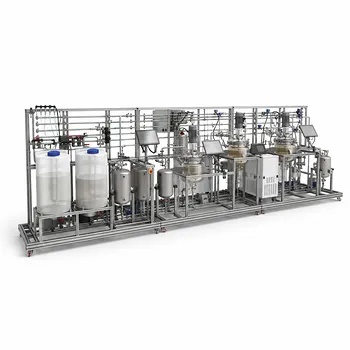
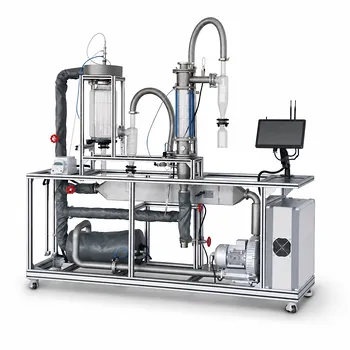
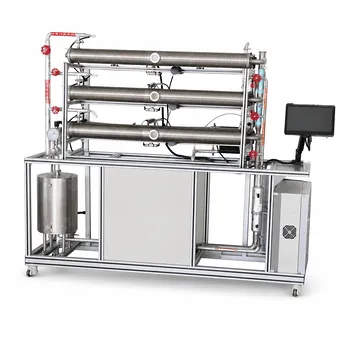
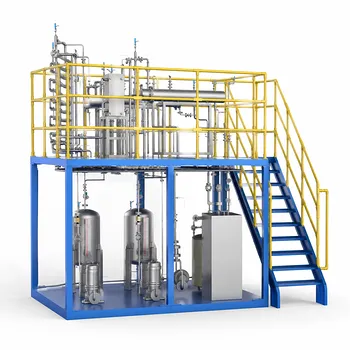
Let’s be direct: the differences between wet and dry granulation do not just suggest different machines—they mandate entirely contrasting equipment trains, driven by the API’s sensitivity to moisture and the desired process dynamics. In a pharmaceutical engineering pilot plant, dry granulation requires high-pressure compaction units like roller compactors or slugging presses, followed by an integrated milling step. Wet granulation, however, demands a sequence of mixers (low-shear, high-shear, or fluid bed) for liquid binder addition, a drying phase, and subsequent milling. For education, a well-designed pilot plant houses both lines side by side so students can trace how one decision—can the API tolerate water?—cascades into a completely different physical footprint, process complexity, and set of unit operations.
The choice of pilot plant machinery for teaching granulation hinges on mirroring an industrial reality: dry granulation is a short, pressure-driven path for moisture-sensitive compounds, while wet granulation is a longer, heat-and-mass-transfer-driven path for robust APIs. A pedagogical pilot plant must physically present both routes to make the underlying material science and process engineering tangible, not just a theoretical lecture slide.
Why the Process Difference Drives Pilot Plant Design
The Fundamental Divide: Agglomeration by Pressure vs. Agglomeration by Liquid
In dry granulation, particles are forced into larger entities solely through mechanical pressure. Pilot equipment like roller compactors uses two counter-rotating rollers to press powder into a dense ribbon, which a mill then breaks into granules. No liquid is introduced, so there is no subsequent drying. This makes the machinery choice centered on compaction and size reduction.
Wet granulation works via three phases: nucleation (liquid droplets form initial nuclei), consolidation and growth (mechanical agitation builds granule size and density), and attrition (breaking of weak granules). The machinery must move powders through a liquid-addition state into a wet mass, then dry it. That immediately adds a granulator (like a high-shear bowl with impeller and chopper) and a dryer (fluid bed or tray) to the equipment list, making the pilot plant visually more complex.
Matching the Machine to the Material’s Weakness
The primary reference is unambiguous: the selection is determined by the API’s physical and chemical properties. If the drug substance degrades in the presence of moisture or heat, wet granulation is off the table. You do not add a fluid bed dryer; you bring in a roller compactor. If the API is not sensitive but has poor flow or compressibility, wet granulation’s ability to create robust, porous agglomerates after drying becomes the better path, and thus the pilot plant must showcase a high-shear granulator and drying unit.
A teaching pilot plant that only offers one method fails to train engineers for the real world, where they must analyze degradation profiles. Studies sited in the supplementary references confirm that wet granulation can significantly accelerate degradation compared to dry blends due to moisture and thermal stress. By processing identical formulations through both routes in the pilot plant and running subsequent stability studies, students learn that the choice of granulation method is fundamentally a stability decision, not a convenience.
Teaching the Contrast Through Pilot-Scale Workflows
Process Complexity and Equipment Footprint Become Visible
In an educational setting, the machinery conveys the workflow. A dry granulation line is compact: a blender feeds a roller compactor, which discharges into a mill, which feeds a tablet press. The footprint is small, and the transition from powder to tablet is rapid. Wet granulation, conversely, requires a high-shear mixer for wet massing, a wet mill or sieve for sizing, a fluid bed dryer, and a dry mill. This physical arrangement lets students instantly grasp why wet granulation is more time-consuming and capital-intensive, even before they run a single batch.
The supplementary references note that wet granulation can be run as a “single pot” process, where mixing, granulating, and drying happen in one vessel. This multistage capability itself is a teaching point: the pilot plant can demonstrate both a segmented train and an integrated processor, showing how equipment selection changes when you prioritize containment or reduce material handling.
Bridging Powder Technology and Industrial Reality with Operable Machines
Dry granulation’s roller compactor turns theory into tactile learning when students adjust roller pressure, gap size, and feed screw speed and immediately measure granule density and flow changes. This hands-on experience with continuous parameters demonstrates the shift from batch (slugging press) to continuous manufacturing—a critical modern trend. Wet granulation units let them manipulate impeller speed and liquid addition rate to observe granule growth curves in real time, then follow the moisture removal in the dryer.
For temperature-sensitive materials, the supplementary references show that a wet milling setup integrated with crystallizers can be a better pilot plant choice, as the liquid medium’s heat capacity buffers temperature spikes, preventing amorphous transitions. This teaches a key nuance: wet granulation is not a monolith; the choice of cooling and drying strategy within the wet line is itself a design variable.
Understanding the Trade-offs and Where Pilot Equipment Falls Short
The Hidden Cost of Moisture—and the Limitations of Pressure
Wet granulation creates an environment where an API can suffer hydrolysis, hydrate formation, or even recrystallization if the drug is amorphous. The pilot plant must therefore include not just the processing gear but the analytical support to detect these changes—dissolution testers, DSC, and stability chambers are the silent partners that make the machinery choice meaningful.
Dry granulation, while protecting moisture-sensitive APIs, can create its own stability problems. The intense pressures can induce mechanical activation, creating amorphous regions or solid-state transformations that accelerate degradation. A roller compactor ribbon may look fine, but its internal stress can cause cracking later. A teaching pilot plant should allow for ribbon property testing (solid fraction, tensile strength) to show that pressure-based agglomeration is not automatically gentle.
The Complexity Burden of the Wet Line
From an educational perspective, a wet granulation line introduces more variables to teach but also more chances for process failure. Over-wetting leads to sludge; under-drying ruins flow. A dry granulation line is more forgiving in terms of endpoint control, but it forces students to understand the relationship between powder pre-conditioning, deaeration, and ribbon quality—a different complexity. The pilot plant’s design should not hide these challenges; it should feature transparent viewing ports and data acquisition to make these minute-to-minute decisions observable.
A final trade-off: a comprehensive pilot plant replicating both routes requires a significantly larger budget and footprint. Educational institutions must weigh the value of demonstrating both mechanisms against the reality of space constraints. The primary reference wisely notes that an ideal pilot plant should offer both units to demonstrate contrasting aggregation mechanisms. Without both, the curriculum has a blind spot.
Designing the Educational Pilot Plant for Maximum Insight
After a brief opening analysis, use these goal-oriented recommendations to guide your pilot plant equipment selection:
- If your primary focus is teaching material-sensitive API formulation: Prioritize a side-by-side layout with a roller compactor and a high-shear wet granulator/dryer train, ensuring students can process the same blend both ways and run stability comparisons to quantify the impact of moisture and heat.
- If your primary focus is illustrating continuous vs. batch manufacturing: Include a roller compactor for continuous dry granulation and an integrated single-pot processor for wet granulation, contrasting the streamlined, short-residence-time approach with a contained but multi-phase batch process.
- If your primary focus is underlying powder mechanics: Augment the dry line with a slugging press in addition to the roller compactor to show how the same theoretical compaction principles produce different granule properties, and equip the wet line with a fluid bed granulator to demonstrate simultaneous spray, agglomeration, and drying.
Equip your pilot plant with the ability to physically manifest the decision-tree—moisture-sensitive vs. robust, batch vs. continuous—and you transform a collection of stainless steel into a true teacher of pharmaceutical engineering.
Summary Table:
| Feature | Wet Granulation Line | Dry Granulation Line |
|---|---|---|
| API Suitability | Moisture and heat-robust APIs | Moisture and heat-sensitive APIs |
| Key Equipment | High-shear mixer, fluid bed dryer, dry mill | Roller compactor (or slugging press), sizing mill |
| Process Footprint | Large, multi-stage batch footprint | Compact, continuous process footprint |
| Critical Parameters | Impeller speed, binder liquid addition, drying temp | Roller pressure, gap size, feed screw speed |
Equip Your Lab for the Future of Pharma Engineering
At LABPARK, we provide state-of-the-art Educational and Vocational Unit Operations Pilot Plants in chemical engineering, bioprocess & biotech, and environmental & water treatment. Designed specifically for universities, research institutes, and enterprises, our systems bridge the gap between classroom theory and industrial reality.
Our customizable granulation pilot lines allow students to experience hands-on parameter control (from high-shear mixing to roller compaction), preparing them for real-world pharmaceutical manufacturing challenges.
Ready to upgrade your educational laboratory? Contact us today to find the perfect pilot plant solution for your institution!
Related Products
- General Purpose Cosmetics Production Unit Operations Training Pilot Plant
- Multi Pump Fluid Transport Process Piping Unit Operations Training Pilot Plant
- Multi-Functional Drying Educational Unit Operations Pilot Plant
- Fixed-Bed Chemical Reaction and Gas Dust Tar Removal Unit Operations Pilot Plant
- 100L Continuous Loop Hydrogenation Educational Unit Operations Pilot Plant
People Also Ask
- How do deviations in estimating latent heat impact pilot plant thermal systems? Avoid hardware mis-sizing.
- Why is the chemical plant startup schedule crucial? De-risk scale-up with pilot plants.
- When to transition from PID to adaptive control in pilot plants? Key process indicators.
- Why Compare Predicted and Experimental Excess Enthalpy? Key to Accurate Pilot Plant Scale-up
- Why Use PTFE & Hastelloy in Chemical Pilot Plants? Prevent Corrosion & Ensure Safety