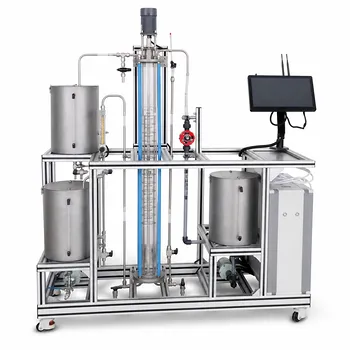
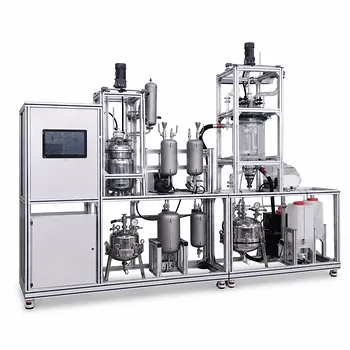
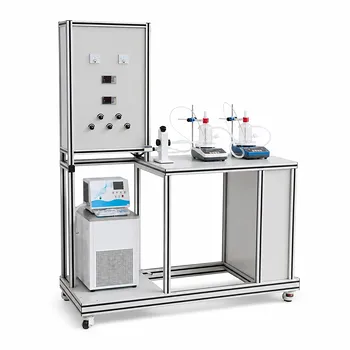
The right educational pilot plant depends on the principle you want to demonstrate. If your primary goal is to teach discrete, stage‑by‑stage extraction calculations and provide a robust, easily observable process, a mixer‑settler system is the ideal choice. If you need to illustrate continuous differential contact, compact vertical design, and the complexities of axial dispersion, a tower‑type extraction column is the better fit.
The mixer‑settler versus column decision is not about which is universally superior; it is about aligning equipment behaviour with specific pedagogical goals. A mixer‑settler makes the ideal stage concept tangible and the calculations straightforward. A tower reveals the realities of continuous mass transfer, backmixing, and fluid‑dynamic compromise — lessons that are essential for advanced chemical engineers.
The Pedagogical Heart of the Decision
Every piece of pilot‑plant equipment tells a story. The story you want your students to learn should dictate your choice.
Stage‑Wise vs. Continuous Contact
Mixer‑settlers operate as ideal equilibrium stages. Each compartment represents a discrete theoretical stage where two phases mix, reach near‑equilibrium (typically over 80% stage efficiency), and then separate completely. This matches the classic McCabe‑Thiele construction perfectly, making it the most intuitive way to teach multi‑stage counter‑current extraction calculations, rare‑earth separation, and process control around individual stages.
Tower‑type columns demonstrate continuous differential contact. Concentration changes gradually over the column height, not in jumps. This forces students to engage with mass transfer coefficients, axial dispersion, and height‑equivalent‑to‑a‑theoretical‑plate (HETP) concepts. The visual of a counter‑current flow without discrete boundaries gives immediate insight into the realities of industrial fluid dynamics.
Linking Theory to Physical Observation
In a mixer‑settler, students can see phase separation happening in real time. They can sample between stages and watch the effect of a failed impeller or a wrong flow ratio. That hands‑on stability and large liquid inventory build confidence with fundamental concepts.
A column offers a more elusive learning experience. Flooding, weeping, and emulsification are dynamic, visible phenomena that connect textbook hydraulic diagrams to real columns. A pulsed or rotating‑disc column heightens this by letting students explore how external energy input changes droplet size, holdup, and separation performance.
Practical Constraints: Footprint, Operation, and Solvent Hold‑Up
Teaching laboratories rarely have unlimited space or budgets. These physical factors often override pure pedagogical preference.
Footprint and Facility Ceilings
Mixer‑settlers expand horizontally. Each additional stage requires another mixer‑settler unit and more floor area. If your laboratory has limited floor space, a multi‑stage counter‑current setup can quickly become unwieldy.
Tower columns exploit vertical headroom. Even a column with many theoretical stages occupies a small footprint — ideal when floor area is scarce but ceiling height is generous. This makes towers the pragmatic choice in cramped pilot‑plant halls.
Energy Consumption and Solvent Inventory
Mixer‑settlers are energy‑intensive. Every stage needs its own agitator, and inter‑stage transfer often requires pumps. Additionally, the large volume of liquid held up in settlers means higher solvent costs and larger chemical inventories for any given experimental run.
Gravity‑driven packed or sieve‑plate columns require minimal external power. Their solvent holdup is also far smaller, which reduces both cost and safety risks when demonstrating extractions with volatile or expensive solvents. Mechanically agitated columns fall between these extremes, offering compactness at a moderate energy cost.
How Fluid Properties Steer the Selection
The physical nature of the liquid–liquid system itself can make one equipment type clearly more suitable, and that lesson is itself a valuable educational outcome.
Density Difference and Interfacial Tension
Systems with a large density difference and low interfacial tension separate readily. A simple gravity column — packed or sieve‑plate — will work reliably, giving students a clear view of counter‑current flow with minimal mechanical complexity.
Systems with a small density difference or high interfacial tension need extra energy input to create fine dispersions. Here, a mixer‑settler or an agitated tower like a rotating‑disc contactor becomes essential. Using a mixer‑settler in this scenario teaches students how impeller speed and residence time compensate for poor natural settling.
Handling Solids and Emulsion‑Prone Feeds
Mixer‑settlers tolerate suspended solids far better than columns. Packed beds and sieve trays are prone to clogging, so if your teaching stream involves realistic crude feedstocks — for example, bio‑oil or leach solutions — the mixer‑settler is the safer, lower‑maintenance choice.
Stable emulsions are a challenge for simple gravity settlers. While neither basic mixer‑settlers nor gravity columns handle severe emulsification perfectly, a mixer‑settler’s active mixing can sometimes be tuned to avoid the worst operating zones, making it a slightly more forgiving teaching platform for tricky systems than a static column.
Understanding the Trade‑offs
No single piece of equipment wins on all fronts. Being transparent about limitations builds a deeper understanding.
Backmixing: The Hidden Efficiency Killer
Continuous columns suffer from axial backmixing. The counter‑current flow inevitably entrains small amounts of the opposite phase in the wrong direction, which reduces the separation efficiency below that of an equivalent number of ideal stages. Teaching this requires students to measure actual concentration profiles and calculate how backmixing erodes performance — a powerful lesson not available with ideal‑stage mixer‑settlers.
Mixer‑settlers effectively suppress backmixing. The physical separation between stages guarantees near‑perfect isolation. This yields high stage efficiency but at the cost of large inter‑stage piping and a bigger overall footprint.
Multi‑Stage Configurations and Scale‑Up
When many theoretical stages are required, mixer‑settlers become unwieldy. Each stage is a separate vessel with its own agitator, pump, and level control, causing capital and maintenance costs to multiply. In contrast, a single tall tower can deliver the same number of stages with much less hardware.
For low‑stage‑count demonstrations, a simple packed column is elegant and low‑cost. If your curriculum only needs to illustrate 2‑4 stages, a spray or packed column is often the most straightforward pilot plant to build and operate. Teaching advanced multi‑stage theory, on the other hand, is more naturally done by stacking several mixer‑settlers in series or by using a mechanically agitated column.
Complexity and Maintenance Burden
Mixer‑settlers demand more ongoing attention. Seals, agitator bearings, and inter‑stage transfer pumps all create potential points of failure. This can either be a nuisance or a valuable lesson in plant maintenance and reliability engineering.
Gravity columns are mechanically simple. Their internals — packing or perforated plates — have no moving parts, making them easier to maintain and allowing students to focus entirely on the mass transfer phenomena. Mechanically agitated columns add complexity, but still less than an equivalent multi‑stage mixer‑settler battery.
Making the Right Choice for Your Course
Align your pilot‑plant selection with the core learning objectives of your unit‑operations laboratory.
- If your primary focus is teaching fundamental stagewise equilibrium calculations and process control: Choose a mixer‑settler system. Its clean, stage‑by‑stage behaviour maps directly to McCabe‑Thiele analysis and gives students a hands‑on feel for inter‑stage stability.
- If your primary focus is demonstrating continuous mass transfer, axial dispersion, and fluid dynamics: Select a tower‑type column, preferably an agitated design like a pulsed or rotating‑disc column. This exposes students to the non‑ideal behaviour that dominates industrial designs.
- If your laboratory has limited floor space but generous ceiling height: A vertical extraction column is the pragmatic answer. It provides many theoretical stages in a compact footprint, and its visual concentration gradient is a powerful teaching tool.
- If you need to work with real, particle‑laden industrial feeds or systems with challenging settling properties: Opt for a mixer‑settler. Its tolerance for solids and ability to handle small density differences with efficient mechanical mixing make it the only reliable choice in these scenarios.
Ultimately, both designs deliver irreplaceable insights that chemical engineers cannot get from a simulator. Choose the one that turns your particular students’ greatest theoretical blind spot into a physical, touchable reality.
Summary Table:
| Feature | Mixer-Settler System | Tower-Type Extraction Column |
|---|---|---|
| Pedagogical Focus | Stage-wise equilibrium calculations (McCabe-Thiele) | Continuous differential contact, HETP, & backmixing |
| Physical Footprint | Large horizontal area | Compact vertical design |
| Solvent Hold-Up | High volume and higher operational cost | Low volume and lower operational cost |
| Fluid Dynamics | Visible phase separation in real time | Dynamic flooding, weeping, and emulsification |
| Maintenance | Higher (multiple agitators, seals, and pumps) | Lower (especially gravity-driven, static designs) |
Elevate Your Engineering Curriculum with LABPARK
Choosing the right pilot plant is key to teaching complex mass transfer concepts effectively. LABPARK provides premium Educational and Vocational Unit Operations Pilot Plants in chemical engineering, bioprocess & biotech, and environmental & water treatment for universities, research institutes, and enterprises.
Whether you need a stage-wise mixer-settler or a continuous tower column, we deliver robust, safe, and highly visual learning platforms. Contact us today to discuss your lab requirements and get a customized solution!
Related Products
- Educational Rotary Disc Liquid-Liquid Extraction Pilot Plant
- Comprehensive Liquid-Liquid Extraction Pilot Plant for Engineering Education
- Gallium and Indium Selective Extraction Educational Pilot Plant
- Ternary Liquid-Liquid Equilibrium Educational Pilot Plant
- Liquid-Liquid Mass Transfer Coefficient Determination Educational Pilot Plant
People Also Ask
- How do density and IFT affect liquid-liquid extraction pilot plants? Optimize Column Performance
- How to Estimate KD for Liquid-Liquid Extraction Pilot Plants Using Henry's Law when Lab Data is Limited
- How are ternary phase diagrams and LLE data applied in extraction experiments? Optimize Pilot Plant Scale-up
- How to resolve emulsion in liquid-liquid extraction? 5 ways to ensure efficient phase separation
- Why is the plait point a critical limit in liquid-liquid extraction pilot plants? Safe LLE Operation