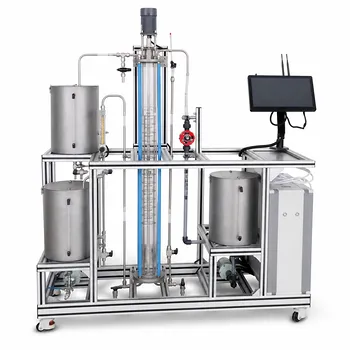
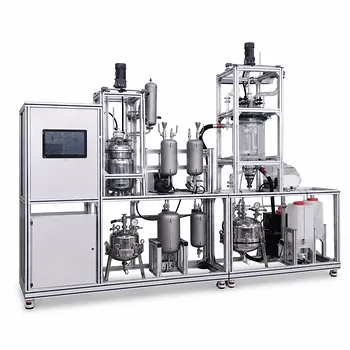
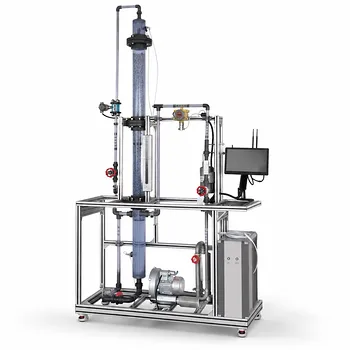
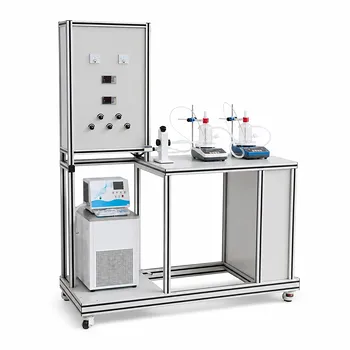
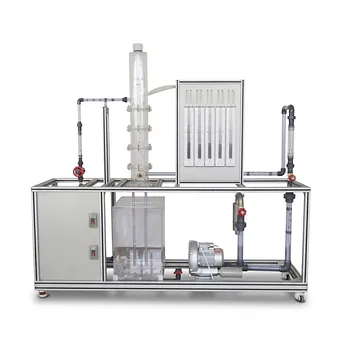
The decision between sieve plates and packed internals is far more than a hardware choice—it will define the fundamental mass transfer lesson your pilot plant teaches. In a liquid-liquid extraction column, sieve plates typically require three to six physical trays to achieve a single theoretical stage, while packed media can deliver one theoretical stage with roughly 2.5 feet of bed depth. This means packed columns are inherently more efficient, but sieve plates offer a clear, stage-by-stage window into the extraction process that is uniquely valuable for education.
While packed internals are the industry standard due to their superior stage efficiency and lower pressure drop, sieve plates provide an unmatched visual, discrete demonstration of equilibrium staging—a critical teaching aid. Your selection should balance the need for high-fidelity industrial representation against the educational power of observable, stage-wise concentration changes.
How the Two Designs Create Contact
The Stage-Wise Approach of Sieve Plates
Sieve plates are perforated trays that force the continuous and dispersed phases to interact in discrete steps.
One phase flows across each plate and through downcomers, while the other phase is dispersed through the holes as droplets that rise or fall to the next stage.
This creates a clear, physical separation between stages, allowing students to sample the composition at each tray and directly calculate a step-wise equilibrium curve.
The Continuous Realm of Packed Media
Packed columns replace trays with a bed of random or structured packing, which provides an enormous surface area for continuous liquid-liquid contact.
Mass transfer occurs along the entire length of the packed bed, without the discrete “mixing and settling” zones seen on a tray.
Because the phases remain in intimate contact throughout the column height, the efficiency is defined not by a tray count but by the Height Equivalent to a Theoretical Stage (HETS), which for typical extraction packings averages around 2.5 feet.
Stage Efficiency: The Key Performance Metric
What the Numbers Reveal
The efficiency gap is substantial: to achieve a single ideal equilibrium contact, you need 3 to 6 actual sieve plates, while a packed section of just 2.5 feet (0.76 m) can provide that same separation power.
This means a packed column can be much shorter than a sieve tray column to accomplish the same separation duty.
In practical terms, the HETS for random packings in extraction service ranges from 0.5 to 1.5 meters (1.6–4.9 feet), depending on packing size and liquid velocities—a flexibility that allows you to tailor efficiency by selecting smaller or larger packing elements.
Why Packing Outperforms Trays in Extraction
Packed internals create a continuously regenerated interfacial area. Each piece of packing breaks and re-coalesces droplets, renewing the mass transfer surface many times along the column.
Sieve plates, by contrast, rely on a single dispersion step per tray. The droplets form at the perforations, pass through the continuous phase once, and then coalesce—this limited residence time per stage demands many more stages.
Additionally, packed columns suffer far less axial mixing, which preserves the concentration driving force along the column height.
Why These Differences Matter in an Educational Pilot Plant
Teaching the Concept of a Theoretical Stage
Sieve plate columns are perfect for introducing the McCabe-Thiele method. Students can draw samples from each downcomer, plot the operating line and equilibrium curve, and literally count stages.
The physical separation between trays reinforces the abstract concept that a “stage” represents a discrete step to equilibrium—something a continuous packed bed cannot show as transparently.
Demonstrating Industry-Relevant Efficiency
If your curriculum connects to real-world extraction processes (pharmaceuticals, hydrometallurgy, petrochemicals), a packed section is essential.
Industry overwhelmingly chooses packed columns for their smaller footprint, reduced solvent inventory, and predictable mass transfer performance across a pressure drop range that plate columns cannot match.
A pilot plant with interchangeable internals lets students measure the drastic difference in HETS firsthand, turning an abstract design parameter into a tangible, experimental result.
Exploring Hydrodynamics and Operating Limits
The two internals also behave very differently at the limits. Packed columns require careful liquid distribution to avoid channeling, and they lose transfer efficiency at low loads when the packing surface is not fully wetted.
Sieve plate columns, on the other hand, offer a wider turndown ratio—they can operate stably at lower flow rates—and make phenomena like entrainment or flooding clearly visible through the individual trays.
This turns the pilot plant into a dynamic laboratory for studying hydraulic capacity as much as mass transfer.
Understanding the Trade-offs: Beyond Pure Efficiency
Cleaning, Maintenance, and Visual Access
Plate columns are typically easier to clean and inspect. Each tray can be removed, and fouling is immediately obvious.
In a teaching lab, where columns may sit idle between experiments and process fluids can be benign but sticky, this rapid turnaround is a significant advantage.
Packed columns demand more effort to remove, clean, or replace media, especially if random packing shifts and settles over time.
Suitability for Problematic Fluids
Packed internals are not recommended for systems with suspended solids or substances that tend to polymerize, because the solids lodge in the packing voids and block flow.
Sieve plates, with their relatively open perforations and discrete liquid paths, handle small amounts of solids far more forgivingly.
For an educational plant that might run student-formulated mixtures of unknown purity, this robustness can prevent frequent shutdowns.
Cost and Construction Complexity
A sieve tray column is often less expensive to fabricate and can be built with easily sourced materials.
Packed columns require precise liquid distributors and support plates, and the packing itself can be costly, especially if high-performance structured packing is chosen.
Budget-conscious teaching labs may lean toward plate columns for the basic extraction module, then add a packed section as a premium upgrade.
Pressure Drop and Solvent Hold-up
Packed columns generate significantly lower pressure drops than trayed columns, which can be crucial when demonstrating vacuum or low-pressure processes.
They also retain less liquid inventory, an important safety and cost consideration when using expensive or hazardous solvents in a laboratory.
This directly connects to lessons on solvent minimization and process intensification that are highly valued in modern chemical engineering education.
Making the Right Choice for Your Educational Pilot Plant
The ideal configuration is often a system that can be reconfigured to compare both internals. But if you must prioritize, let your core teaching objectives guide you.
- If your primary focus is teaching equilibrium stage calculations and McCabe-Thiele analysis: Start with a sieve plate column. The discrete tray samples and clear stage boundaries make abstract theory concrete and measurable.
- If your primary focus is simulating industrial extraction processes with realistic efficiency: Choose a packed column. It mirrors plant-scale performance and allows students to determine HETS experimentally, bridging the lab-to-industry gap.
- If your primary focus is hydrodynamic studies and operational troubleshooting: A plate column excels. It visually reveals weeping, flooding, and entrainment, making it a superior diagnostic tool for student-led investigations.
- If your primary focus is running a versatile, multi-fluid curriculum with minimal maintenance: A sieve plate column’s ease of cleaning and tolerance for variable feed quality will keep the pilot plant operational with less downtime.
Ultimately, the best educational pilot plant turns a design choice into a learning outcome. By understanding that sieve plates sacrifice stage efficiency for clarity while packing trades visibility for performance, you can engineer a laboratory experience that not only answers “how does extraction work?” but also “why does it matter which internal I choose?”
Summary Table:
| Feature | Sieve Plates | Packed Media |
|---|---|---|
| Stage Efficiency | Lower (Requires 3-6 physical plates per theoretical stage) | Higher (1 theoretical stage per ~2.5 feet of bed depth) |
| Mass Transfer | Discrete, stage-by-step contact (mixing and settling) | Continuous contact along the entire bed length |
| Educational Value | Excellent for visual flow and McCabe-Thiele stage calculations | Ideal for simulating real-world industrial scale efficiency |
| Maintenance & Cleaning | Easy to inspect, clean, and handles solids | Prone to fouling; harder to clean and unpack |
| Hydrodynamic Limits | Wide turndown ratio; visible flooding/weeping | Prone to channeling; lower pressure drop and solvent hold-up |
Optimize Your Chemical Engineering Lab with LABPARK
Choosing the right column internals is crucial for delivering impactful educational outcomes. LABPARK provides state-of-the-art Educational and Vocational Unit Operations Pilot Plants in chemical engineering, bioprocess & biotech, and environmental & water treatment.
Whether you are representing a university, research institute, or enterprise, our customizable pilot plants—featuring interchangeable sieve plate and packed column configurations—are engineered to bridge the gap between classroom theory and industrial practice.
Ready to elevate your training facility? Contact our engineering experts today to discuss your curriculum requirements and receive a tailored solution.
Related Products
- Educational Rotary Disc Liquid-Liquid Extraction Pilot Plant
- Comprehensive Liquid-Liquid Extraction Pilot Plant for Engineering Education
- Gallium and Indium Selective Extraction Educational Pilot Plant
- Packed Bed Absorption Educational Unit Operations Pilot Plant
- Continuous Batch Extractive Distillation Educational Pilot Plant
People Also Ask
- How do density and IFT affect liquid-liquid extraction pilot plants? Optimize Column Performance
- How to Estimate KD for Liquid-Liquid Extraction Pilot Plants Using Henry's Law when Lab Data is Limited
- In a liquid-liquid extraction pilot plant, how is a ternary-phase diagram utilized to determine solvent feed requirements?
- How to Select a Liquid-Liquid Extraction Pilot Plant with Space Constraints: Key Factors
- Why is the plait point a critical limit in liquid-liquid extraction pilot plants? Safe LLE Operation