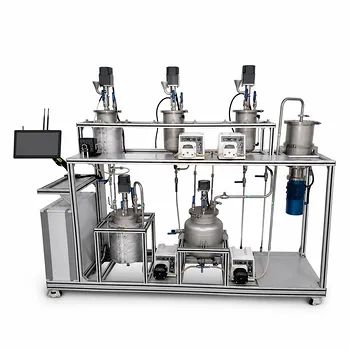
Maintaining separation efficiency during scale-up is not about blindly increasing dimensions—it’s a precise exercise in fluid dynamics and geometric balance. The critical design factors are managing the column’s Height Equivalent to a Theoretical Plate (HETP), selecting the correct length-to-diameter ratio based on separation difficulty, and integrating advanced flow distributors. An effective training pilot plant must make these factors tangible, with adjustable bed heights and transparent flow paths that reveal how radial mixing and axial dispersion change with scale.
The central challenge of chromatography scale-up is preserving the sharp concentration profile that delivers high purity and recovery. A training pilot plant succeeds when it lets students manipulate the key leverage points—geometric aspect ratio, packing uniformity, and distributor design—and directly observe their impact on plate height and resolution, turning abstract theory into a visible, measurable hydraulic reality.
The Foundation of Scalable Efficiency: Minimizing HETP
The primary goal when scaling any chromatographic column is to keep the Height Equivalent to a Theoretical Plate (HETP) as low as possible. HETP quantifies how much column length is needed to achieve one equilibrium stage; a smaller HETP means sharper peaks and cleaner separation. All design decisions—from particle selection to column internals—must serve the single purpose of reducing this number.
The Three Main Sources of Band Broadening
In practice, HETP is driven by three dispersion mechanisms, all of which become riskier at larger scales. Eddy diffusion arises from uneven flow paths through the packed bed, creating a smearing effect. Longitudinal molecular diffusion is time-dependent and less dominant in fast process-scale runs. Mass transfer resistance between the mobile and stationary phases depends on particle size and flow velocity. A well-designed pilot plant makes each of these visible by allowing the packing density and flow rate to be varied systematically.
Why Particle Size and Packing Quality Are Non‑Negotiable
Uniform packing is the single most important operational factor. If the stationary phase settles with cracks, gaps, or air bubbles, the mobile phase will channel through those low‑resistance paths, completely destroying separation. Educational pilot plants should therefore incorporate automated slurry packing systems and pressure‑controlled consolidation to demonstrate how a homogenous bed is achieved at process scale, bridging the gap between hand‑packed lab columns and industrial units.
Geometric Scaling: When to Go Long vs. Wide
Column geometry is not a free variable—it must match the intrinsic difficulty of the separation you are teaching. The selectivity factor (α) dictates the strategy. A one-size-fits-all column fails to illustrate this critical decision, so the pilot plant should offer flexibility in both aspects.
Designing for Difficult Separations (α < 1.15)
When two solutes are nearly identical in their interaction with the stationary phase, you need abundant theoretical plates. Here, a long and narrow column is essential. The increased length provides more equilibrium stages, while the smaller diameter reduces the risk of flow maldistribution that would destroy the delicate separation. Trainees learn that in these cases, throughput is sacrificed for the purity that only extra plates can deliver.
Designing for Easier Separations (α > 1.15)
When selectivity is generous, the bottleneck shifts to productivity. A wider column with a larger diameter is the correct choice. The extra width boosts volumetric throughput dramatically without requiring an impractically long bed height. This is where the pilot plant should clearly show the trade‑off: a wider column has a greater potential for wall effects and radial non‑uniformity, which must be countered by the next design layer.
Controlling Flow Dynamics: Distributors and Packing Quality
As a column’s diameter increases, the distance the mobile phase must travel radially grows, and the tendency for a parabolic flow profile intensifies. This is where the design of the liquid distribution system becomes the deciding factor for efficiency.
The Role of Specialized Distributor Plates and Baffles
Simple inlet tubing is inadequate for large‑diameter columns. Specialized distributor plates or baffles are mandatory to break up the incoming fluid jet, spread the flow evenly across the entire cross‑section, and minimize axial dispersion. A training pilot plant should feature interchangeable distributors so users can compare the resulting chromatograms and see the direct link between inlet hydraulics and peak shape.
Bridging Lab‑Scale Habits with Process‑Scale Reality
In a laboratory column, a student manually keeps the solvent level above the bed. In a pilot plant, automated pressure‑controlled flow and continuous slurry packing serve the same foundational goal: preventing the stationary phase from drying out or channeling. The design must include sensors that monitor pressure drop and elution profiles in real time, transforming qualitative lab habits into quantitative process control strategies.
Translating Resolution and Operating Parameters to Scale‑up
A chromatogram’s resolution (Rs) is the final scorecard. A training pilot plant should allow students to see that efficiency isn’t just about minimizing HETP—it’s about achieving the target Rs with economic realism.
Balancing Purity and Cost with Optimal Resolution
A resolution above 1.0 indicates complete peak separation, but chasing an unnecessarily high Rs is a common mistake. It extends run times and wastes mobile phase. A well-designed pilot plant lets operators observe this directly: by adjusting flow rate or gradient parameters, they can dial Rs into the optimal 1.0–1.5 range and learn to define the endpoint not as “perfect resolution” but as “resolution that meets purity requirements at minimum cost.”
Reproducing Industrial Robustness Studies
Scale‑up isn’t just about reaching a target; it’s about knowing how far you can drift and still succeed. An effective pilot plant must allow students to independently vary temperature, mobile phase concentration, and gradient time while monitoring retention time and baseline quality. This mirrors the robustness studies required in pharmaceutical manufacturing, where understanding the edges of the operational envelope is as important as finding the center.
Understanding the Trade‑offs in Scale‑up Design
Every design lever comes with a penalty. A pilot plant that ignores these trade‑offs fails to prepare trainees for real‑world decision‑making.
- Additional Plates vs. Pressure Drop: Longer columns generate more theoretical plates but also dramatically increase backpressure, which can crush compressible beads or exceed equipment limits.
- High Flow Rate vs. Resolution: Pushing flow rates for higher throughput reduces separation time but increases mass transfer resistance, widening peaks and lowering Rs.
- Radial Uniformity vs. Mechanical Complexity: Large‑diameter columns with sophisticated distributors fix flow maldistribution but add cost, cleaning challenges, and potential dead zones.
- Flexible Bed Height vs. Reproducibility: While adjustable bed heights are invaluable for teaching, each adjustment risks disturbing the packed bed and introducing new channels if not done with controlled consolidation systems.
How to Evaluate a Pilot Plant for Training Purposes
Selecting the right pilot plant means matching the hardware’s demonstrable range to the educational objectives. The true measure is not the number of features, but how vividly a student can connect a design decision to a chromatographic outcome.
- If your primary focus is fundamental scale‑up principles: Prioritize a unit with an adjustable bed height and a transparent column section. The ability to visually confirm packing uniformity and solvent level is irreplaceable for building intuition.
- If your primary focus is industrial method transfer and robustness: Choose a system that includes automated slurry packing, pressure‑controlled flow, and interchangeable distributor plates. It must allow for systematic variation of gradient, temperature, and flow rate to teach operational envelope mapping.
- If your primary focus is throughput economics: Insist on a column with a variable diameter option (or multiple column sizes) and integrated pressure drop monitoring. The hardware must make the trade‑off between resolution and production rate an active, measurable experiment.
The ideal chromatography pilot plant for training is not a scaled‑up lab column; it is a deliberate design instrument that forces users to confront the real forces of eddy diffusion, radial maldistribution, and economic optimization that define every successful industrial separation.
Summary Table:
| Design Factor | Scale-Up Challenge | Educational/Pilot Plant Solution |
|---|---|---|
| HETP Minimization | Band broadening from eddy & molecular diffusion | Variable flow rates and packing density controls |
| Geometric Scaling | Balancing purity (long/narrow) vs. throughput (wide) | Flexible column options and adjustable bed heights |
| Flow Dynamics | Radial maldistribution & parabolic flow | Interchangeable distributor plates and baffles |
| Packing Quality | Bed channeling and drying | Automated pressure-controlled slurry packing |
Bring Industrial-Scale Chromatography into Your Lab
Mastering separation efficiency requires hands-on experience with real-world hydraulic dynamics. LABPARK provides advanced Educational and Vocational Unit Operations Pilot Plants in chemical engineering, bioprocess & biotech, and environmental & water treatment. Designed for universities, research institutes, and enterprises, our systems feature transparent flow paths, adjustable bed heights, and automated controls to bridge the gap between lab-scale theory and industrial reality.
Ready to upgrade your training facility? Contact LABPARK today to explore our custom solutions!
Related Products
- Multi Functional Membrane Crystallization Educational Unit Operations Pilot Plant
- Multi-Functional Special Distillation Educational Pilot Plant
- Natural Product Extraction Unit Operations Training Pilot Plant
- Educational Unit Operations Pilot Plant for Intraparticle Diffusion Effective Factor Measurement
- Dual-Mode Rectification Pilot Plant for Practical Training Unit Operations
People Also Ask
- Control Crystallization Pilot Plant Secondary Nucleation: 4 Key Adjustments
- Why is precise temperature control critical in crystallization pilot plants? Key to Scale-Up Success
- What key factors should be considered when configuring a crystallization unit operations pilot plant?
- What are the benefits of integrating online PAT tools like ATR-FTIR into crystallization unit operations pilot plants?
- How to use crystallization pilot plant agitation speed to identify diffusion vs reaction growth?