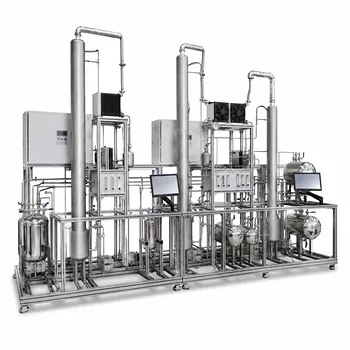
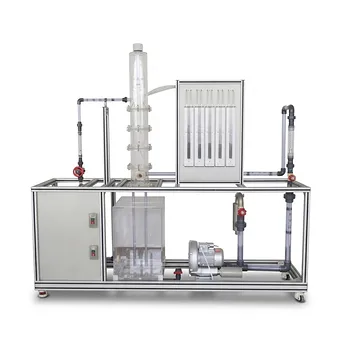
Height is determined by translating theoretical separation stages into physical dimensions using an efficiency factor. For tray columns, engineers calculate the actual number of plates needed by dividing the required theoretical stages by an overall plate efficiency ($E_T$), then multiply by the chosen plate spacing. For packed columns, they multiply the same theoretical stages by the Height Equivalent to a Theoretical Plate (HETP), often applying a safety factor and segmenting the bed with redistributors. These calculations directly link separation efficiency to the total column height required in a pilot plant.
Both tray and packed columns demand the same number of theoretical stages to achieve a given separation. Their physical height diverges, however, based on how effectively each internal arrangement transfers mass. Tray columns rely on an overall efficiency factor and fixed plate spacing, while packed columns use HETP—a direct depth-per-stage—and must account for practical safety margins and liquid redistribution. In a pilot plant, the final design height is not just a number from a formula; it is a balance between separation efficiency, hydraulic limits, and educational intent.
The Role of Separation Efficiency in Column Sizing
Theoretical Stages: The Common Starting Point
Every distillation design begins with vapor-liquid equilibrium calculations that yield the number of theoretical stages ($N_T$) needed to achieve the desired purity. This is a thermodynamic ideal.
For both tray and packed columns, $N_T$ is the fixed target. The challenge is converting that ideal into a physical column height that a pilot plant can actually deliver.
Making the Leap to Reality with Efficiency Metrics
A theoretical stage assumes perfect, instantaneous equilibrium between rising vapor and falling liquid. Real internals never achieve that ideal.
So engineers introduce an efficiency factor. For trays, it’s the overall plate efficiency $E_T$ (or $E_o$). For packing, it’s the Height Equivalent to a Theoretical Plate (HETP), which directly expresses how many centimeters (or inches) of packed bed equal one perfect stage. The height determination then becomes a straightforward multiplication, but only after the right efficiency value is selected.
Tray Column Height: Bridging Theory with Plate Counts
From Theoretical Stages to Actual Plates
A tray column’s effective separation zone is defined by its actual number of physical plates ($N_p$). You calculate it with:
$N_p = N_T / E_T$
where $E_T$ is the overall plate efficiency (the ratio of theoretical stages to real plates needed). For example, if $N_T = 10$ and $E_T = 0.7$, you need about 15 actual trays.
Calculating Effective Height with Tray Spacing
Once $N_p$ is known, the effective column height ($Z$) is simply the plate spacing ($H_T$) times the number of gaps between trays:
$Z = (N_p - 1) H_T$
A typical pilot-plant tray spacing might be 0.3–0.5 meters. So for 15 actual plates with 0.45 m spacing, the active separation height is about 6.3 meters. This formula bridges the idealized world of thermodynamic stages directly into the physical lab.
Determining Overall Plate Efficiency ($E_T$)
$E_T$ is not a constant. It depends on fluid properties (viscosity, relative volatility), tray geometry (weir height, hole size), and operating vapor/liquid loads.
For pilot-scale design, engineers often use empirical correlations such as the A.I.Ch.E. method to estimate $E_T$ before running the actual column. Without a reliable $E_T$ value, the computed number of trays could be dangerously under- or over-sized, undermining the separation guarantee.
Packed Column Height: The Continuous Contact Approach
The HETP Method: Direct from Stages to Bed Height
Packed columns handle mass transfer continuously, so engineers use the simple relationship:
$Z_{packing} = N_T \times \text{HETP}$
HETP rolls all the complexities of packing geometry, liquid distribution, and vapor-liquid contact into a single number. For a given packing and system, HETP tells you exactly how much bed depth is needed per theoretical stage.
Typical HETP Values and Conservative Safety Margins
In pilot-scale distillation, HETP for standard metal pall rings often ranges from 2 to 3 feet (0.6–0.9 m), but it varies with packing size and efficiency. A 1-inch metal ring might have an HETP of about 1.5 ft at 100% tray efficiency, rising to 2.1 ft at 50% efficiency.
Because lab conditions fluctuate, a safety factor is essential: design height ($Z'$) is typically multiplied by 1.2 to 1.5, and many experienced designers add an additional 6-inch margin. This safeguards against unexpected liquid maldistribution or lower-than-expected efficiency.
Overcoming Wall Flow with Redistributors and Segment Height Limits
In small-diameter pilot columns, liquid tends to creep toward the wall, reducing mass transfer and artificially increasing the effective HETP. To counter this, the packed bed must be divided into sections, each with a liquid redistributor between them.
For random packings, the maximum section height is governed by a height-to-diameter ratio ($h/D$). For structured packing, the section height is typically set to (15–20) $\times$ HETP. This segmentation prevents efficiency loss but also adds physical height, as redistributors and collection trays occupy incremental space.
Alternative: The Transfer Unit Method (NTU/HTU)
While the HETP method is the workhorse for pilot-scale design, the transfer unit approach ($Z = NTU \times HTU$) is sometimes used when detailed mass-transfer coefficients are available. For most pilot-plant sizing, however, HETP dominates because it is directly relatable to theoretical plates.
Understanding the Trade-offs in Pilot-Plant Design
Educational Visibility vs. Cost and Pressure Drop
Tray columns are highly visual—students can see weeping, froth height, and flooding. This makes them ideal for teaching stagewise contact. But they tend to have higher pressure drop and can be more expensive to fabricate, especially with bubble-cap trays.
Packed columns, by contrast, excel at demonstrating continuous contact, lower pressure drop, and lower liquid holdup (safer for hazardous fluids). The trade-off is that internal flow patterns are invisible, and poorly designed distributors can severely cut efficiency.
Small-Diameter Columns: Why Packed Often Wins Below 0.6 m
In columns with diameters under 0.6 meters, liquid maldistribution in trays can dramatically lower $E_T$, requiring many more plates and extra height. Packed beds, especially with careful redistribution, maintain efficiency better at these small scales and are often more cost-effective.
Interchangeability and the Best of Both Worlds
Many advanced pilot plants offer interchangeable internals—the ability to swap trays for random or structured packing in the same shell. This flexibility lets students directly compare the impact of internals on separation efficiency and column height, reinforcing why design choices matter.
Making the Right Choice for Your Pilot Plant Goal
After calculating the required height for both internals based on separation efficiency, the final decision should align with your primary objective:
- If your primary focus is educational demonstration of stage-to-stage contact and hydraulics: Choose a tray column, calculate the height from $N_p$ and $H_T$, and ensure the tray spacing lets students observe weeping and flooding clearly.
- If your primary focus is minimizing pressure drop or handling corrosive/hazardous materials: A packed column with a conservative HETP and safety factor will give a shorter, safer unit—just factor in redistributor heights.
- If your primary focus is maximum flexibility and side-by-side comparison: Select a column that accepts both trays and multiple types of packing; use the same $N_T$ to compare the resulting physical heights and reinforce how efficiency defines the column’s footprint.
- If your primary focus is rapid prototyping and cost control at small diameters (<0.6 m): Start with a structured or random packed bed, apply an HETP with a 20–50% safety margin, and segment the bed as required by manufacturer recommendations.
An accurately sized pilot-plant column is not just a tall pipe—it is a physical expression of separation efficiency, and the right height ensures meaningful, reproducible results that truly bridge classroom theory and industrial reality.
Summary Table:
| Parameter | Tray Columns | Packed Columns |
|---|---|---|
| Contact Type | Stagewise contact | Continuous contact |
| Efficiency Metric | Overall plate efficiency ($E_T$) | Height Equivalent to a Theoretical Plate (HETP) |
| Height Formula | $Z = (N_p - 1) H_T$ | $Z = N_T \times \text{HETP}$ |
| Design Factors | Tray spacing, actual plate count | Safety margins (1.2-1.5x), liquid redistributors |
| Ideal Scale | Better visual for >0.6 m diameter | Preferred for small diameter (<0.6 m) |
Optimize Your Chemical Engineering Lab with LABPARK
Are you looking to equip your laboratory with high-performance distillation systems? LABPARK provides premium Educational and Vocational Unit Operations Pilot Plants in chemical engineering, bioprocess & biotech, and environmental & water treatment. We help universities, research institutes, and enterprises bridge the gap between classroom theory and industrial reality with flexible, safely designed, and highly visual training systems.
Contact our engineering experts today to design the ideal pilot plant for your academic or research requirements!
Related Products
- Continuous Sieve-Plate Distillation Pilot Plant for Unit Operations Laboratory Education
- Multi-Functional Special Distillation Educational Pilot Plant
- Multi-Modal Distillation Unit Operations Training Pilot Plant
- Continuous Batch Extractive Distillation Educational Pilot Plant
- Dual-Mode Rectification Pilot Plant for Practical Training Unit Operations
People Also Ask
- How to select the right activity coefficient model (Wilson, NRTL, UNIQUAC) for distillation pilot plants?
- Why is vacuum operation capability an essential feature for a distillation unit operations pilot plant? Unlock Efficiency
- How does catalyst water concentration affect distillation pilot plant design? Key separation train choices.
- What are the primary reflux ratio control strategies? Master Distillation Unit Operations
- How can real-time carbon number prediction improve distillation pilot plants? Optimize control.