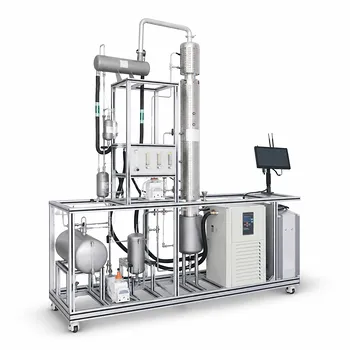
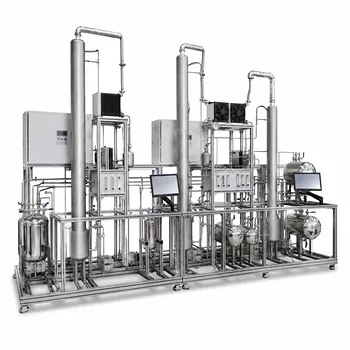
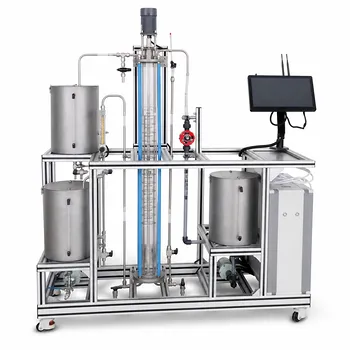
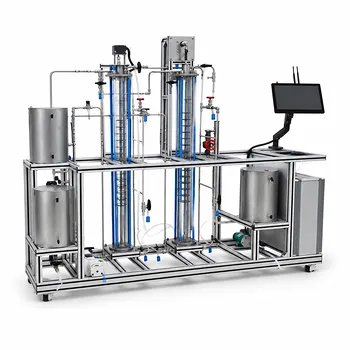
The key to effective indirect composition control in an educational distillation column is not a single, pre-calculated sensor location—it's an experimental discovery process. You should install temperature sensors on multiple trays, avoid the extreme top and bottom, and then systematically determine which tray exhibits the largest temperature swing in response to operational changes. That tray, known as the sensitive tray, becomes your primary control point.
Indirect composition control relies on temperature as a proxy for purity. In an educational pilot plant, the sensitive tray—the tray whose temperature changes most dramatically with composition shifts—must be located through hands-on experimentation. Installing multiple thermocouples and allowing students to find this tray is the definitive method for both accurate control and deep learning.
Understanding the Core Problem: Why Temperature Can't Be Placed Just Anywhere
You need to control product composition, but you’re measuring temperature. This indirect approach only works if the temperature signal is actually meaningful. The challenge is that distillation columns have zones where temperature barely moves, even when composition strays.
The Illusion of Stability at the Extremes
At the very top of the column, the vapor is nearly pure low-boiler. Its dew point changes almost imperceptibly with small composition variations. The same happens at the bottom with the high-boiler. If you place your control thermocouple in these high-purity zones, you might see a rock-steady temperature reading while product quality drifts off-spec. The controller simply can’t “see” the disturbance.
The Real Clue is the Steepest Slope
The temperature profile inside the column is not a straight line. There is a region, often around the feed tray or somewhere in the middle of the rectifying or stripping section, where the temperature gradient is steepest. This is where a tiny change in liquid or vapor composition translates into a large, measurable temperature shift. This sensitivity is what makes automatic control possible.
The Sensitive Tray: Your Target for Indirect Control
The goal of sensor placement is to locate this exact tray—the sensitive plate. It’s the tray that reacts most vigorously to upsets in feed rate, feed composition, or reboiler duty.
What Defines a Sensitive Tray
A sensitive tray displays two critical behaviors simultaneously:
- Maximum static gain: A small change in the manipulated variable (e.g., reflux flow) causes a large change in tray temperature.
- Fast dynamics: The temperature responds quickly, giving the controller a fighting chance to correct the disturbance before product quality suffers.
Why You Can't Calculate It Perfectly on Paper
In an educational setting, you’re often running non-ideal mixtures, varying pressures, or testing columns with uncertain tray efficiencies. A simulation might give you a theoretical sensitive tray location, but the plant’s actual behavior—due to heat losses, tray weeping, or non-equilibrium effects—often shifts that point by one or two trays. The only way to know for sure is to measure it under real operating conditions.
A Practical Configuration Approach for an Educational Pilot Plant
Your mission is twofold: achieve stable process control and create a powerful learning experience. The following steps address both.
Install a Distributed Array of Temperature Sensors First
Instead of guessing a single spot, permanently install thermocouples on multiple trays across the column. Place them in the middle region of the rectifying section and the stripping section, deliberately leaving out the very top and bottom trays. This gives students a complete picture of the column’s thermal profile.
Use the "Step Test" to Identify the Winner
Once the column is running at steady state with a known feed mixture, you or the students perform a simple experiment:
- Make a small, deliberate step change in reflux ratio or reboiler duty.
- Log the temperature response from every installed thermocouple simultaneously.
- The tray that shows the largest steady-state temperature change and the fastest initial response is your sensitive tray.
Designate That Signal as the Process Variable
After the experiment, configure the control system to use the temperature reading from that specific tray as the process variable for the temperature control loop. Cascade this loop to a composition analyzer, if available, so the temperature setpoint can be automatically adjusted by a slower-acting composition controller.
What About a Cascade Structure with an Analyzer?
If you integrate an online composition analyzer (like a gas chromatograph or NIR probe), do not use its direct output to drive the final control element—its response is too slow and noisy. Instead, set the analyzer as the primary controller in a cascade loop. Its output becomes the remote setpoint for the fast-responding temperature controller tied to the sensitive tray. This marries ultimate product accuracy with loop stability.
Understanding the Trade-offs and Common Pitfalls
While using the sensitive tray is powerful, the approach has limitations you must teach your students.
The Single-Point Trap
A sensitive tray identified at one feed composition may lose its sensitivity if you switch to a drastically different mixture. The steep temperature front simply moves to a different part of the column. If your pilot plant runs multiple experiments, the most responsive tray might need re-identification each time.
The Cost of Too Many Sensors vs. Educational Value
Adding thermocouples to every tray is expensive and complicates wiring and data acquisition. However, for an educational pilot plant, the ability to visualize the entire temperature profile and "hunt" for the sensitive tray is precisely the point. The hardware investment directly translates into a deeper understanding of column dynamics.
Pressure Drop and Tray Location Confusion
In a packed column, you don't have physical trays. The "sensitive height" in the packing becomes the target, and you'll need to install multiple temperature probes at different vertical positions. The principle remains identical: find the location of the steepest thermal gradient.
Avoiding the Lazy Default of the Top Tray
A common mistake is to simply control the top temperature, assuming it reflects distillate purity. In high-purity separations, the top temperature can remain pinched at the boiling point of the pure component for a wide range of reflux ratios, giving the illusion of control while the column actually floods or dries up internally.
Making the Right Choice for Your Educational Goal
Your sensor placement strategy should mirror what you want your students to learn. Here’s how to align your configuration with specific outcomes.
-
If your primary focus is teaching fundamental column dynamics and control: Install individual thermocouples on at least five trays in the rectifying section and three in the stripping section, omitting the condenser and reboiler. Require students to perform step tests for every new mixture, analyze the temperature profiles, and justify their choice of sensitive tray in a lab report. The learning is in the process, not a pre-set configuration.
-
If your primary focus is demonstrating advanced cascade control with a composition analyzer: Install the analyzer but retain a dense array of temperature sensors. Have students first run on temperature-only control, then switch to composition-to-temperature cascade, observing how the sensitive tray’s setpoint is automatically adjusted. This illustrates the critical role of the secondary loop’s dynamics.
-
If your primary focus is operating a fixed, multi-purpose pilot plant on a tight budget: Perform the step test once using the most common feed mixture, then permanently configure the loop to the identified tray. Document that the location is valid only for that specific recipe, and teach the limitation as a key safety case when discussing operational discipline.
Always let the column itself show you where its most dynamic behavior lies. The sensor that tells the most dramatic story is the one that will keep your product quality on target.
Summary Table:
| Column Zone | Temperature Stability | Composition Sensitivity | Suitable for Process Control? |
|---|---|---|---|
| Column Extremes (Top/Bottom) | High (Pinched at boiling point) | Extremely Low | No (Leads to product drift/illusion of control) |
| Steep Gradient Zone (Middle) | Moderate | High | Potential (Needs empirical validation) |
| Identified Sensitive Tray | Highly Dynamic | Highest (Fastest response) | Yes (Best choice for primary control loop) |
Enhance Your Process Control Lab with LABPARK
Ready to bring advanced, hands-on distillation control to your students or researchers? LABPARK provides high-quality Educational and Vocational Unit Operations Pilot Plants in chemical engineering, bioprocess & biotech, and environmental & water treatment.
Designed specifically for universities, research institutes, and enterprises, our modular pilot plants allow students to physically experiment with sensor arrays, perform step tests, and master real-world process dynamics.
Contact LABPARK today to customize your distillation pilot plant!
Related Products
- Continuous Sieve-Plate Distillation Pilot Plant for Unit Operations Laboratory Education
- Multi-Functional Special Distillation Educational Pilot Plant
- Multi-Modal Distillation Unit Operations Training Pilot Plant
- Continuous Batch Extractive Distillation Educational Pilot Plant
- Dual-Mode Rectification Pilot Plant for Practical Training Unit Operations
People Also Ask
- What are the primary reflux ratio control strategies? Master Distillation Unit Operations
- How does catalyst water concentration affect distillation pilot plant design? Key separation train choices.
- Why is vacuum operation capability an essential feature for a distillation unit operations pilot plant? Unlock Efficiency
- How to select the right activity coefficient model (Wilson, NRTL, UNIQUAC) for distillation pilot plants?
- How can real-time carbon number prediction improve distillation pilot plants? Optimize control.