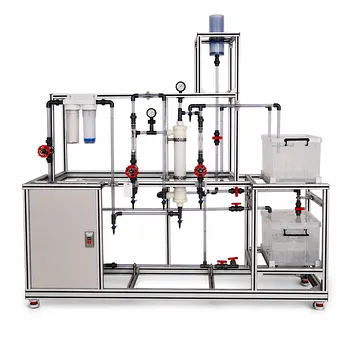
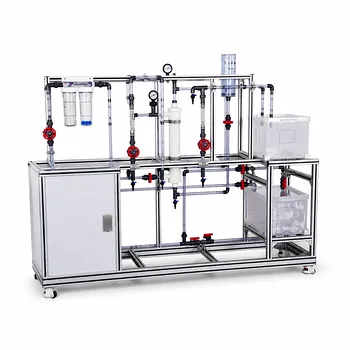
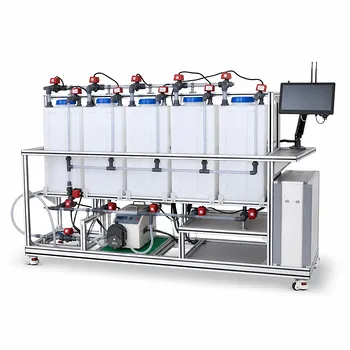
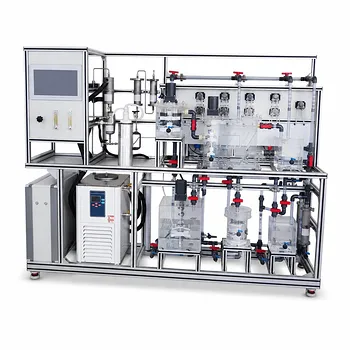
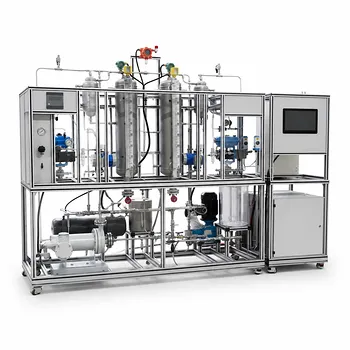
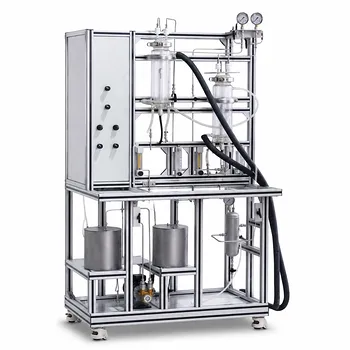
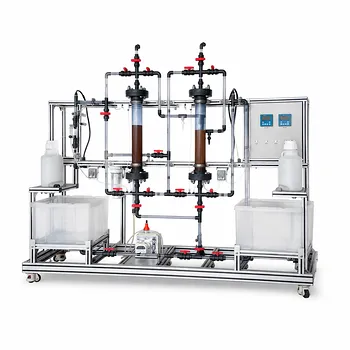
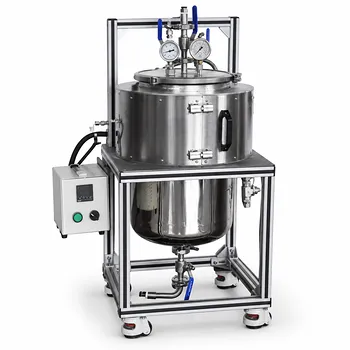
The primary difference between NF and RO membranes in an educational pilot plant setting is a trade-off between selective separation and complete desalination, coupled with a significant gap in energy demand. RO membranes utilize a hyper-dense polymeric barrier requiring high pressure to reject virtually all dissolved solids, while NF membranes operate at lower pressures to selectively remove hardness ions and larger organic molecules without stripping beneficial monovalent minerals.
Configuring a pilot plant correctly hinges on understanding that RO is a non-selective, absolute barrier for total desalination, whereas NF is a selective separation tool designed for targeted softening and organic removal. For an educational environment, RO safely demonstrates complete ion rejection under high pressure, while NF provides a richer, safer platform for exploring nuanced molecular selectivity and complex transport phenomena.
The Core Physical Difference: A Tale of Two Barriers
The distinction between these two technologies starts at the molecular level with pore size and transport mechanisms. Students often mistakenly group them together, but their physical structure dictates vastly different operational behaviors.
The Molecular Gateway of NF
Nanofiltration serves as the "middle ground" of membrane technology. It bridges the gap between ultrafiltration (UF) and reverse osmosis (RO).
NF membranes possess a pore size of approximately 1 to 2 nanometers. This allows them to effectively filter solutes with a Molecular Weight Cut-Off (MWCO) typically in the 200–400 Dalton range. This size exclusion is loose enough to let small monovalent salts pass but tight enough to catch larger organic molecules.
The Hyper-Dense Barrier of RO
Reverse osmosis is accurately described as a dense, non-porous diffusive barrier. Think of it less as a microscopic sieve and more as a continuous, homogeneous film.
With an effective pore size of roughly 0.0001 microns (0.1 nanometers), RO membranes demand that permeating molecules dissolve into and diffuse through the polymer matrix. This structure is what grants RO its near-absolute rejection capability, allowing only highly ordered water molecules to pass through.
Rejection Capabilities: Selective Softening vs. Absolute Stripping
This is the most critical conceptual pivot for any laboratory experiment. NF does not simply perform "poorer" RO; it performs a fundamentally different type of chemical separation based on ionic charge and size.
The Divalent vs. Monovalent Paradigm
An NF membrane’s defining characteristic is its charge-dependent rejection.
The membrane surface typically carries a negative charge that repels multivalent anions.
- Divalent Ions (Hardness): NF rejects 90–98% of calcium (Ca²⁺) and magnesium (Mg²⁺) ions. This makes it ideal for demonstrating water softening.
- Monovalent Ions (Salinity): NF allows sodium (Na⁺) and chloride (Cl⁻) ions to pass with significantly lower rejection, often only 20–80%. It reduces Total Dissolved Solids (TDS) but does not eliminate them.
The RO Sweet Spot in Education
RO membranes reject virtually all dissolved species regardless of their valence charge. In a lab setting, operation drastically flattens the rejection curve. They remove:
- Monovalent salts (like NaCl) at rates exceeding 99%.
- Heavy metals, bacteria, and dissolved organics.
For an educational pilot plant, RO is the definitive tool for producing ultrapure water, demonstrating how pressure overcomes the osmotic gradient to strip water down to its base molecular structure.
Operating Pressure and Energy Demands
The membrane’s density directly translates into the kinetic energy required for separation. This creates a clear safety and utility consideration for a laboratory configuration.
Low-Pressure Operation of NF
NF membranes operate effectively at moderate transmembrane pressures of 3.5 to 16 bar (50–225 PSI). In a laboratory setting, this lower pressure profile is advantageous because it reduces the strain on pumps and piping, improving equipment longevity and lowering the risk of catastrophic leaks during student-led experiments.
High-Pressure Demands of RO
To overcome the natural osmotic pressure of saline solutions and force water through the dense barrier, RO systems demand much higher feed pressures. Depending on the feed salinity, RO pilot units may need to sustain pressures from 15 bar for brackish water up to 100 bar for seawater.
A common educational oversight is misjudging the impact of concentration polarization at these pressures. As feed solute concentration increases, osmotic pressure at the membrane surface spikes, requiring a corresponding increase in applied pressure just to maintain the same flux.
Understanding the Trade-offs in Pilot Plant Configuration
When selecting a system, instructors must look beyond catalog rejection percentages. The dynamic performance of the membrane in a lab evolves over time due to fouling and chemical compatibility.
The Fouling Factor and Hydrophilicity
Membrane lifetime in a pilot plant is largely governed by organic fouling. Hydrophilicity (contact angle) is the key metric:
- A more hydrophilic NF membrane (e.g., a 25° contact angle) can deliver nearly double the pure water flux compared to a hydrophobic variant (46° contact angle), while resisting the adhesive buildup of proteins and oils.
- Both NF and RO suffer permeate flux decline, but NF’s looser structure often allows for more forgiving Clean-in-Place (CIP) regimes using extreme pH solutions (pH 2–11), whereas RO membranes are more sensitive to oxidative degradation from cleaning chemicals.
Separation Efficiency Limits
NF is not a desalinator. In educational testing, students will observe that NF rejection of NaCl rarely exceeds 90%. This is the critical boundary: if the learning objective is complete saline rejection, NF is the wrong tool. The pilot plant design must confirm this by demonstrating that higher feed concentrations reduce flux and rejection capability due to concentration polarization, a mass transfer limitation visible across both technologies but operationally distinct in its impact.
Making the Right Configuration Choice for Your Educational Lab
Selecting between these membranes requires defining the specific scientific phenomenon you intend the student to observe and measure.
- If your primary focus is demonstrating total desalination: Configure the pilot plant with RO modules. Use this setup to teach students about overcoming osmotic pressure, calculating salt passage rates approaching zero, and the energy-water nexus inherent to producing high-purity water.
- If your primary focus is industrial water softening and molecular selectivity: Prioritize the NF configuration. Use divalent-rich feeds (like magnesium sulfate) versus monovalent feeds (sodium chloride) to showcase the charge-based rejection mechanism that defines modern water treatment.
- If your primary focus is investigating fouling mechanics and mass transfer: Use a modular system that allows switching between both NF and RO. This enables a direct comparison of flux decline curves under identical feed conditions, highlighting how tighter RO membranes foul faster but respond differently to crossflow velocity adjustments.
Ultimately, pairing the correct membrane with the correct solute in a well-configured pilot plant transforms abstract transport theory into tangible operational logic.
Summary Table:
| Feature | Nanofiltration (NF) | Reverse Osmosis (RO) |
|---|---|---|
| Pore Size | ~1 to 2 nm (MWCO: 200-400 Da) | ~0.1 nm (0.0001 μm) |
| Rejection Mechanism | Selective (90-98% Divalent, 20-80% Monovalent) | Absolute (>99% Monovalent & Divalent) |
| Operating Pressure | 3.5 to 16 bar (50–225 PSI) | 15 to 100 bar (217–1450 PSI) |
| Primary Educational Focus | Selective separation, softening, charge effects | Total desalination, high-pressure mass transfer |
Upgrade your engineering labs with state-of-the-art pilot systems. LABPARK provides Educational and Vocational Unit Operations Pilot Plants in chemical engineering, bioprocess & biotech, and environmental & water treatment for universities, research institutes, and enterprises. Contact our experts today to configure the ideal membrane system for your curriculum!
Related Products
- Multifunctional Membrane Separation Educational Pilot Plant with Ultrafiltration, Nanofiltration, Reverse Osmosis
- Multi-Functional Membrane Separation Educational Pilot Plant for Unit Operations Lab
- Ultrafiltration Membrane Separation Educational Pilot Plant
- Hollow Fiber Ultrafiltration Membrane Separation Educational Pilot Plant
- Electrochemical Water Treatment Educational Unit Operations Pilot Plant
People Also Ask
- How do PEI, PVDF, and PSU membranes compare in pilot plants? Find the best fit.
- Pervaporation vs. Vapor Permeation: Handling Suspended Solids in Membrane Pilot Plants
- What are the trade-offs of polymer vs inorganic membranes in teaching pilot plants? Key laboratory comparison.
- What are the advantages of membrane separation in pilot plants? Efficient Organic Vapor Recovery
- How can operators optimize operating conditions and cleaning protocols in membrane separation pilot plants to mitigate fouling?