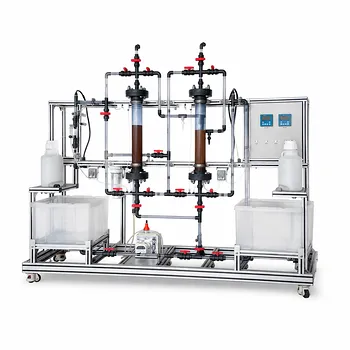
The Wurster column doesn’t just move particles—it orchestrates their journey.
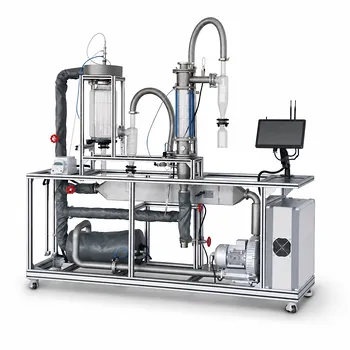
In a fluid bed coating pilot plant configured for vocational training, the Wurster column design creates a predictable, controlled circulation loop by channeling the majority of fluidizing air through a central draft tube. This generates a strong upward current that draws particles from the surrounding annular bed, accelerates them past a bottom-spray nozzle for a precise coating application, and then allows them to gently fall back into the return zone as the air velocity decreases in the expansion chamber. The result is a repeatable, visually intuitive cycle that makes core coating principles tangible for trainees.
The Wurster column transforms chaotic particle movement into a deliberately engineered circulation path. By physically separating the high-velocity spray zone from the low-velocity return bed, it ensures every particle follows a consistent cyclical route—exactly what a vocational training environment needs to demonstrate how hydrodynamics directly control coating uniformity and drying rates.
The Wurster Column: A Structured Circulation Loop
The genius of the Wurster design lies in how it imposes order on particle flow. Instead of random motion, it delivers a repeatable sequence that can be observed, measured, and adjusted by trainees.
The Air Distributor Plate’s Critical Dual Function
The heart of circulation control rests in the air distributor plate at the base of the unit.
It is engineered to direct the largest portion of the high-velocity drying gas straight up through the central Wurster column.
The remaining air passes through the surrounding annular downbed at a lower flow rate.
This deliberate imbalance creates a pressure differential—the column operates at a lower pressure relative to the downbed, naturally pulling particles from the periphery into the upward draft.
How the Draft Tube Enforces a One-Way Path
The physical presence of the central draft tube (the Wurster column itself) is what enforces controlled flow.
Particles cannot bypass the high-velocity region; they are funneled upward in a near plug-flow pattern past the atomizer.
Because the tube extends from just above the distributor plate to a defined height, it defines exactly where acceleration, coating, and initial drying occur.
For vocational training, this means the circulation path is visible and predictable—you can literally watch particles enter at the base and exit at the top of the tube.
The Expansion Chamber and Controlled Particle Return
At the top of the Wurster column, the cross-sectional area expands dramatically in the expansion chamber.
Here, the gas velocity falls below the minimum entrainment velocity required to keep particles aloft.
Gravity takes over, and the partially dried particles disengage from the air stream and fall back into the outer downbed.
This creates the completion of the cycle: particles travel slowly down the annular bed, get drawn back into the draft tube inlet at the bottom, and repeat the loop.
The Spray Zone: Coating One Layer at a Time
Positioned at the bottom of the Wurster column, the bottom-spray atomizer delivers a fine mist of coating solution directly into the upward-moving particle stream.
In a single pass, each particle receives only a minute amount of coating before entering the drying zone.
This per-pass minimal application is not a flaw—it’s a design feature.
It ensures that coating builds up gradually, cycle after cycle, giving the instructor a perfect platform to explain concepts like droplet spreading, film formation, and the importance of recirculation count.
Why Controlled Circulation Directly Equals Coating Uniformity
Uniform coating thickness emerges only when every particle passes through the spray zone a statistically similar number of times.
The Wurster column’s forced circulation pattern guarantees this because particles cannot randomly wander or remain stagnant.
In vocational training, you can adjust processing time and air velocity to demonstrate a profound principle: faster circulation (higher air flow) may increase the number of passes per minute, but it must still be balanced with sufficient drying time to avoid agglomeration.
This direct cause-and-effect visibility between hydrodynamics and coating quality is the ultimate teaching advantage of a Wurster-equipped pilot plant.
Understanding the Trade-offs and Learning Opportunities
An effective training tool doesn’t just show what works—it reveals what can go wrong and why. The Wurster design’s tight control makes it uniquely suited to illustrate critical process pitfalls.
Balancing Air Flow for Stable Circulation
Too little fluidizing air in the downbed leads to poor particle mobility.
Particles may not enter the draft tube opening reliably, causing circulation to stall or create “dead zones” where uncoated particles hide.
Too much air through the column causes particles to accelerate aggressively, increasing attrition and potentially ejecting them into the expansion chamber before droplet deposition is complete.
Vocational exercises can deliberately push these boundaries to teach trainees how to read manometers and adjust air flow for a stable, smooth circulation pattern.
Preventing Dead Zones and Uneven Distributor Flow
A poorly designed or damaged distributor plate can channel air unevenly, allowing some particles to remain motionless in the downbed.
This is a powerful lesson in the indispensable role of equipment integrity and proper setup.
By exaggerating the effect—e.g., partially blocking a section—an instructor can show how coating variance skyrockets when circulation is compromised.
Trainees learn that uniform air distribution is the silent foundation of all subsequent coating quality.
The Per-Pass Coating Challenge and Solution Content
The small amount of coating applied per pass means that processing time and the solids content of the coating solution become critical tuning knobs.
If the solution is too dilute, drying may be excessive before the next layer bonds properly. If too concentrated, droplets may not spread evenly.
These trade-offs provide excellent discussion points for training: students can run short experiments altering one variable at a time and immediately see the impact on coating morphology and final thickness.
Making the Right Choice for Your Vocational Training Setup
Every vocational pilot plant can be tuned to emphasize different learning objectives. The Wurster column’s transparent operating logic makes it simple to pivot the narrative.
- If your primary focus is demonstrating fluid bed hydrodynamics: Use tracer particles and glass view ports to highlight the pressure-driven circulation loop. Have trainees map the visible particle velocity changes from draft tube to expansion chamber, then correlate with pressure readings.
- If your primary focus is teaching coating uniformity fundamentals: Run multiple batches with increasingly longer processing times. Measure coating thickness per particle and plot the distribution. Show how adequate recirculation count shrinks the variance, making the concept of per-pass approximation crystal clear.
- If your primary focus is training operators for industrial processes: Introduce real-world disruptions—a clogged nozzle, fluctuating air supply, batch overload. Let students diagnose circulation problems and adjust air flow or atomization pressure to restore steady-state conditions, reinforcing the critical link between equipment design and process control.
The Wurster column is a masterclass in practical fluidization engineering—and by exploiting its ordered circulation loop, you give vocational trainees a front-row seat to the principles that govern every coated particle they will ever work with.
Summary Table:
| Component | Role in Circulation Loop | Educational & Process Impact |
|---|---|---|
| Air Distributor Plate | Generates pressure differential | Directs particles from the downbed into the central column |
| Central Draft Tube | Enforces a one-way path | Ensures visible, predictable plug-flow particle acceleration |
| Expansion Chamber | Reduces gas velocity below entrainment level | Allows particles to disengage from the air stream and return |
| Bottom-Spray Atomizer | Applies coating mist in the high-velocity zone | Delivers precise, gradual, layer-by-layer coating deposition |
Bridge the Gap Between Theory and Practice with LABPARK
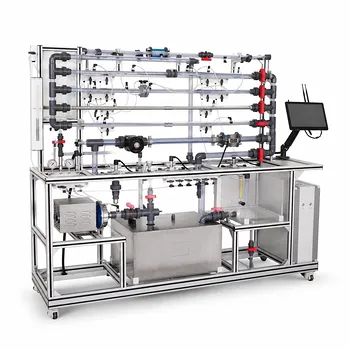
Mastering fluid dynamics and process control requires hands-on, visual learning. LABPARK provides state-of-the-art Educational and Vocational Unit Operations Pilot Plants in chemical engineering, bioprocess & biotech, and environmental & water treatment.
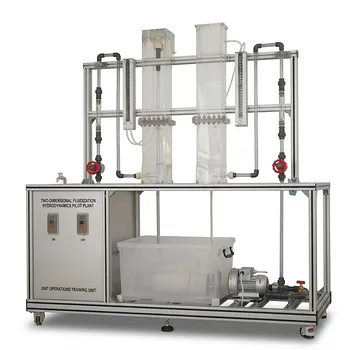
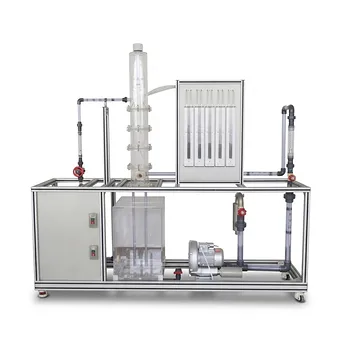
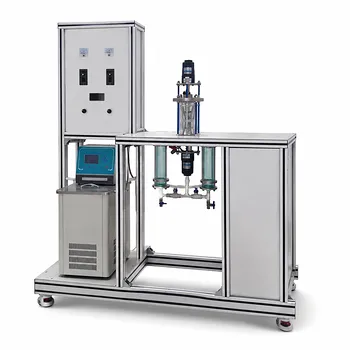
Tailored for universities, research institutes, and enterprises, our pilot plants feature highly transparent designs—like our Wurster-equipped fluid bed systems—to help students visualize complex thermodynamic processes and fluidization cycles.
Equip your training facility with industry-standard tools. Contact our experts today to find the perfect pilot plant solution for your curriculum!
Related Products
- Multi-Functional Drying Educational Unit Operations Pilot Plant
- Packed Bed Absorption Educational Unit Operations Pilot Plant
- Fluidized Bed Gas Solid Catalytic Reaction Educational Pilot Plant
- Comprehensive Liquid-Liquid Extraction Pilot Plant for Engineering Education
- Educational Rotary Disc Liquid-Liquid Extraction Pilot Plant
People Also Ask
- How do deviations in estimating latent heat impact pilot plant thermal systems? Avoid hardware mis-sizing.
- Why is the chemical plant startup schedule crucial? De-risk scale-up with pilot plants.
- Why Use PTFE & Hastelloy in Chemical Pilot Plants? Prevent Corrosion & Ensure Safety
- How to study gasification in pilot plants? Compare exit gas composition & efficiency
- When to transition from PID to adaptive control in pilot plants? Key process indicators.