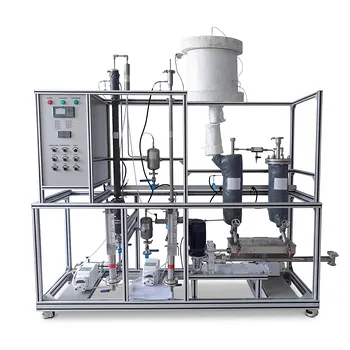
Alkali-catalyzed transesterification relies on high temperatures, aggressive purification, and struggles with acidic feedstocks, whereas enzyme-catalyzed processes operate under mild conditions, avoid washing, and seamlessly convert free fatty acids into fuel. For students configuring a pilot plant, the essential differences to study lie in reactor design, downstream separation complexity, and the resulting energy and waste profiles. These unit operations highlight a fundamental choice: tolerate a demanding purification train for a cheap catalyst, or invest in an expensive biological catalyst to radically simplify the process.
The central lesson for students is that the catalyst system dictates every downstream unit operation. Alkaline catalysts force a plant into high-temperature processing, acid neutralization, and multiple wash steps, while immobilized lipases eliminate these entirely at the expense of catalyst cost and a shift from stirred tanks to packed-bed reactors. The pilot plant should be configured to make these trade-offs measurable and tangible.
The Core Process Differences
Reaction Temperature and Energy Input
Alkali-catalyzed transesterification typically runs at 320–350 K, requiring a heated stirred-tank reactor and significant thermal energy input. In contrast, enzyme-catalyzed routes operate at 305–315 K, a much milder range that reduces heating demands and allows simpler temperature control. Students should measure energy consumption across both pathways to quantify this savings and understand its impact on process economics.
Feedstock Flexibility and Free Fatty Acid Handling
One of the starkest differences lies in how each process handles free fatty acids (FFAs). In alkaline conditions, FFAs saponify, forming soap that consumes catalyst, emulsifies phases, and complicates separation. Enzyme-catalyzed processes, however, directly esterify FFAs into Fatty Acid Methyl Ester (FAME), turning a liability into a yield boost. By running high-FFA feedstocks (e.g., waste oils) side by side, students can observe the alkaline process fail without pretreatment while the enzymatic route thrives.
Reactor Configuration and Catalyst Form
The physical form of the catalyst changes the reactor entirely. A classical alkaline pilot plant uses a stirred-tank reactor with a homogeneous base catalyst dissolved in methanol. An enzyme pilot plant typically employs immobilized lipase packed into a packed-bed reactor, allowing continuous operation and easy catalyst retention. Students should study pressure drop, residence time distribution, and catalyst deactivation patterns specific to each configuration.
Downstream Purification and Waste Generation
Purification is where the alkali-catalyzed route becomes operationally intensive. After phase separation, the FAME layer requires a neutralization vessel where acid addition removes residual catalyst but generates waste salts, followed by water washing and drying columns to meet fuel specifications. The enzyme-catalyzed process requires no neutralization and no washing, dramatically reducing wastewater and eliminating inorganic salt disposal. Quantifying these waste streams—volume, composition, and treatment cost—provides a powerful educational comparison.
Glycerol Recovery and By-Product Quality
In the alkaline route, glycerol recovery is difficult: the by-product phase contains base, soap, and methanol, requiring costly purification for any commercial value. The enzymatic route yields a cleaner glycerol stream with no salt contamination, allowing straightforward recovery and higher potential revenue. Students should analyze glycerol purity and estimate recovery costs as a key differentiator.
Understanding the Trade-offs
Catalyst Cost vs. Operational Savings
The enzymatic catalyst is significantly more expensive per activity unit than sodium or potassium hydroxide. However, the savings from eliminating neutralization chemicals, washing water, and wastewater treatment can close the gap. Students must mass-balance both routes to see whether the lower operating expenses of the enzyme process can offset the upfront catalyst cost—especially in a continuous packed-bed configuration where the enzyme stays in situ for long durations.
Product Purity and Yield Considerations
While enzymes avoid saponification losses, their reaction rates can be slower and may require longer residence times. Alkaline catalysts achieve fast, complete conversion but at the cost of yield loss with acidic oils. Students should compare final FAME yield, purity (including residual glycerol and moisture), and compliance with standards like ASTM D6751. Enzymatic processes often deliver a cleaner FAME phase immediately after phase separation, while alkaline FAME demands post-treatment.
Scalability and Industrial Relevance
Most commercial biodiesel today is produced via homogeneous alkaline catalysis, making it essential for students to understand its unit operations. However, the enzyme-catalyzed route is industrially attractive for low-quality feedstocks and offers a glimpse into future biorefining. The pilot plant study should emphasize why each method is chosen at scale: alkaline for capital simplicity with refined oils, enzymatic for feedstock flexibility and environmental compliance.
How to Design a Meaningful Pilot Plant Study
The goal is not to declare a winner but to make the process trade-offs concrete. Depending on your educational objective, prioritize the following:
- If your primary focus is on classical chemical engineering unit operations: Configure the plant with the full alkaline train—heated stirred tank, decanter, neutralization vessel, wash columns, and dryer. Have students troubleshoot emulsification and salt disposal.
- If your primary focus is on modern bioprocess intensification: Build the enzyme line with a packed-bed reactor, simple phase separation, and no washing. Let students analyze catalyst lifetime, pressure drop, and feedstock variability.
- If your primary focus is on holistic process evaluation and sustainability: Run both trains in parallel using identical, challenging feedstocks. Task students with comparing energy consumption per liter, water usage, waste generation, and total operating cost.
By instrumenting both process lines for mass and energy balances, the pilot plant transforms from a demonstration rig into a benchmarking platform that teaches the essence of bioprocess selection.
Summary Table:
| Parameter | Alkali-Catalyzed | Enzyme-Catalyzed |
|---|---|---|
| Reaction Temp | 320–350 K (High energy) | 305–315 K (Mild energy) |
| Reactor Type | Stirred-Tank (Homogeneous) | Packed-Bed (Immobilized) |
| FFA Handling | Saponification (creates soap) | Direct Esterification to FAME |
| Downstream | Neutralization & water washing | No washing or neutralization |
| By-Product | Impure glycerol (salts & soap) | High-purity, salt-free glycerol |
Bring Hands-On Process Engineering to Your Lab
Ready to equip your students or research team with advanced training systems? LABPARK provides state-of-the-art Educational and Vocational Unit Operations Pilot Plants in chemical engineering, bioprocess & biotech, and environmental & water treatment. Designed specifically for universities, research institutes, and enterprises, our modular pilot plants make complex process trade-offs tangible and measurable.
Contact LABPARK today to configure your custom pilot plant!
Related Products
- Bio-fermentation Ethanol Production Practical Training Unit Operations Pilot Plant
- Continuous Batch Extractive Distillation Educational Pilot Plant
- Multi-Functional Special Distillation Educational Pilot Plant
- Natural Product Extraction Unit Operations Training Pilot Plant
- Green Anhydrous Ethanol Refining Practical Training Pilot Plant
People Also Ask
- Why Use PTFE & Hastelloy in Chemical Pilot Plants? Prevent Corrosion & Ensure Safety
- Why Compare Predicted and Experimental Excess Enthalpy? Key to Accurate Pilot Plant Scale-up
- Why is the chemical plant startup schedule crucial? De-risk scale-up with pilot plants.
- When to transition from PID to adaptive control in pilot plants? Key process indicators.
- Why must batch and fed-batch fermentation pilot plants be designed to accommodate changing rheological conditions?