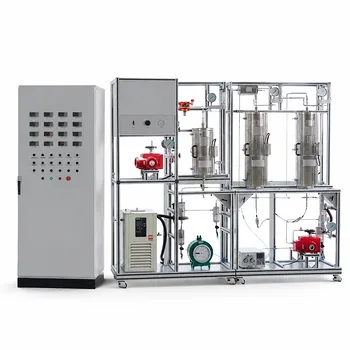
Your entrainer choice is the single most decisive factor in whether your azeotropic distillation pilot run becomes a clear, reproducible demonstration or a frustrating mess. The right agent must form a new, preferably minimum‑boiling azeotrope with at least a 10 K boiling point gap from the original components, and it must do so while being safe, low‑energy, and easy to separate in a teaching or research environment. In practice, this means you are searching for a compound that is heterogeneous, low‑dose, low‑latent‑heat, non‑corrosive, non‑toxic, and cost‑effective.
A successful azeotropic distillation pilot experiment relies on an entrainer that thermodynamically “breaks” the original azeotrope while also integrating smoothly into the plant’s hardware and safety envelope. The ideal entrainer forms a heterogeneous minimum‑boiling azeotrope, can be separated by gravity in the decanter, and requires minimal energy and inventory—all without corroding your glass column or endangering your team.
The Thermodynamic Imperative: Altering Relative Volatility
The fundamental job of an entrainer is to change the vapor‑liquid equilibrium so that separation becomes possible. It achieves this by introducing a new azeotrope—typically one that boils lower than the original mixture—creating a pathway to remove one component overhead.
Forming a New Azeotrope with a Clear Boiling Point Gap
Your entrainer must form an azeotrope with one or more of the feed components that has a boiling point at least 10 °C lower than the existing azeotrope you are trying to break. Without this gap, driving force for distillation vanishes.
In a pilot plant, this is non‑negotiable. A difference of less than 10 K leads to sloppy splits, poor reproducibility, and data that will confuse students or invalidate a research campaign.
Minimum‑Boiling vs. Maximum‑Boiling Azeotropes
Most educational and research azeotropic distillation setups use a minimum‑boiling entrainer that carries the lighter component overhead, leaving the target product in the bottoms.
This configuration is preferred because it aligns with standard column designs, reduces thermal stress on heat‑sensitive components, and keeps the more volatile, entrainer‑rich stream in the vapor phase where it can be easily condensed and decanted.
Designing for the Decanter: Why Heterogeneity Wins Hands‑Down
In a pilot plant, the ability to see phase separation happen turns an abstract concept into a tangible learning moment. That is why forming a heterogeneous azeotrope is one of the most important practical criteria.
Gravity Separation in the Pilot Plant Decanter
A heterogeneous azeotrope condenses into two immiscible liquid phases. The entrainer‑rich phase can be separated by simple gravity settling and returned directly to the column.
This eliminates the need for an extra distillation train to recover the entrainer, dramatically simplifying the pilot plant layout. Modern pilot columns with glass decanters and viewport windows let students and researchers watch the liquid‑liquid interface in real time—a powerful visual reinforcement of the phase equilibrium theory.
Avoiding Homogeneous Azeotropes When Possible
If the new azeotrope is homogeneous, you lose the simple decantation advantage. Recovery of the entrainer then requires a secondary separation step, making the experiment more complex, energy‑intensive, and harder to control.
For a pilot plant built around process understanding and simplicity, heterogeneity is a massive operational lever.
Operational Efficiency: Minimizing Energy and Entrainer Inventory
A pilot plant is a small‑scale mirror of industrial reality. You want to demonstrate the principles without burning excessive energy or tying up hazardous chemicals.
Low Latent Heat of Vaporization
The entrainer should have a low latent heat of vaporization. Because the entrainer is vaporized, condensed, and recycled many times throughout a batch or continuous run, its heat of vaporization directly drives reboiler duty.
A high‑latent‑heat entrainer can easily double the required heating duty for the same separation, making temperature control and energy balances both costly and less visually clear to students recording lab data.
Minimal Dosage Requirement
The amount of entrainer needed relative to the feed should be as small as possible. A low‑dosage entrainer translates into a smaller inventory in the column, faster achievement of steady state, and lower risk of contaminating product streams.
This also reduces the volume of entrainer that must be stored, handled, and eventually disposed of in a fume‑hood‑limited pilot plant bay.
Safety and Material Compatibility in a Pilot Plant
Azeotropic distillation often involves flammable solvents. In a teaching or research lab, safety is the overriding boundary condition.
Non‑Toxic and Non‑Corrosive Selection
Most pilot‑scale columns use glass sections, PTFE gaskets, and stainless‑steel packing. Your entrainer must be chemically compatible with these materials—avoiding chlorinated solvents that can attack gaskets, or corrosive acids that would ruin column internals.
Toxicity is equally critical. A high‑toxicity entrainer (e.g., benzene) may deliver excellent thermodynamics but introduces unacceptable exposure risk in a room where students lean over the unit to take manual samples. Modern pilot plant design leans heavily toward low‑toxicity, high‑flash‑point alternatives.
Thermal Stability and Long‑Term Cost
The entrainer should not decompose at column operating temperatures. Degradation products can accumulate as new low‑volatility impurities, alter pH, or foul the reboiler.
While cost is often secondary in research, a pilot plant that runs the same experiment multiple times per semester needs a chemical that is inexpensive and readily available to avoid annual budget surprises.
Understanding the Trade‑offs
No single compound will check every box perfectly. The art of pilot plant configuration lies in balancing competing priorities.
Thermodynamic Power vs. Safety
The most effective entrainers historically—like benzene for ethanol‑water—are often carcinogenic or highly toxic. Using safer replacements (cyclohexane, ethyl acetate, toluene) may require a slightly higher entrainer‑to‑feed ratio or a taller column, but the safety gain is almost always worth it in a teaching setting.
Heterogeneous Ease vs. Entrainer Availability
Some mixtures simply do not have a known heterogeneous entrainer that is both cheap and non‑toxic. In such cases, you may be forced to use a homogeneous entrainer with a secondary recovery step, accepting higher complexity in exchange for demonstrating the core azeotropic principle.
Pilot Plant Purpose Determines Acceptable Compromise
A research lab investigating new separation pathways might tolerate a more exotic or costly entrainer because the goal is to prove feasibility. An undergraduate unit ops lab, on the other hand, must prioritize reliability, visual clarity, and absolute safety—even if that means choosing a slightly less thermodynamically perfect agent.
Making the Right Choice for Your Specific Pilot Plant Goal
The final entrainer selection must reflect what you are trying to achieve. Use these goal‑based filters to narrow your choices.
- If your primary focus is visual demonstration and student learning: Prioritize heterogeneous azeotrope formation and a clear, stable phase boundary visible through glass components. Education always trumps the last fraction of separation efficiency.
- If your primary focus is research on a novel azeotropic separation: Start with the thermodynamic criterion—a boiling point gap ≥ 10 K—then screen for structural similarity to the key component you wish to extract, using homologous series or hydrogen‑bonding rules to maximize relative volatility.
- If your primary focus is minimizing operating cost and complexity: Seek the entrainer with the lowest latent heat and dosage requirement that still forms a heterogeneous azeotrope, while ensuring it is non‑corrosive and readily available at lab scale.
- If your primary focus is scaling up to a larger pilot or production column: Insist on an entrainer that is proven, thermally stable over extended runs, and inherently safe for closed‑loop recycling, avoiding those that degrade or form corrosive by‑products over time.
The right entrainer transforms a confusing VLE diagram into a clean, repeatable separation that your team can trust and learn from—choose with that end goal in mind.
Summary Table:
| Selection Criterion | Key Requirement | Why It Matters in Pilot Plants |
|---|---|---|
| Thermodynamics | Boiling point gap of ≥ 10 K | Provides the driving force needed for clean, reproducible separations. |
| Phase Behavior | Heterogeneous azeotrope | Allows easy gravity decanting, eliminating complex secondary separation. |
| Energy & Inventory | Low latent heat & minimal dosage | Reduces energy consumption, speeds up steady-state, and lowers chemical risk. |
| Safety & Materials | Non-toxic and non-corrosive | Ensures student/researcher safety and compatibility with glass/PTFE hardware. |
Optimize Your Chemical Engineering Lab with LABPARK
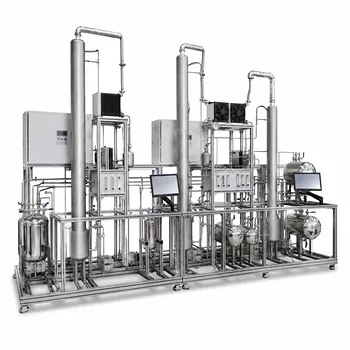
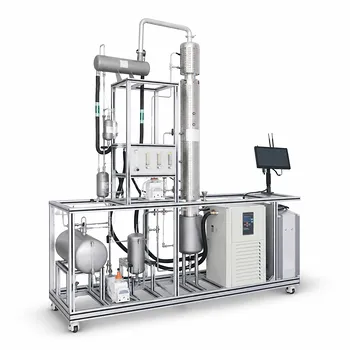
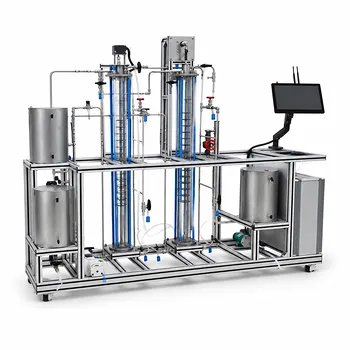
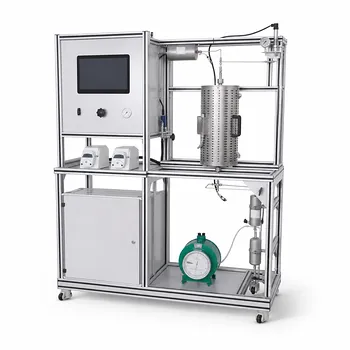
Ready to elevate your teaching and research capabilities? LABPARK provides state-of-the-art Educational and Vocational Unit Operations Pilot Plants in chemical engineering, bioprocess & biotech, and environmental & water treatment. Tailored for universities, research institutes, and enterprises, our pilot plants are designed for safety, durability, and clear visual learning.
Contact our engineering experts today to find the perfect pilot plant configuration for your lab!
Related Products
- Multi-Functional Special Distillation Educational Pilot Plant
- Ethyl Acetate Synthesis Unit Operations Pilot Plant for Practical Training
- Continuous Batch Extractive Distillation Educational Pilot Plant
- Green Anhydrous Ethanol Purification Extractive Distillation Unit Operations Training Pilot Plant
- Green Anhydrous Ethanol Refining Practical Training Pilot Plant
People Also Ask
- Why does simple distillation yield higher efficiency than flash distillation? Key thermodynamic differences.
- How does double temperature difference control improve distillation pilot plants? Stabilize purity.
- How to Integrate Spectroscopy in Distillation Pilot Plants for Advanced Process Control
- How to Verify Distillation Boundary Lines & Composition Regions with Pilot Plants
- Why is the acentric factor important in pilot plants? Fluid property prediction.