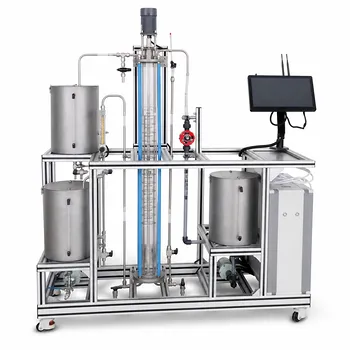
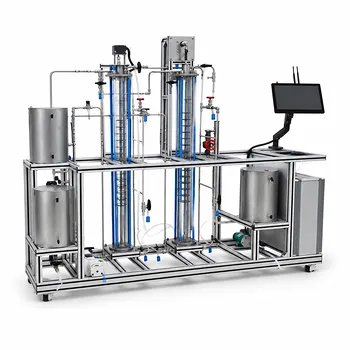
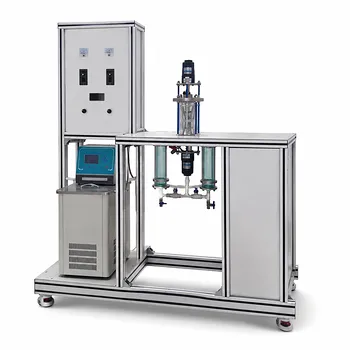
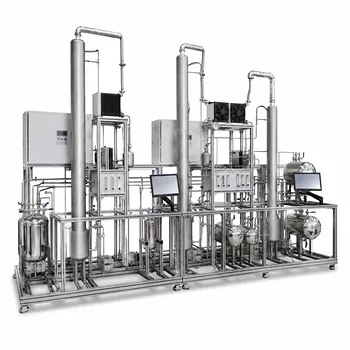
The answer comes down to three core process conditions. When configuring a chemical engineering unit operations lab, you should prioritize a liquid-liquid extraction pilot plant over a distillation system if you need to separate components with a relative volatility near 1.0 or forming azeotropes, recover a low-concentration solute from a high-boiling-point diluent, or handle highly heat-sensitive materials that would degrade in a thermal column.
Distillation fails economically or technically when volatility differences vanish, when you’re boiling enormous volumes of inert diluent, or when heat destroys your product. Liquid-liquid extraction sidesteps these problems by operating at ambient temperature with no phase change, making it the go-to choice for azeotropes, dilute high-boilers, and fragile biomolecules in a teaching or research pilot plant.
The Core Decision Framework: Three Primary Conditions
When you’re designing a unit-ops lab, the first question is not “which piece of equipment” but “what separation challenge am I actually modeling.” Liquid-liquid extraction gets prioritized when the process fluid presents one of these three clear failure modes for distillation.
When the Mixture Has a Relative Volatility Close to 1 or Forms an Azeotrope
Distillation relies on a meaningful difference in vapor pressures. If that difference collapses—typically when the relative volatility drops below about 1.2—the number of theoretical trays and the reflux ratio become economically absurd. For a lab pilot plant meant to demonstrate practical industrial behavior, a column separating close-boiling hydrocarbons like aromatics from aliphatics can require hundreds of stages, obscuring the core learning objective. Extraction, by contrast, leverages solubility differences that often remain large even when boiling points converge.
Azeotropic mixtures magnify the problem. Standard fractional distillation hits a composition wall where the vapor and liquid compositions become identical. While special distillation techniques (extractive or salt distillation) can break the azeotrope, they introduce a third component and shift the plant’s complexity into solvent management. A liquid-liquid extraction pilot plant can often achieve the same separation more straightforwardly, using an immiscible solvent that selectively dissolves one of the key components at room temperature. This keeps the lab module focused on fundamental mass transfer and phase equilibrium rather than on advanced column configuration.
When the Solute Is Present in Very Low Concentration and Has a High Boiling Point
This is a subtle but powerful economic signal. Imagine recovering acetic acid from a 2% aqueous solution, or extracting a valuable pharmaceutical intermediate out of a massive fermentation broth. In distillation, you would have to vaporize nearly all the water to concentrate the high-boiling solute, burning an enormous amount of energy for very little recovered mass. A research lab simulating such a process would face unrealistic utility costs and run times.
Liquid-liquid extraction flips the problem. You contact the dilute feed with a solvent that has a high affinity for the target solute, transferring it into a much smaller organic phase. Then, if needed, you can recover the solute from that solvent via a smaller, more efficient distillation or back-extraction step. The pilot plant demonstrates an integrated, energy-smart sequence rather than a brute-force evaporation. This condition applies especially in green chemistry modules, where energy efficiency is a core learning outcome.
When the Feed Contains Highly Heat-Sensitive Materials
Bioprocessing and natural product isolation frequently involve compounds—antibiotics, proteins, natural flavors, caffeine—that degrade at moderate temperatures. Even vacuum distillation, which lowers boiling points, can cause product loss or unwanted chemical transformations. In a hands-on educational lab, a liquid-liquid extraction plant can operate at ambient or chilled temperatures, letting students see separation of fragile molecules without charring or denaturing.
The supplementary references reinforce this point: extraction proceeds without a phase change, so the latent heat penalty disappears, and the operating temperature is set by the solvent’s boiling point and process design, not the solute’s thermal sensitivity. This makes it the default teaching platform for downstream processing of biochemicals, where extraction often precedes finishing steps like crystallization or chromatography.
Understanding the “Why” Behind the Choice
Beyond the three triggers, there’s a set of thermodynamic and practical drivers that solidify extraction’s advantage in a lab setting. As a technical advisor, you need to see the full logic board before committing equipment funds.
Avoiding Phase Change to Save Energy and Simplify Operations
Distillation is a thermal separation process: you add heat to vaporize the more volatile component and then remove heat to condense. That energy-intensive cycle dominates cost and requires robust utilities (steam, cooling water). In a pilot plant, this utility burden can limit what other experiments are run simultaneously.
Liquid-liquid extraction, by contrast, moves mass between two liquid phases. The energy needed is primarily for pumping and, in certain column types, mechanical agitation to create interfacial area. The process can run cold or at room temperature, which not only saves energy but also reduces safety risks associated with hot organic vapors.
Handling Systems That Defy Thermal Separation
The supplementary references mention “special distillation systems” for very low relative volatility or azeotropes. Those solutions—extractive distillation with a high-boiling solvent, azeotropic distillation with an entrainer—superficially resemble extraction because they introduce a third component to change relative volatilities. But the core physical mechanism is still thermal, and the pilot plant needs high-pressure steam, sophisticated solvent recovery columns, and often corrosion-resistant materials for acidic entrainers.
Liquid-liquid extraction takes a fundamentally different route, based simply on solubility differences. This makes it a cleaner teaching platform for the underlying thermodynamics: students directly measure distribution coefficients and watch phase separation, without the confounding variable of temperature probes and condensation dynamics. For research groups studying new solvent systems, it’s also faster to screen extractants at room temperature than to re-tune a distillation column’s pressure and reflux ratio.
Matching the Equipment to the Material System
The primary reference focuses on “when to choose extraction,” but a properly configured lab needs to think about the type of extraction equipment. The supplementary references break this down by required theoretical stages, throughput, settling behavior, and floor space.
For an educational lab, the equipment selection becomes a critical teaching point. A simple packed column or spray tower suits systems needing only 1–3 equilibrium stages, while a pulsed column or rotating disc contactor can pack 10–20 stages into a compact vertical unit. If the system forms stubborn emulsions—a common headache with certain bioprocess streams—the pilot plant might need a centrifugal extractor to force rapid separation, demonstrating how industrial reality shapes hardware choice.
Physical extraction (using inert solvents like MIBK) and chemical extraction (using reactive extractants like D2EHPA for metals) place different demands on wetted materials. A well-designed teaching plant will include borosilicate glass or PTFE internals so students can observe flow patterns while handling corrosive acidic extractants. This visibility is an educational bonus that no stainless steel distillation column can match.
Trade-offs and Limitations to Consider
No separation technology is a panacea. If you are deciding which pilot plant to build or procure, you must weigh extraction’s strengths against its inherent complexity.
Solvent Selection and Recovery Add an Extra Separation Task
Extraction solves the primary separation, but it creates a new one: you must recover and recycle the solvent. A pilot plant that showcases liquid-liquid extraction often needs a supporting distillation or evaporation step to isolate the product from the solvent, especially in research focused on high-purity API synthesis. This downstream recovery must be factored into the total cost and footprint. The reference framework is clear: extraction is prioritized when it dramatically reduces the main burden (e.g., vaporizing 98% water), even if a smaller finishing distillation is required.
Emulsion Formation Can Paralyze a Pilot Run
The supplementary references emphasize settling characteristics as a primary equipment selection factor. Systems with low interfacial tension or high viscosity can form stable emulsions that refuse to separate. In a student lab, this can derail a session. You may need to specify pulsed columns or centrifugal contactors if your target chemical system is prone to rag layers. This adds cost and maintenance complexity compared to a simple distillation column.
Material Compatibility Demands Careful Component Selection
Especially for chemical (reactive) extraction, the extractant is often acidic or basic. A pilot plant’s wetted materials must withstand corrosion, which often means moving from standard 316 stainless to PTFE, glass, or exotic alloys. Glass extraction columns, while visually excellent for teaching, are fragile and limit throughput. This trade-off between visibility, chemical resistance, and robustness must be explicitly weighed against the ubiquitous stainless steel packing of a distillation column.
The Educational Footprint Can Be Larger Than Expected
A distillation pilot plant is a single, tall column with a reboiler and condenser. An extraction train might require multiple mixer-settlers in series to achieve enough stages, occupying significant horizontal floor space. Alternatively, a tall vertical column saves floor space but needs sufficient headroom. The decision to prioritize extraction thus needs to account for the physical constraints of the laboratory bay, not just the process chemistry.
Making the Right Choice for Your Lab’s Goals
Your decision hinges on what you intend to teach or investigate. Use the following guide to match the technology to the objective.
- If your primary focus is demonstrating azeotrope-breaking fundamentals: Liquid-liquid extraction provides a direct, visual, room-temperature demonstration of how to separate ethanol from water without resorting to benzene (as in azeotropic distillation), making it safer and conceptually clearer.
- If your primary focus is bioprocessing or “green” extraction: Prioritize a liquid-liquid extraction pilot plant. It will allow you to recover heat-labile natural products, antibiotics, or organic acids at mild conditions, directly mirroring pharmaceutical downstream processing.
- If your primary focus is petrochemical separations of close-boiling aromatics/aliphatics: Extraction is the industrial norm (e.g., sulfolane process). A pilot plant with a rotating disc contactor will teach mass transfer in a way that a mock distillation unit cannot.
- If your primary focus is on scalable energy efficiency: Choose extraction for the classic high-dilution, high-boiling solute scenario. Students can measure the dramatic reduction in energy needed to recover acetic acid from water versus the corresponding steam consumption in a distillation simulator.
Your ultimate choice should be guided by the process conditions you want to master. When volatility works against you, when heat destroys your product, or when you’re fishing a precious drop of solute from an ocean of diluent, liquid-liquid extraction is not just an alternative—it becomes the definitive separation tool for a modern unit operations lab.
Summary Table:
| Process Condition | Distillation Challenge | Liquid-Liquid Extraction (LLE) Advantage | Target Application |
|---|---|---|---|
| Azeotropes / Volatility ≈ 1.0 | Requires excessive trays, high reflux, or complex entrainers. | Separates via solubility differences at room temperature. | Aromatics/aliphatics, ethanol-water separation. |
| Dilute High-Boilers | Extremely energy-intensive (must vaporize bulk solvent). | Extracts solute into small organic phase, saving energy. | Acetic acid recovery, fermentation broths. |
| Heat-Sensitive Solutes | Thermal degradation or product loss even under vacuum. | Operates at ambient/chilled temperatures with no phase change. | Pharmaceuticals, biomolecules, active ingredients. |
Upgrade Your Chemical Engineering Lab with LABPARK
Are you looking to optimize your chemical engineering, bioprocess & biotech, or environmental & water treatment curricula?
LABPARK provides state-of-the-art Educational and Vocational Unit Operations Pilot Plants specifically engineered for universities, research institutes, and enterprises. We help you choose the right configuration—whether advanced liquid-liquid extraction columns or classic distillation systems—to match your teaching objectives and research needs.
Contact our technical specialists today to receive a customized solution and quote!
Related Products
- Educational Rotary Disc Liquid-Liquid Extraction Pilot Plant
- Comprehensive Liquid-Liquid Extraction Pilot Plant for Engineering Education
- Gallium and Indium Selective Extraction Educational Pilot Plant
- Ternary Liquid-Liquid Equilibrium Educational Pilot Plant
- Liquid-Liquid Mass Transfer Coefficient Determination Educational Pilot Plant
People Also Ask
- How do density and IFT affect liquid-liquid extraction pilot plants? Optimize Column Performance
- In a liquid-liquid extraction pilot plant, how is a ternary-phase diagram utilized to determine solvent feed requirements?
- How are ternary phase diagrams and LLE data applied in extraction experiments? Optimize Pilot Plant Scale-up
- How Do Selectivity & Distribution Coefficients Influence LLE Pilot Plant Solvent Choice?
- How to Validate BIPs for LLE Pilot Plants? Steps to Align Simulations with Reality