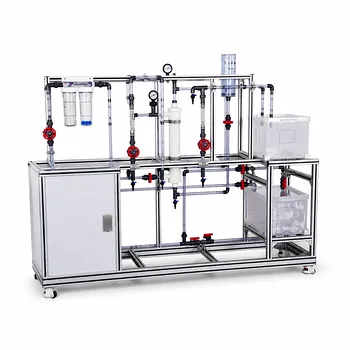
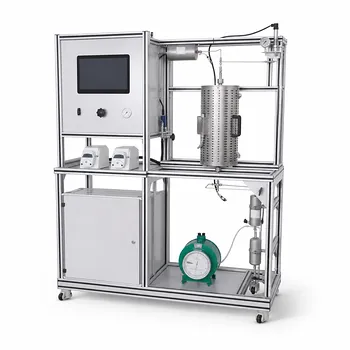
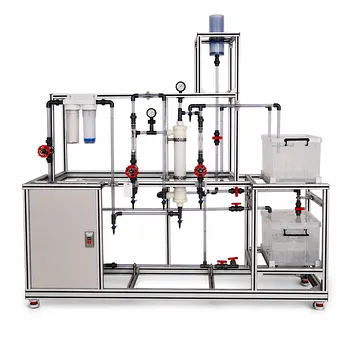
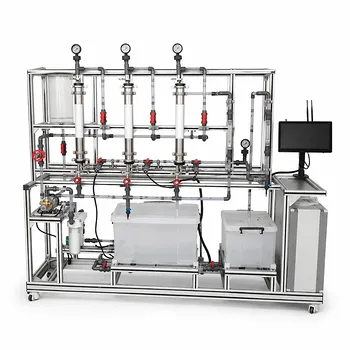
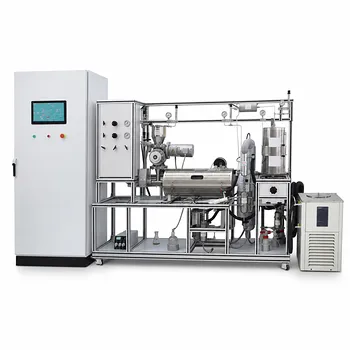
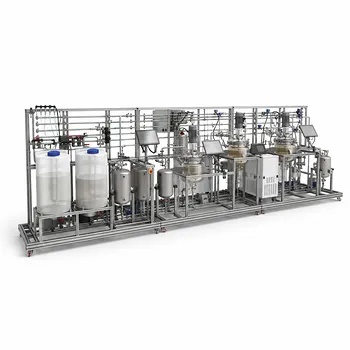
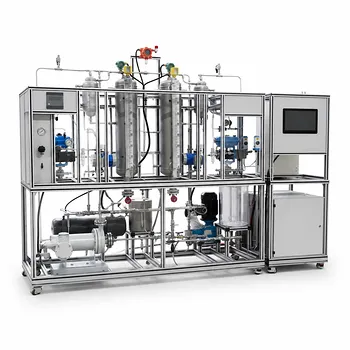
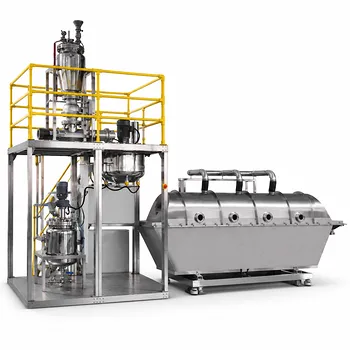
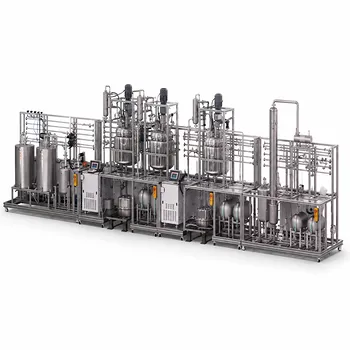
Converting corncobs or bagasse into furfural at pilot scale is not a single reactor—it is a carefully choreographed sequence of unit operations designed to handle a product that begins to destroy itself the moment it is formed. The essential unit operations required are acid-catalyzed hydrolysis of the hemicellulose fraction, dehydration of the liberated pentoses into furfural, and simultaneous steam distillation to strip the furfural from the reactive liquid phase. In physical terms, this translates to a heated reactor system, a steam-injection line, a distillation or stripping column, a condenser, and a liquid-liquid phase separator. Depending on the raw biomass handling strategy, a solid-liquid extraction or filtration step may also be needed to separate the pentose-rich liquor from the residual lignin and cellulose.
The core challenge in a pilot plant for furfural valorization is not the chemistry itself—it is the integration of reaction and separation. Because furfural rapidly degrades into tars and polymers under the same acidic conditions that create it, the only way to achieve meaningful yields is to continuously remove it via steam as it forms. This coupling of reactor and distillation teaches students process intensification, mass-balance closure, and the practical reality that a molecule’s instability can completely dictate plant design.
The Three Essential Unit Operations
Pilot-scale furfural production from agricultural waste centers on three interconnected physical steps. Understanding their function and interdependence is what transforms a theoretical conversion into a working demonstration plant.
Hydrolysis Reactor: Liberating Pentoses from Biomass
The first unit operation is a heated, acid-dosed reactor that breaks down the pentosan chains in the hemicellulose fraction.
In this vessel, the biomass is contacted with a dilute acid (often sulfuric) and water at elevated temperature. The acid catalyzes the cleavage of the glycosidic bonds in the hemicellulose, releasing pentose sugars (mainly xylose) into the liquid phase. This step can be conducted in a simple stirred-tank reactor operated in batch mode, or in a continuous tubular arrangement for higher throughput studies.
The key output is a pentose-rich hydrolysate still mixed with solid lignin and cellulose. How the plant handles this slurry determines the next unit operation.
Dehydration Reactor: Transforming Pentoses into Furfural
The pentose molecules must then undergo acid-catalyzed cyclohydration to form the furan ring of furfural.
In many pilot-plant configurations, this dehydration is not carried out in a separate vessel but as a rapid subsequent step in the same reactor or a downstream heated pipe. The reaction requires sustained heat and the acid already present from the hydrolysis stage. However, furfural is extremely reactive under these conditions—it easily condenses with itself or with reaction intermediates to form solid humins and tars. This instability is what makes the third unit operation non-negotiable.
Steam Distillation: The Key to Preserving Furfural
To prevent yield-killing degradation, the pilot plant must integrate a steam distillation or stripping unit directly with the reactor.
Steam is injected into the hot reaction mixture, volatile furfural partitions into the vapor phase, and the steam carries it out of the reactor. This continuous removal keeps the liquid-phase concentration of furfural low, drastically reducing the rate of side reactions. The steam–furfural vapor mixture then passes into a distillation column or a simple stripping section where the separation is refined. This is the single most critical design lesson of the pilot plant: without real-time product removal, the observed yield collapses.
The Supporting Cast: Separation and Utilities
Once the reaction–distillation core is established, additional unit operations are needed to handle the starting solid and the final product, and to keep the entire system running within defined parameters.
Solid-Liquid Extraction or Filtration
Depending on the reactor configuration, the spent biomass solids must be separated from the acidic hydrolysate either before or during the reaction.
Some pilot plants employ a dedicated solid-liquid extraction step upstream, where the pentose sugars are leached from the comminuted biomass before the solution is fed to the reactor. Others keep the solids in the reactor and separate them only at the end using a filter or centrifuge. In either case, this operation gives students hands-on experience with pressure filtration, centrifuge operation, or leaching kinetics—all essential unit operations in a complete valorization chain.
Condensation and Phase Separation
The vapor leaving the distillation column must be condensed, resulting in a two-phase liquid mixture of water and furfural.
A total condenser followed by a decanter or continuous liquid-liquid separator exploits the limited miscibility of furfural in water. The heavier aqueous phase is often recycled back to process, while the furfural-rich organic layer is collected as the primary product. This phase separation step is straightforward in principle but highly instructive for understanding equilibrium curves, decanter design, and product purities.
Infrastructure and Utility Demands
No pilot plant operates in isolation. Based on the utility requirements captured in educational plant design guidelines, a furfural pilot plant typically demands:
- Steam: For direct injection into the reactor and for heating jackets.
- Cooling water: For condensers and any jacketed vessel cooling.
- Electrical supply: For pumps, agitators, instrumentation, and control systems.
- Ventilation and safe drainage: Essential when handling hot acid and volatile organic vapors.
Verifying that the laboratory can supply these utilities at the required flow rates and pressures is a fundamental prerequisite for safe, accurate operation.
Understanding the Trade-offs and Pitfalls
A faithfully replicated pilot plant exposes every sensitivity that would be hidden in a textbook. The main operational trade-offs center on yield, corrosion, and complexity.
- Temperature versus degradation: Higher reactor temperatures accelerate both furfural formation and its subsequent degradation. The pilot plant teaches students to find the narrow operating window where net production is maximized.
- Acid handling and materials of construction: Hot dilute acid is corrosive. Pilot plants built from standard stainless steel may suffer rapid attack; glass-lined or advanced alloy components are often required, raising cost and maintenance complexity.
- Steam-to-biomass ratio: Excessive steam stripping improves furfural recovery but dilutes the vapor, increasing downstream separation energy costs. Too little steam invites dramatic yield losses.
- Batch versus continuous operation: A batch reactor with in-situ steam stripping is simpler to build but offers less representative data for scale-up. A continuous tubular reactor with downstream stripping column is more industrially relevant but heavier in instrumentation and control demands.
Acknowledging these trade-offs openly is what turns a pilot-plant project from a simple laboratory experiment into a genuine engineering education tool.
Making the Right Choice for Your Pilot Plant Goal
The selection and arrangement of unit operations should ultimately serve the plant’s primary purpose—whether that is training, research, or process demonstration. Consider the following starting points:
- If your primary focus is educational versatility: Choose a flexible stirred-tank reactor with an integrated steam distillation leg and a clear decanter. This configuration makes every unit operation visible, tractable, and easy to vary, giving students a complete process narrative.
- If your primary focus is maximizing furfural yield: Invest in a continuous steam-stripping reactor with precise temperature and pressure control, and keep the residence time in the hot acid zone as short as possible. The plant will be more complex, but it will generate the data needed for true process optimization.
- If your primary focus is scale-up readiness: Incorporate a solid-liquid pre-extraction step, a tubular dehydration reactor, and a packed stripping column. This sequence mirrors commercial operations and builds the mass balances and kinetic models required for a techno-economic assessment.
A pilot plant that turns corncobs into furfural is, at its core, a lesson in instability-driven design. By treating the reaction and separation as inseparable partners, you build not just a molecule, but a deep engineering understanding that scales well beyond the laboratory.
Summary Table:
| Unit Operation | Core Function | Critical Design Focus |
|---|---|---|
| Hydrolysis Reactor | Breaks down hemicellulose into pentose sugars | Temperature control & acid corrosion resistance |
| Dehydration Reactor | Converts pentoses into volatile furfural | Preventing furfural degradation & tar formation |
| Steam Distillation | Continuously strips furfural from liquid phase | Integrated reaction-separation to preserve yield |
| Phase Separation | Condenses vapors and decants furfural from water | Optimizing liquid-liquid equilibrium & recovery |
Accelerate Chemical Engineering Education with LABPARK
Are you looking to demonstrate advanced processes like biomass valorization in your laboratory?
LABPARK provides state-of-the-art Educational and Vocational Unit Operations Pilot Plants in chemical engineering, bioprocess & biotech, and environmental & water treatment. Designed specifically for universities, research institutes, and progressive enterprises, our systems offer students hands-on experience with process intensification, mass balance, and industrial-scale operations.
Contact us today to find the perfect pilot plant solution for your educational or research needs!
Related Products
- Green Anhydrous Ethanol Refining Practical Training Pilot Plant
- Hollow Fiber Ultrafiltration Membrane Separation Educational Pilot Plant
- Ethylbenzene Dehydrogenation Educational Unit Operations Pilot Plant
- Bio-fermentation Ethanol Production Practical Training Unit Operations Pilot Plant
- Natural Product Extraction Unit Operations Training Pilot Plant
People Also Ask
- How do deviation & overshoot serve as quality indicators in pilot plant control loop tuning?
- How is settling time measured on chemical engineering pilot plants? Master process control dynamics.
- How Batch vs. Continuous Pilot Plants Affect Polymer Distribution: Reactor Selection Guide
- What parameters are critical when teaching reactor mechanical design and safety? Key Pilot Plant Metrics
- How to Integrate Spectroscopy in Distillation Pilot Plants for Advanced Process Control