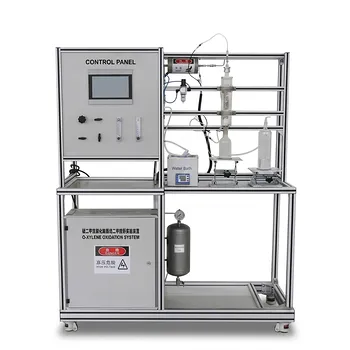
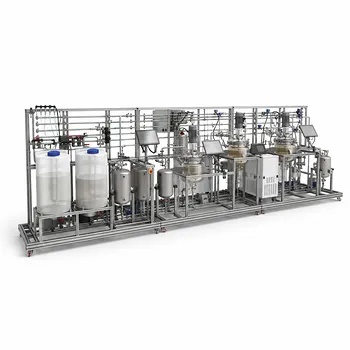
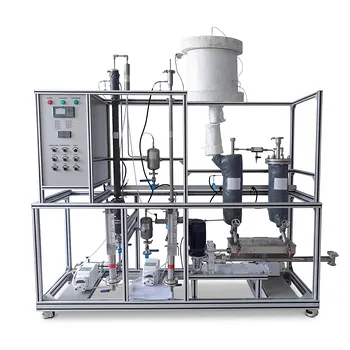
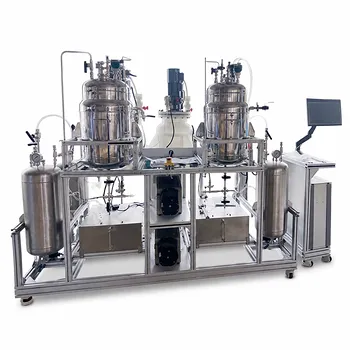
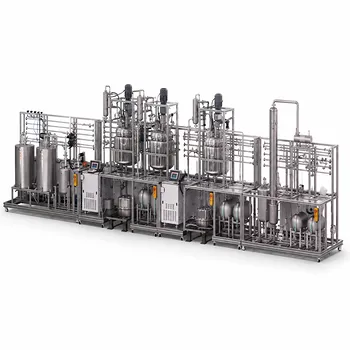
At the heart of any rigorous pilot-plant comparison of formaldehyde production routes is a sequence of four unit operations: a methanol‑air vaporization system, a fixed‑bed catalytic reactor, a gas‑liquid absorber, and a distillation column. The silver‑catalyzed process operates with excess methanol and incomplete conversion, so it demands a distillation column to recover and recycle unreacted methanol. The metal‑oxide‑catalyzed process runs with excess air and achieves over 99 % conversion, which allows the distillation step to be bypassed entirely. Anchoring the pilot plant around these four operations lets you directly observe how reactor selectivity and feed stoichiometry drive downstream separation requirements, utility loads, and overall plant economics.
Core Takeaway: The distillation column is the make‑or‑break unit that separates the two industrial routes. Silver catalysis needs it to salvage unreacted methanol; metal‑oxide catalysis does not. A platform that houses a vaporizer, a versatile reactor, a water absorber, and a modular distillation column—complete with a bypass line—is therefore essential to quantify the real cost and complexity differences between the two processes.
The Non‑Negotiable Front‑End: Feed Preparation and Reaction
Methanol Vaporization with Air Sparging
Both catalytic routes begin in a vaporizer where liquid methanol is stripped into a stream of air. The vessel typically employs air sparging to ensure thorough mixing and a homogeneous, combustible gas mixture. In the silver‑catalyzed route the vaporizer must deliver a methanol‑rich stream (excess methanol relative to air), while the metal‑oxide route demands an air‑rich, lean methanol feed. A pilot‑plant vaporizer must therefore be instrumented to accurately meter and vary the methanol‑to‑air ratio across these very different stoichiometries, often using mass‑flow controllers and pre‑heaters to guard against condensation.
The Catalytic Reactor and the Bed‑Design Trade‑off
Downstream of the vaporizer sits the fixed‑bed catalytic reactor, the unit where the defining chemistry occurs. For a side‑by‑side comparison, the reactor shell is usually designed to accept interchangeable catalyst inserts. The silver‑catalyzed process uses a shallow gauze or granular bed (10–50 mm deep) operating around 890 K and slightly elevated pressure; its residence time is intentionally short to favor formaldehyde over complete combustion. The metal‑oxide process—most commonly employing an iron‑molybdenum mixed‑oxide catalyst—runs at a different temperature profile and typically uses a deeper bed. The pilot reactor must therefore allow independent control of bed depth, temperature, and feed composition so that students and researchers can map conversion and selectivity differences back to the distinct mechanisms.
The Separation Backbone: Absorption and Distillation
Gas Absorption – Capturing the Product
The hot reactor effluent—a mixture of formaldehyde, water, unreacted methanol, nitrogen, and by‑products—is quenched and directed to a water absorber. In this counter‑current column, formaldehyde dissolves into water, forming a crude aqueous solution while the inert gases vent overhead. The absorber is identical in function for both catalyst systems, making it a shared unit. Proper operation demands careful temperature control to avoid formaldehyde polymerization and to ensure a stable liquid product that can be sampled for conversion and yield calculations.
Distillation – The Differentiator Between the Two Routes
The final unit operation is a distillation column, placed downstream of the absorber. Here the two processes diverge sharply. In the silver‑catalyzed route, the crude formaldehyde solution still contains significant unreacted methanol because the reactor conversion is incomplete—typically 70–80 % per pass. The distillation column strips this methanol from the top and recycles it back to the vaporizer, while a concentrated 50‑wt% formaldehyde solution is withdrawn from the bottom. In the metal‑oxide route, the reactor conversion exceeds 99 %, so the recovered solution already meets commercial specifications and the distillation column is bypassed entirely. A pilot plant dedicated to comparison must therefore include a fully functional distillation column together with the piping, valves, and control logic that allow it to be inserted or removed from the process stream on demand.
Why a Side‑by‑Side Pilot Plant Matters
Demonstrating the Link Between Reactor Selectivity and Downstream Cost
The most powerful lesson the pilot plant teaches is how a reactor’s performance dictates the entire separation train. The silver process’s lower selectivity forces a capital- and energy‑intensive distillation step, while the metal‑oxide process’s near‑total conversion eliminates that cost. By physically reconfiguring the plant, operators can quantify the additional utilities (steam, cooling water) and the extra column holdup associated with the silver route, making the economic trade‑offs concrete.
Handling Non‑Ideal Vapor‑Liquid Equilibria
The distillation step also exposes a deep chemical engineering challenge: formaldehyde, water, and methanol form reactive mixtures with hydrates and hemiformal adducts. This non‑ideality profoundly alters vapor‑liquid equilibrium (VLE) and can falsify simple separation predictions. Running the distillation column in the pilot plant gives students and engineers first‑hand experience with these complex equilibria, helping them understand why industrial columns demand rigorous thermodynamic models and careful tray‑efficiency estimates.
Common Pitfalls to Avoid in Pilot Plant Design
When designing the modular pilot plant, several traps can undermine its value as a comparison tool:
- Omitting the distillation bypass flexibility: A fixed, always‑on column forces the metal‑oxide route to bear separation costs it does not incur industrially, corrupting the comparison.
- Ignoring methanol‑water‑formaldehyde VLE complexities: Treating the system as ideal leads to unrealistic column operation and prevents accurate methanol recovery calculations for the silver route.
- Under‑instrumenting the vaporizer: Inability to independently set methanol and air flow rates blurs the distinction between the two feed regimes, making it impossible to attribute performance differences to the correct cause.
- Assuming the same reactor temperature profile works for both catalysts: The silver bed needs a rapid quench to avoid deep oxidation; the metal‑oxide bed demands its own thermal management. A single‑zone heater without the ability to mimic both profiles will mask true catalyst behavior.
Making the Right Choice for Your Educational or R&D Goal
- If your primary focus is reactor engineering and catalyst comparison: Ensure the reactor internals can be swapped quickly and that the control system logs axial temperature profiles. The vaporizer and absorber can be standard, but invest in the reactor’s flexibility first.
- If your primary focus is process economics and energy integration: Design the distillation column with state‑of‑the‑art energy‑metering. Run the silver route with column online and the metal‑oxide route with the bypass, then directly compare steam and cooling‑water usage.
- If your primary focus is fundamental thermodynamics and separations: Size the distillation column to accommodate long‑term, steady‑state runs so you can collect reliable VLE samples and validate the non‑ideal models required for industrial design.
A pilot plant that couples a flexible front‑end with a switchable separation train does far more than make formaldehyde—it reveals the inseparable link between catalyst chemistry and plant‑wide economics.
Summary Table:
| Unit Operation | Silver-Catalyzed Route | Metal Oxide-Catalyzed Route |
|---|---|---|
| Methanol Vaporizer | Delivers methanol-rich (excess methanol) feed | Delivers air-rich (lean methanol) feed |
| Fixed-Bed Reactor | Shallow catalyst bed, 890 K, incomplete conversion | Deeper mixed-oxide bed, >99% conversion |
| Gas-Liquid Absorber | Captures crude formaldehyde-water-methanol mix | Captures high-purity formaldehyde-water mix |
| Distillation Column | Required to recover and recycle unreacted methanol | Bypassed (unreacted methanol is negligible) |
Upgrade Your Chemical Engineering Lab with LABPARK
Are you looking to provide students or research teams with hands-on experience in process economics, reaction engineering, and complex separation equilibria?
LABPARK designs and delivers state-of-the-art Educational and Vocational Unit Operations Pilot Plants in chemical engineering, bioprocess & biotech, and environmental & water treatment. Specifically tailored for universities, research institutes, and enterprises, our modular pilot plants feature:
- Process Flexibility: Easily configure bypass lines, swap reactor beds, and study competing industrial pathways in one system.
- Advanced Instrumentation: Real-time data logging for temperature profiles, mass flows, and energy consumption.
- Industrial Fidelity: Expose students to real-world chemical challenges like non-ideal VLE and heat integration.
Bring industrial reality to your laboratory—contact LABPARK today to customize your unit operations pilot plant!
Related Products
- O-Xylene Oxidation to Phthalic Anhydride Educational Unit Operations Pilot Plant
- General Purpose Cosmetics Production Unit Operations Training Pilot Plant
- Bio-fermentation Ethanol Production Practical Training Unit Operations Pilot Plant
- Ethylbenzene Dehydrogenation Educational Unit Operations Pilot Plant
- Methanol Synthesis and Catalyst Performance Evaluation Educational Unit Operations Pilot Plant
People Also Ask
- Why determine reaction order & activation energy in pilot plants? Key to safe scale-up.
- What materials fit high-temp oxidation pilot plants? Key Hastelloy & Titanium Requirements
- Under what conditions can axial diffusion be neglected? Reactor Simulation Guide
- What limitations exist in high-temp pilot reactor design? Key Material & Safety Rules
- How are sensitivity functions applied to parameter estimation in chemical reactor pilot plants? Guide