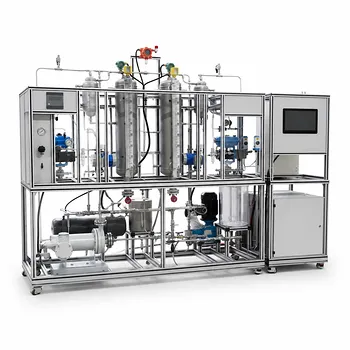
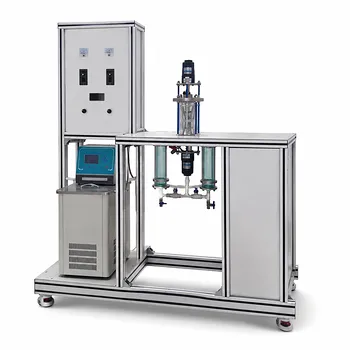
A pilot plant’s brain is only as sharp as its senses and limbs.
To interface with process sensors and actuators, you need four core types of PLC I/O modules: digital input for binary signals from level switches and pushbuttons, digital output for driving solenoid valves and pump relays, analog input for continuous measurements like pH and dissolved oxygen, and analog output for modulating control valves and variable‑speed drives. Together, these modules translate the physical world into a precise, closed‑loop control system.
The wrong I/O mix—or ignoring signal type and environmental demands—turns your automation backbone into a guessing game. In bioprocess and water‑treatment pilots, stable control starts with matching each field device to the correct input/output module, then protecting those signals from the electrical noise of wet, conductive environments.
The Four Pillars of Pilot Plant I/O
A bioreactor or a flocculation basin is a chaotic symphony of on/off events and smoothly changing variables. The PLC organizes this into a clean data stream through four distinct module types.
Digital Input Modules – Capturing Discrete States
Digital input (DI) modules read binary “1” or “0” signals.
They confirm that a tank’s high‑level float switch has tripped, a valve limit switch reports “fully closed,” or an operator has pressed the emergency stop.
These modules typically accept 24 V DC or 120 V AC signals and provide optical isolation to protect the PLC backplane.
Digital Output Modules – Commanding On/Off Actions
Digital output (DO) modules send binary commands into the field.
They energize solenoid valves for chemical dosing, start/stop feed pumps via interposing relays, and light up status beacons.
Like their input counterparts, they use transistor or relay outputs—relays for high inrush currents, transistors for fast, wear‑free switching.
Analog Input Modules – The Eyes of Your Process
Biotech and water‑treatment pilots live on continuous variables.
Analog input (AI) modules convert signals—almost always 4‑20 mA (sometimes 0‑10 V)—from transmitters measuring temperature, pH, dissolved oxygen, turbidity, pressure, and flow.
The 4‑20 mA current loop is preferred because it’s immune to voltage drop over long cable runs and provides a built‑in “live zero” to detect broken wires.
Analog Output Modules – Precise Actuator Control
When you need to smoothly vary a parameter, analog output (AO) modules translate digital setpoints into a proportional control signal.
They drive control valves to throttle steam for temperature regulation, send speed references to variable frequency drives (VFDs) on recirculation pumps, or adjust metering pump stroke length for precise nutrient addition.
The resulting continuous feedback loop—measure with AI, decide in the CPU, command with AO—is the essence of PID control.
The Hidden Complexity: Signal Integrity in Wet Environments
Pilot plants mix water, salts, and agitated vessels—a recipe for electrical noise.
The I/O choice isn’t just about signal type; it’s about delivering a clean, reliable signal despite the chaos.
Why Isolation Matters More Than You Think
Ground loops form easily when sensors in conductive media share a common reference with the PLC.
Galvanically isolated analog input modules break these loops, preventing offset drift in your pH reading or flow totalizers.
In a water‑treatment skid, a single non‑isolated sensor can inject noise that corrupts every channel sharing the same power supply.
4‑20 mA vs. 0‑10 V: A Practical Survival Tip
You will find both, but 4‑20 mA dominates for good reason.
Voltage signals degrade over distance and act like antennas for variable‑frequency drive noise.
If a legacy sensor only offers 0‑10 V, mount an isolated converter near the device—never run a high‑impedance voltage signal across the plant floor.
Environmental Hardening
Look for modules with conformal coating and wide temperature ratings.
Water‑treatment plants can be humid and condensate‑prone; bioprocess SIP (steam‑in‑place) cycles expose nearby electronics to radiant heat.
Ruggedized I/O avoids intermittent faults that are impossible to troubleshoot later.
Understanding the Trade‑offs
No single I/O family is perfect. Objective awareness of limitations keeps your design honest.
- Cost versus channel density: High‑density 16‑ or 32‑channel modules save space but raise the risk of a single module failure knocking out multiple loops. Lower‑density (4‑ or 8‑channel) cards offer finer isolation and easier maintenance.
- Speed versus filtering: Very fast analog input modules (sub‑millisecond) capture pressure pulsations but can introduce aliasing. Slower, integrated‑filter modules reject 50/60 Hz hum without external conditioning—critical for clean water process signals.
- Resolution versus dynamic range: A 12‑bit analog input gives 4096 steps, fine for level measurements; 16‑bit resolution is needed when logging subtle pH trends or validating mass‑flow sensor linearity for data‑integrity reports.
- Mixed I/O versus dedicated modules: Some compact PLCs offer cards with a few DI, DO, AI, and AO points. They simplify wiring but force compromises—if you need eight analog channels and the mixed module provides only two, you end up with dead points and extra nodes.
- Relay outputs vs. solid‑state: Relay DO modules handle large inductive loads but wear out. Solid‑state outputs last forever but can leak enough current to hold small solenoid valves partially energized—a nightmare in a dosing line.
Common Pitfalls to Avoid
Even experienced engineers slip here. These are the errors that turn commissioning into crisis.
Underestimating Power Requirements
Analog loops need 24 V DC loop power. Many modules have a limited power budget per channel.
Daisy‑chaining multiple 4‑20 mA sensors off the same supply without checking total load can cause voltage sag, making every transmitter read 3.8 mA—the universal “fail‑low” state.
Forgetting About Signal Span
A 0‑100 psi pressure transmitter outputs 4‑20 mA. If your AI module scales 4‑20 mA to 0‑100, a 3.5 mA broken‑wire signal shows as negative pressure.
Always configure module diagnostics to detect out‑of‑range currents (<4 mA or >20 mA) and trigger an alarm, not a control action.
Mixing Intrinsically Safe and Non‑IS Signals
Pilot plants handling solvents or oxygen‑enriched off‑gas may require intrinsic safety (IS) barriers.
Those barriers work only with specific IS‑rated AI modules. Placing a standard module behind a barrier risks shunt‑diode zener failure—and a spark.
Ignoring Channel‑to‑Channel Crosstalk
Cheap analog modules can suffer crosstalk when one channel carries a fast‑switching signal while its neighbor reads a sensitive dissolved‑oxygen probe.
Check the manufacturer’s specification for “channel isolation” or “cross‑talk rejection” at the frequencies you expect (like VFD carrier harmonics).
Making the Right Choice for Your Goal
Your specific process objectives determine which I/O characteristics take priority. Use this decision framework to cut through the datasheets.
- If your primary focus is biological culture stability: Invest in high‑resolution, galvanically isolated analog input modules. A 0.01 pH drift from a ground loop can silently kill a mammalian cell line.
- If your primary focus is ruggedness in a water‑treatment skid: Choose modules with robust 4‑20 mA inputs, solid‑state digital outputs, and conformal coating. Simplicity and immunity to moisture trump advanced features.
- If your primary focus is fast control loops (e.g., dissolved oxygen cascade): Select analog input/output modules with conversion times under 10 ms and support for PID loop execution directly on the module backplane, avoiding CPU scan‑lag.
- If your primary focus is initial build cost: Use high‑density digital modules and consolidated mixed I/O cards, but never sacrifice isolation on the analog channels that guard your most critical measurements.
- If your primary focus is data integrity for regulatory filings: Pair 16‑bit or higher analog inputs with non‑volatile onboard firmware that timestamps every sample, ensuring the module itself becomes part of the data trail.
Selecting pilot‑plant I/O is never just about pinouts—it’s the engineering discipline that turns a collection of sensors and valves into a predictable, trustworthy process.
Summary Table:
| I/O Module Type | Signal Type | Primary Function | Pilot Plant Application Examples |
|---|---|---|---|
| Digital Input (DI) | Binary (On/Off, 24V DC / 120V AC) | Captures discrete states | Level switches, emergency stops, limit switches |
| Digital Output (DO) | Binary (On/Off, Relay/Transistor) | Commands discrete actions | Solenoid valves, pump start/stop, status beacons |
| Analog Input (AI) | Continuous (4-20 mA / 0-10 V) | Measures variable parameters | pH, dissolved oxygen, temperature, flow sensors |
| Analog Output (AO) | Continuous (4-20 mA / 0-10 V) | Modulates control devices | VFD speed control, steam control valves, dosing pumps |
Build a More Reliable Automation System with LABPARK
Designing the control system for a pilot plant requires perfect synchronization between your sensors, actuators, and PLC modules. LABPARK provides advanced Educational and Vocational Unit Operations Pilot Plants in chemical engineering, bioprocess & biotech, and environmental & water treatment tailored for universities, research institutes, and enterprises.
Whether you need to configure precise PID loops, eliminate electrical noise, or choose the right I/O mix for wet environments, our technical experts are here to help.
Contact LABPARK today to optimize your pilot plant setup!
Related Products
- Electrochemical Water Treatment Educational Unit Operations Pilot Plant
- Natural Product Extraction Unit Operations Training Pilot Plant
- Quantitative Dosing and Liquid Flow Control Educational Unit Operations Pilot Plant
- Electrolytic Hydrogen Production Educational Unit Operations Pilot Plant
- Multi Pump Fluid Transport Process Piping Unit Operations Training Pilot Plant
People Also Ask
- What design features do educational electrochemical pilot plants utilize to manage gas liberation and water loss?
- How can unit operations pilot plants show lead-acid concentration vs state of charge? Real-time monitoring guide.
- How do educational electrochemical pilot plants scale up electrolysis? Master industrial engineering.
- How to Estimate Sulfate in Water Treatment Pilot Plant Deposits: Gravimetric Guide
- How can foaming be managed during steam generation experiments in water treatment unit operations pilot plants? Tips