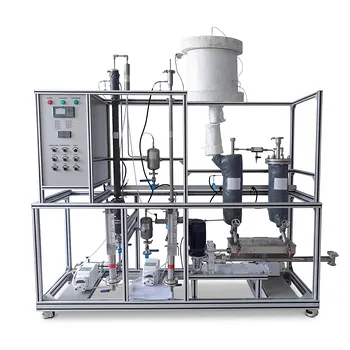
The absolute first filter for any reactive distillation process is the alignment of reaction and separation conditions. If the reaction doesn't happen where the distillation naturally occurs, the entire integrated concept fails. Successfully running a process in a reactive distillation pilot plant is not about compromising one for the other, but finding a precise thermodynamic and kinetic sweet spot where the reaction drives separation, and separation drives the reaction.
The core challenge is a fundamental conflict: most reactions need time, while distillation favors equilibrium. The winning criteria combine a liquid-phase, moderately fast, and non-endothermic reaction whose operating window perfectly overlaps with the vapor-liquid equilibrium of the mixture, allowing the immediate removal of a product to break chemical equilibrium.
The Kinetic Boundary Conditions
The Non-Negotiable: Liquid-Phase Reaction
The reaction must occur entirely in the liquid phase. Reactive distillation relies on the intimate contact of liquid and vapor on the column's packing or trays. If the reaction happens in the vapor phase, the catalyst would be bypassed, and the separation mechanism would not selectively remove the product from the reaction zone.
The Goldilocks Principle of Reaction Rate
The reaction time must fall within a narrow window. It cannot be excessively long relative to the column's liquid residence time. If the reaction is too slow, conversion will be negligible during the time the liquid spends on each tray. The process would then require an impractically large column with massive liquid holdups, defeating the purpose of process intensification.
The Temperature-Rate Floor
The operating temperature must be high enough for viable kinetics. This is a direct trade-off, famously illustrated by the CO shift reaction. High temperatures are needed for a fast reaction, but they may limit equilibrium conversion for exothermic systems. A pilot plant must demonstrate this tension by maintaining precise, multi-zone temperature control to find the optimal catalyst bed profile.
The Thermodynamic Compass
Perfecting the Temperature-Pressure Window
This is the most critical synchronization. The reaction temperature must closely match the bubble point of the desired product at the column's operating pressure. This allows the product to vaporize instantly upon formation, stripping it from the reactive liquid phase. If the product boils at a much higher temperature than the reaction requires, it will remain a liquid, and the reaction equilibrium will stall.
The Energy Balance of the Reaction
The reaction cannot be strongly endothermic. An endothermic reaction would consume the sensible heat of the liquid mixture, disrupting the vapor-liquid equilibrium and mass transfer. For exothermic reactions, the heat of reaction is an asset. It is directly utilized to vaporize the liquid, a process known as heat integration, which reduces the reboiler energy load and promotes a near-isothermal operation.
Phase Equilibrium as the Separation Limit
The driving force for distillation is a difference in chemical potential between phases. Phase equilibrium is established when the chemical potential of a component is identical in the liquid and vapor. This defines the theoretical limit of separation. In a reactive system, the reaction equilibrium manifold continuously shifts this target, making the dynamic path on a residue curve map (RCM) the essential guide to determining if a pure product is even reachable.
The Catalyst and Flow Dynamics Constraint
Avoiding Hydraulic Failure
The physical presence of the catalyst is as important as the chemistry. The column relies on a two-phase countercurrent flow—liquid flowing down and vapor rising. A standard powder catalyst would simply flood the column, creating a pressure drop that stops operation. The catalyst must have a specific morphology, packed into structured envelopes that ensure sufficient active surface area while keeping vapor and liquid pathways open.
Operational Window for Catalyst Activity
The column’s temperature profile must not deactivate the catalyst. The selected operating pressure and temperature range must simultaneously satisfy the boiling points for separation and maintain the catalyst's high activity. For instance, if a catalyst requires a minimum temperature of 300°C but the reaction mixture boils at 250°C at the top, the reactive zone must be strategically positioned where the column's thermal profile aligns.
Understanding the Common Pitfalls
The Saddle Point Trap
The most subtle thermodynamic failure occurs when every component in the reaction mixture is a distillation saddle point. In this scenario, no pure product is a stable or unstable node, meaning no direct path exists to a pure component via distillation. This is not a failure of kinetics but of topology. A standard reactive distillation column will fail here, necessitating a switch to Batch Reactive Extractive Distillation (BRED), where an entrainer is added to alter the residue curve map.
The Column Configuration Mismatch
Even with perfect kinetics, choosing the wrong column configuration in a pilot plant will yield confusing results. The selection is rigidly tied to product identity:
- A Batch Rectifier works only if the desired product is an unstable node (UN), leaving from the top.
- A Batch Stripper works only if the product is a stable node (SN), leaving from the bottom.
- A Middle Vessel Column is necessary when both unstable and stable node products share a distillation region.
Making the Right Choice for Your Pilot Plant Operation
Your approach should be determined by your primary analytical goal.
- If your primary focus is demonstrating kinetic principles: Prioritize the reactor's multi-zone temperature control and liquid holdup. Ensure the system can clearly show how a change in reflux ratio alters the residence time and, consequently, the conversion rate.
- If your primary focus is proving a thermodynamic separation concept: Start with a residue curve map analysis to confirm your target product is a stable or unstable node, and verify that the reaction bubble point aligns with your column's operating pressure before any equipment is assembled.
- If your primary focus is training operators on process control: Use a batch distillation configuration to teach the dynamic relationship between material balance, reflux ratio, and column pressure. The transient nature of batch operation forces operators to understand that a change in distillate flow rate directly disrupts the internal concentration profile.
A reactive distillation pilot plant succeeds when the driving force of the reaction is married to the driving force of separation under a single, stable thermal roof.
Summary Table:
| Criterion Type | Key Requirement | Operational Impact |
|---|---|---|
| Kinetic | Liquid-phase reaction | Ensures reactant-catalyst contact and selective product removal |
| Kinetic | Optimal reaction rate | Aligns reaction time with column liquid residence time to prevent bypass |
| Thermodynamic | Temp-pressure alignment | Reaction temperature matches bubble point for instant product vaporization |
| Thermodynamic | Exothermic heat balance | Minimizes reboiler energy load through integrated heat of reaction |
Accelerate Your Chemical Engineering Research & Training with LABPARK
To successfully model complex chemical processes like reactive distillation, having the right hardware is essential. LABPARK designs and manufactures high-performance Educational and Vocational Unit Operations Pilot Plants in chemical engineering, bioprocess & biotech, and environmental & water treatment.
We support universities, research institutes, and enterprises by delivering:
- Hands-on training tools for process control, thermodynamics, and kinetics.
- Scalable, robust pilot systems to validate research and process intensification concepts.
- Tailored engineering solutions built to match your specific curriculum or research goals.
Ready to elevate your laboratory capabilities? Contact us today to discuss your pilot plant requirements!
Related Products
- Multi-Functional Special Distillation Educational Pilot Plant
- Continuous Sieve-Plate Distillation Pilot Plant for Unit Operations Laboratory Education
- Electrolyte Distillation Purification and Formulation Educational Pilot Plant
- Green Anhydrous Ethanol Purification Extractive Distillation Unit Operations Training Pilot Plant
- Dual-Mode Rectification Pilot Plant for Practical Training Unit Operations
People Also Ask
- Why does simple distillation yield higher efficiency than flash distillation? Key thermodynamic differences.
- How to Integrate Spectroscopy in Distillation Pilot Plants for Advanced Process Control
- How does double temperature difference control improve distillation pilot plants? Stabilize purity.
- How Batch vs Continuous Configuration Affects Distillation Pilot Plant Versatility & Footprint
- How to Verify Distillation Boundary Lines & Composition Regions with Pilot Plants