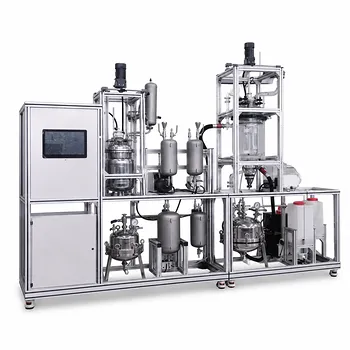
You need to think beyond simple checklists and build a multi-layered defense system. The absolute bedrock is preventing the fire triangle from ever forming inside the vessel. This is achieved by integrating inert gas blanketing with nitrogen to keep oxygen levels below the flammability threshold, combined with explosion-proof structural designs, strategically placed flame arresters, and a robust web of automatic interlocks, alarms, and pressure relief systems. These aren't just safety features; they are the physical embodiment of professional, industrial risk management that you are also teaching.
The surface need is for a list of safety equipment. The deep need is for a systematic safety philosophy. Integrating these measures into a student pilot plant does two critical things: it physically protects the operator and it ingrains the layered, defense-in-depth thinking required to handle flammable hazards in any professional setting.
Building the Foundation: Intrinsic Safety and Leak Prevention
The most effective safety measures are those that eliminate the hazard at its source. For a student pilot plant, this begins with design choices that make it inherently difficult for a dangerous situation to arise.
The Critical Role of Containment and Equipment Design
Your first line of defense is preventing the release of flammable vapors. This requires meticulous attention to the physical design.
Prioritize high-quality welded joints over flange connections wherever possible. This significantly reduces the number of potential leak points where vapors can escape into the laboratory environment.
Pay special attention to dynamic equipment. The shaft seal on a standard agitator is a notorious leak point and a potential ignition source if it fails. A powerful, intrinsically safer alternative is the liquid jet mixer, which has no rotating shaft or mechanical seal, effectively removing this risk entirely.
Why Material Compatibility is a Safety Feature
Selecting the correct materials for every wetted part is a non-negotiable safety task. The materials must be chemically compatible with the flammable solvents you’re using, like toluene or acetone.
Construction components should be chosen to minimize fire risks. This often means specifying stainless steel, high-density polyethylene (HDPE), or polypropylene. For storage, robust double-walled insulated steel safety cabinets provide an extra layer of protection for flammable feed and product containers.
Neutralizing the Threat: Managing the Atmospheric Hazard
Once you’ve secured the process containment, the next layer of defense is to control the atmosphere inside the equipment, directly combating the potential for an explosive vapor-air mixture.
Inert Gas Blanketing: The Heart of Explosion Prevention
This is the definitive answer to preventing internal fires and explosions. By introducing an inert gas, typically nitrogen, to purge the vapor space in feed and product tanks, you actively displace oxygen.
The goal is to maintain the oxygen concentration below the material’s limiting oxygen concentration (LOC) , ensuring the vapor mixture is non-flammable regardless of the fuel concentration. This is the primary method for complying with standards like NFPA 69 for explosion prevention systems.
Designing for the Worst Case with Explosion Protection
While prevention is the goal, you must prepare for a failure scenario. This is where explosion protection measures come in.
Install flame arresters on piping to prevent a flame front from propagating through the system. Incorporate deflagration relief vents designed in accordance with NFPA 68. These vents safely direct the pressure wave of an explosion out of the vessel, preventing catastrophic equipment rupture.
The Active Safety Net: Monitoring and Automated Response
Physical designs can be compromised, and conditions can change rapidly. An integrated system of sensors, alarms, and automated actions is your active safety net.
Layering Control, Alarms, and Interlocks
This layer of the safety concept must be fully automated and fail-safe. It starts with a Basic Process Control System (BPCS) to maintain stable temperatures, pressures, and flows.
If the BPCS cannot handle a deviation, critical alarms must alert the students to intervene. If the deviation crosses a dangerous threshold, the final automated layer—the Safety Instrumented System with automatic interlocks—must take over. These interlocks should safely halt the distillation or extraction run, shutting off heat sources and closing critical valves.
The Sensory System: Detecting the Invisible Threat
You cannot rely on human senses to detect vapor accumulation. The plant must be equipped with a dedicated sensor network.
Install fixed gas detectors with alarm functions at strategic points near the pilot plant, specifically around pumps, vessels, and valves. These sensors continuously monitor the air to warn of vapor accumulation long before it reaches the Lower Flammability Limit (LFL) . Use this setup to actively teach students how to manage a process outside the flammability range.
Understanding the Trade-offs
A perfectly safe plant that teaches nothing is a failure in an educational context. The challenge is balancing absolute safety with pedagogical value.
- Complexity vs. Clarity: A fully automated, black-box safety system hides the real-world challenges from students. The plant must be designed so that the safety layers are observable and their logic traceable, even if it adds some operational complexity.
- Inherent Safety vs. Practical Training: Using liquid jet mixers is inherently safer, but it deprives students of learning how to safely inspect, monitor, and maintain a mechanical seal. The choice must be deliberate, understanding that you are trading one learning outcome for a guaranteed safety win.
- False Sense of Security: A plant bristling with sensors and alarms can make students complacent. The pedagogical program must explicitly combat this by teaching the failure modes of the safety systems themselves.
Making the Right Choice for Your Educational Goals
Your specific learning objectives will determine the final configuration of the safety measures. The integration of these systems isn't just to prevent accidents; it's to produce engineers with an intuitive understanding of industrial safety protocols.
- If your primary focus is demonstrating fundamental physical chemistry: Equip the plant with gas concentration sensors, precise flow controllers, and a nitrogen inerting system so students can map out flammability diagrams and learn to operate outside the explosive envelope.
- If your primary focus is on industrial unit operations: Prioritize a full multi-layered safety system with BPCS, critical alarms, and safety interlocks that students can trace, along with standardized components like flame arresters and a nitrogen blanketing system.
- If your primary focus is on minimizing mechanical hazards in a crowded lab: Opt for inherently safer designs like liquid jet mixers and maximum welded construction to eliminate leak and ignition risks at their source before considering procedural or automated controls.
Ultimately, the pilot plant must be a physical lesson in responsibility, transforming students from passive operators into active guardians of their own safety.
Summary Table:
| Safety Layer | Key Measures | Primary Purpose |
|---|---|---|
| Design & Containment | Welded joints, liquid jet mixers, chemical-compatible materials | Minimizes leak points and eliminates seal-related ignition hazards. |
| Atmospheric Control | Nitrogen gas blanketing, flame arresters, deflagration vents | Displaces oxygen below LOC and safely manages pressure/flame propagation. |
| Active Monitoring | Fixed gas detectors, BPCS, safety instrumented interlocks | Automatically detects vapor leaks and shuts down operations during deviations. |
Build a Safer Learning Environment with LABPARK
At LABPARK, we provide state-of-the-art Educational and Vocational Unit Operations Pilot Plants in chemical engineering, bioprocess & biotech, and environmental & water treatment for universities, research institutes, and enterprises.
We help you balance rigorous safety with hands-on learning by integrating industrial-grade safety systems like nitrogen blanketing, leak-free containment, and automated interlocks into your curriculum.
Ready to upgrade your lab's safety and educational value? Contact our expert team today to design your custom pilot plant!
Related Products
- Multi-Functional Special Distillation Educational Pilot Plant
- Multi-Modal Distillation Unit Operations Training Pilot Plant
- Comprehensive Liquid-Liquid Extraction Pilot Plant for Engineering Education
- Green Anhydrous Ethanol Refining Practical Training Pilot Plant
- Continuous Batch Extractive Distillation Educational Pilot Plant
People Also Ask
- Why does simple distillation yield higher efficiency than flash distillation? Key thermodynamic differences.
- Why is the acentric factor important in pilot plants? Fluid property prediction.
- How to Estimate Distillation Pilot Plant Tray Efficiency? O'Connell's Correlation Guide
- How to Verify Distillation Boundary Lines & Composition Regions with Pilot Plants
- How Batch vs Continuous Configuration Affects Distillation Pilot Plant Versatility & Footprint