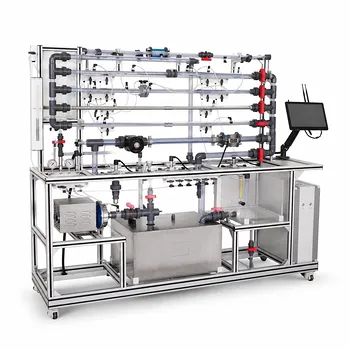
The absolute priority is to eliminate the primary source of ignition and leakage: the rotating shaft and its mechanical seal. The most effective safety design consideration is a fundamental process change—replacing a traditional agitator with a liquid jet mixer.
The core problem in mixing flammable liquids is the rotating equipment penetrating the vessel. This creates a wear-prone seal that can leak and potentially act as an ignition source. An intrinsically safer design removes this hazard entirely by using a liquid jet mixer, which has zero moving parts in the hazardous zone, eliminating the primary leak path and ignition source in one stroke.
The Enemy is the Mechanical Seal
A pilot plant agitator’s shaft seal is its single most vulnerable point. It’s under constant mechanical and chemical stress, making it the most likely source of a flammable leak and, if it catastrophically fails, frictional heat that can provide an ignition source.
Why Jet Mixing is an Intrinsically Safer Design
This is the concept of Inherent Safety, the most robust layer of protection you can add. It doesn't try to control a hazard—it removes it.
- A Seal-less Future: A liquid jet mixer is a static device. It uses an external pump to recirculate fluid through a nozzle inside the tank. No shaft, no mechanical seal, no periodic maintenance that could be done incorrectly.
- Zero Ignition Potential: By physically eliminating the rotating component inside the flammable atmosphere, you bypass the entire problem of friction-generated heat or sparks from a failing seal.
Designing Your Lines of Defense
Removing the agitator is your ideal first step, but safety requires multiple layers. Your pilot plant’s design must assume that a leak and a flammable atmosphere are still possible.
Layer 1: Prevent the Vapor Cloud
A leak only becomes a fire or explosion if it forms a vapor cloud within its flammability limits. Your design must prevent this.
- Containment is King: Minimize potential leak points from the start. Welded pipes are vastly superior to flanged connections. Every flange is a potential release point that requires a gasket, which can fail.
- Inert Gas Blanketing: Design the vapor space of all storage and process vessels to be purged with an inert gas like nitrogen. This process keeps the oxygen concentration below the Limiting Oxygen Concentration (LOC), making ignition impossible even if a vapor cloud exists.
- Relentless Ventilation: Operate the unit in an open-frame structure or a properly designed fume hood. The goal is to keep any escaping vapor concentration well below 25% of its Lower Flammability Limit (LFL).
Layer 2: Detect and Warn
Your first line of defense—prevention—needs a guardian to prove it’s working.
- Installed fixed gas detectors are non-negotiable. Position them near the most probable leak points, like pump seals and sampling stations.
- They must be set to alarm at a low threshold (e.g., 10-20% LFL) to give operators ample time to intervene before a dangerous concentration can form.
Layer 3: Control Every Ignition Source
Even with no agitator shaft, other hazards exist. You must systematize their control.
- Formal Area Classification: Follow NFPA 497. Classify the area around your pilot plant (Zone 1 or Zone 2) and ensure every electrical device—from a lighting fixture to a pump motor—is certified for that zone using explosion-proof or purged enclosures.
- Rigorous Static Control: Flowing flammable liquids generates static electricity. Bond all conductive equipment and ground the entire system to a single, verified earth point as dictated by NFPA 77. A single unbonded flange can be an ignition source.
Layer 4: Make the System Fail-Safe
The automation system is your final, fully independent responder that doesn't require a human to be present or react quickly enough.
- Safety Interlocks: Design a hard-wired safety system, separate from the basic process controller. Set critical thresholds for tank level, pressure, and temperature that, if exceeded, automatically trigger a safe shutdown, close isolation valves, and stop pumps.
- Deflagration Protection: As a last resort to protect the physical equipment and the room, integrate flame arrestors on tank vents and size emergency relief vents per NFPA 68. This ensures that if all other layers fail, the explosion is contained and properly directed.
Understanding the Trade-offs
Moving to a jet mixer isn't a magic wand. It introduces new design parameters you must evaluate.
When a Jet Mixer Might Not Work
Jet mixers create turbulence by momentum transfer. They are highly effective for blending and liquid motion but have limitations.
- Shear-Sensitive Materials: A jet mixer is not a high-shear device. If your process requires physical grinding, rapid particle size reduction, or emulsifying highly viscous materials, a jet mixer likely won’t provide the necessary energy and a traditional rotor-stator in a sealed, inerted vessel might be the only option.
- Suction of Light Solids: A jet mixer excels at suspending settling solids. However, if your goal is to rapidly draw light, floating powders down from the liquid surface, a jet mixer’s top-entry flow pattern is less effective than a carefully designed pitched-blade turbine, requiring you to double down on the other safety layers.
The Solvent Problem
The chemical itself must always inform the design. The principle of substitution is key. A common teaching solvent like diethyl ether has a flash point of -45°C and forms deadly explosive peroxides. An inherently safer approach is to ask if toluene or cyclohexane can achieve the educational or research objective, as they have much lower ignition risks and no peroxide hazard.
Making the Right Choice for Your Pilot Plant
Every choice is a trade-off between operational performance, cost, and a careful assessment of risk. Here’s how to decide based on your primary goal.
- If your primary focus is operator safety in an educational lab: Eliminate the rotating shaft entirely. A liquid jet mixer is the single most impactful design choice you can make, as it prevents the hazard rather than just managing it.
- If your primary focus is high-shear mixing that a jet mixer cannot achieve: Accept that a rotating shaft is unavoidable and build a rigorous defensive strategy around it. Mandate a dual mechanical seal with a nitrogen purge, a fixed vibration monitor, and an automatic interlock that shuts down the drive upon seal failure.
- If your primary focus is process development with a new, hazardous solvent: Begin with a chemical hazard assessment. Substitute the most dangerous substance for a safer alternative. Then, apply the remaining defensive layers, from inert gas blanketing to an NFPA-68-compliant deflagration relief vent.
True safety comes from a design that doesn't require heroic effort to operate safely.
Summary Table:
| Safety Layer | Core Action | Key Objective |
|---|---|---|
| Inherent Safety | Replace rotating shafts with liquid jet mixers | Eliminate seal leaks & mechanical ignition sources |
| Layer 1: Prevention | Use nitrogen blanketing & welded piping | Prevent flammable vapor clouds |
| Layer 2: Detection | Install fixed gas detectors (10-20% LFL alarm) | Warn operators before critical thresholds |
| Layer 3: Control | Classify areas (NFPA 497) & ground system (NFPA 77) | Eliminate electrical & static ignition sources |
| Layer 4: Fail-Safe | Implement safety interlocks & deflagration vents | Automatically shut down system & contain explosions |
Build a Safer Pilot Plant with LABPARK
Ensuring operator safety during hazardous chemical operations requires robust equipment design. LABPARK provides state-of-the-art Educational and Vocational Unit Operations Pilot Plants in chemical engineering, bioprocess & biotech, and environmental & water treatment, engineered specifically for universities, research institutes, and enterprises.
Whether you need inherently safe liquid jet mixing systems or integrated explosion-proof controls, our pilot plants are built to comply with strict safety standards.
Ready to upgrade your lab's safety and research capabilities? Contact LABPARK today to consult with our engineering experts and get a customized solution for your facility!
Related Products
- General Purpose Cosmetics Production Unit Operations Training Pilot Plant
- Multi Pump Fluid Transport Process Piping Unit Operations Training Pilot Plant
- Multi-Functional Drying Educational Unit Operations Pilot Plant
- Fixed-Bed Chemical Reaction and Gas Dust Tar Removal Unit Operations Pilot Plant
- 100L Continuous Loop Hydrogenation Educational Unit Operations Pilot Plant
People Also Ask
- Why is the chemical plant startup schedule crucial? De-risk scale-up with pilot plants.
- How do deviations in estimating latent heat impact pilot plant thermal systems? Avoid hardware mis-sizing.
- When to transition from PID to adaptive control in pilot plants? Key process indicators.
- Why Compare Predicted and Experimental Excess Enthalpy? Key to Accurate Pilot Plant Scale-up
- How to study gasification in pilot plants? Compare exit gas composition & efficiency