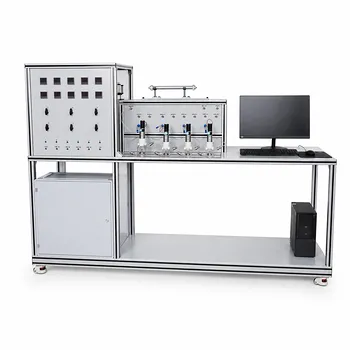
The defining safety advantage is a dramatic reduction in the potential for catastrophic release. Continuous-flow microreactors contain reactions within channels measured in micrometers, holding only microliters of material at any given moment. This tiny reaction volume, combined with an extraordinary ability to dissipate heat, fundamentally shifts the risk profile for hazardous chemistry in teaching and research laboratories.
The core safety innovation is the synergy of sub-millimeter channel dimensions and minuscule active reaction volumes. These features enable microreactors to tame highly exothermic events and contain dangerous intermediates that would be prohibitively risky in a conventional batch vessel. The result is a laboratory environment where students and researchers can safely explore aggressive chemistries that were once relegated to theoretical discussion.
The Fundamental Safety Principle: Intensified Heat and Mass Transfer
Safety in microreactors starts with physics, not just protective measures. The design itself is a passive safeguard.
The Role of Surface-Area-to-Volume Ratio
A microreactor’s channels offer an extremely high surface-area-to-volume ratio, often two orders of magnitude greater than a batch reactor. Every unit of reaction mixture is in intimate contact with the channel wall, which acts as an efficient heat exchanger.
This means heat cannot accumulate in a single hot spot. Rapid heat dissipation prevents the exponential temperature spikes that lead to runaway scenarios.
How Micromixing Stops Thermal Runaways
The narrow channels also ensure mass transfer distances are minuscule. Reagents mix in milliseconds, not seconds or minutes. This prevents the formation of localized regions where heat-producing reactions could outpace cooling.
As a result, even mixtures with aggressive exotherms stay thermally controlled. The reaction behaves more like a precisely tuned burner than a potential bomb.
Containing Danger: How Small Volumes Erase Large-Scale Hazards
The threat of a chemical accident scales with the quantity of hazardous material present. Microreactors slash that quantity to laboratory-safe levels.
Minimizing the Instantaneous Hazard Inventory
A conventional 1-liter batch reactor holding reactive azides or nitrating mixtures represents a significant potential energy. A microreactor performing the same transformation might have less than 1 milliliter in the reaction zone at any moment.
The total energy releasable in a worst-case failure is reduced by a factor of one thousand or more. Even a complete release inside a fume hood becomes a manageable event, not a disaster.
Stabilizing Reactive Intermediates
Many dangerous reactions go through toxic or explosive intermediates. In a batch reactor, these species can accumulate, waiting to react in an uncontrolled burst.
In a microreactor, the intermediate forms and immediately reacts with the next reagent downstream. The hazardous species never builds up a dangerous inventory. This allows students to safely generate and consume compounds like nitrated aromatics or organic azides in real time.
Inhibiting Gas-Phase Free-Radical Reactions
The microscale environment also provides an unexpected safety barrier against vapor-phase explosions. The narrow channels quench free-radical chain reactions by forcing radical species to collide with channel walls before they can propagate through a large volume.
This surface-dominated quenching mechanism effectively suppresses the flame fronts or explosive gas-phase reactions that could occur in the headspace of a batch reactor.
Distinct Safety Benefits for Laboratory and Educational Settings
In a chemical engineering teaching laboratory, the user is often less experienced. Microreactors accommodate this reality without sacrificing the breadth of possible experiments.
Enabling Hands-On Process Intensification Training
Teaching nitration, hydrogenation, or other "forbidden" reactions is a pedagogical challenge. Microreactors solve this by making the processes inherently safer. Students can gain tactile experience with hazardous unit operations while operating in a low-consequence failure mode.
This bridges the gap between theoretical knowledge and industrial reality. Learning happens through doing, not just observing.
Lowering the Risk Profile While Accelerating Research
Research into novel high-energy materials or ultrafast reactions requires exploring the unknown. The small holdup of a microreactor allows for rapid kinetic screening under extreme conditions (high temperature, high pressure) with minimal sample consumption.
If an unexpected decomposition occurs, the resulting pressure pulse is contained within the microchannel, not a large glass vessel. The researcher can quickly iterate without fear of a major setback.
Understanding the Trade-Offs and Realistic Limitations
No technology is a universal safety panacea. Acknowledging the boundaries of microreactor safety is essential for responsible use.
The Critical Rule: Solids Are the Enemy
Microchannels, with diameters often 10–1000 µm, are highly susceptible to blockage by particulates. Slurries, precipitating products, or catalytic fines can clog the channel instantly.
This is not just an operational failure; it can become a pressure-accumulation hazard. A blocked downstream channel turns a continuous reactor into an unintentional bomb. Robust upstream filtration and careful reaction design are non-negotiable safety prerequisites.
Corrosion Amplification at Microscale
The high surface-to-volume ratio that aids heat transfer also accelerates corrosion. Wall thinning happens faster, potentially leading to channel rupture. Material compatibility with the process stream must be meticulously verified before a campaign begins, especially with corrosive reagents at elevated temperatures.
Making the Right Choice for Your Laboratory Goal
Your decision to adopt a continuous-flow microreactor should align with your specific educational or research objective. The safety advantage is real, but it must be matched to the task.
- If your primary focus is teaching process safety fundamentals: Use microreactors to demonstrate safe handling of model nitrations and azidations. The small inventory lets students witness exothermic control without anxiety, while you emphasize the crucial "no solids" constraint as part of the lesson.
- If your primary focus is exploring high-energy or previously "too dangerous" reactions: Adopt microreactors as your primary screening tool. The ability to contain and quench reactive intermediates in real time will open up synthetic pathways that a batch lab simply cannot run.
- If your primary focus is scaling up a hazardous reaction from lab to pilot plant: Choose the "numbering up" approach. The inherent safety of a single microchannel is retained when you multiply the module, providing a safer, predictable scale-up route compared to re-engineering a large batch vessel.
Microreactors fundamentally reclassify risk by reducing the consequence of failure, not just its probability, making them a pivotal tool for a new generation of safer, more courageous chemical engineering.
Summary Table:
| Safety Feature | Continuous-Flow Microreactors | Conventional Batch Reactors |
|---|---|---|
| Active Reaction Volume | Microliters to milliliters (minimal inventory) | Liters (high instantaneous hazard) |
| Surface-to-Volume Ratio | Extremely high (rapid heat dissipation) | Low (prone to localized hot spots) |
| Thermal Runaway Risk | Extremely low; rapid heat/mass transfer | High; risk of exponential temp spikes |
| Reactive Intermediates | Formed and consumed instantly downstream | Can accumulate, increasing hazard risk |
| Gas-Phase Explosions | Suppressed via wall-collision radical quenching | High risk in large vessel headspace |
| Main Vulnerability | Clogging from solids/particulates | Thermal control and scale-up complexity |
Elevate Laboratory Safety and Innovation with LABPARK
Are you looking to modernize your training and research facilities without compromising on safety? LABPARK provides world-class Educational and Vocational Unit Operations Pilot Plants in chemical engineering, bioprocess & biotech, and environmental & water treatment.
Specially designed for universities, research institutes, and enterprises, our pilot systems enable you to:
- Minimize Risks: Conduct highly exothermic and advanced chemical operations with micro-inventories that virtually eliminate catastrophic failure hazards.
- Enhance Training: Provide students and operators with hands-on experience in modern process intensification and continuous-flow technologies.
- Accelerate Research: Facilitate rapid kinetic screening under precise thermal control and safe operating conditions.
Ready to transform your lab operations? Contact LABPARK today to discuss your pilot plant requirements!
Related Products
- 100L Continuous Loop Hydrogenation Educational Unit Operations Pilot Plant
- Residence Time Distribution and Reactor Flow Characteristics Determination Educational Pilot Plant
- Micro-Scale Gas-Solid Catalytic Reaction Educational Pilot Plant
- Gas Phase Mixing and Residence Time Distribution Determination Educational Unit Operations Pilot Plant
- Continuous Batch Extractive Distillation Educational Pilot Plant
People Also Ask
- Why is the chemical plant startup schedule crucial? De-risk scale-up with pilot plants.
- How to study gasification in pilot plants? Compare exit gas composition & efficiency
- How do deviations in estimating latent heat impact pilot plant thermal systems? Avoid hardware mis-sizing.
- Why Use PTFE & Hastelloy in Chemical Pilot Plants? Prevent Corrosion & Ensure Safety
- Why Compare Predicted and Experimental Excess Enthalpy? Key to Accurate Pilot Plant Scale-up