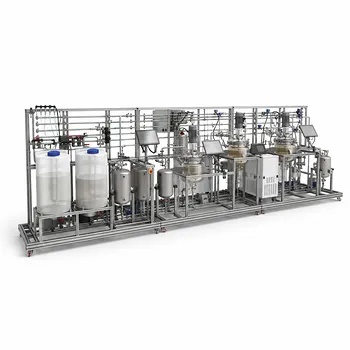
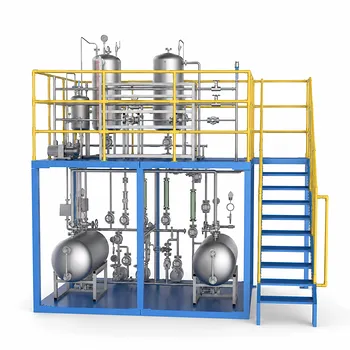
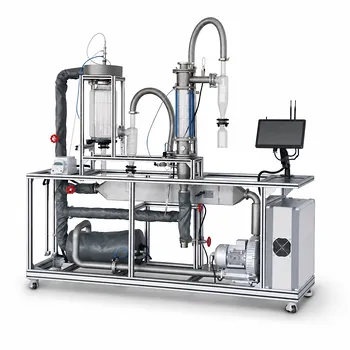
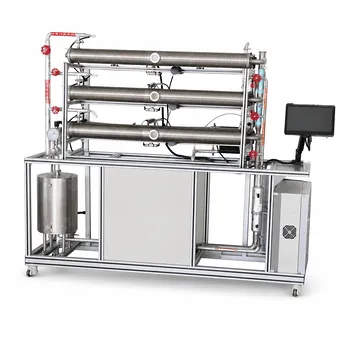
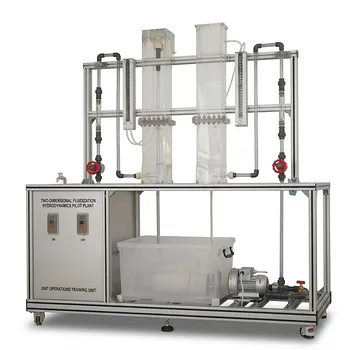
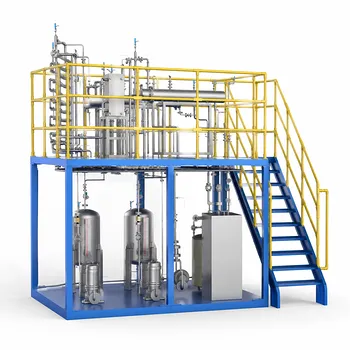
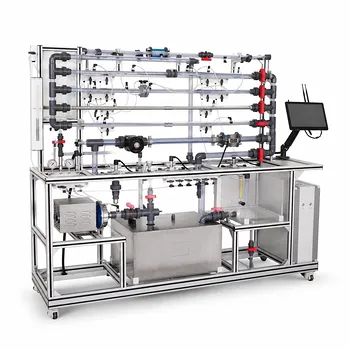
The true power of a unit operations pilot plant isn't in its size—it's in its ability to compress the distance between a textbook equation and a live, flowing process.
A pilot plant serves as the critical bridge where abstract theory becomes tangible skill. It teaches modern separation and purification not by watching, but by doing. Students move beyond calculating a distillation curve on paper to physically manipulating reflux ratios on a column and seeing the immediate impact on purity. More critically, these platforms integrate modern tools like inline sensors and automated controls, shifting the learning focus from merely executing a method to actively analyzing, controlling, and optimizing a process in real-time.
The core challenge of modern bioprocess education is not teaching a single technique, but cultivating the mindset to navigate the complex trade-offs between purity, yield, cost, and time. Unit operations pilot plants are the definitive proving ground where this engineering judgment is built. They transform a theoretical understanding of separation into a practical mastery of process control and economic optimization.
Bridging the Cognitive Gap Between Theory and Industrial Reality
Chemical engineering is built on elegant fundamentals—heat transfer, mass transfer, and phase equilibrium. The critical pedagogical challenge is that these phenomena are invisible and abstract when solved on paper. A pilot plant makes them visible.
The Physical Manifestation of Abstract Principles
Students can calculate a mass transfer coefficient from a correlation. But they only truly understand its meaning when they measure it. A pilot-scale distillation column or membrane filtration unit provides the physical platform for this discovery. Students measure flow rates and compositions, then back-calculate stage efficiency. They observe flooding or channeling, directly connecting a pressure drop reading to a physical failure in the column internals. This closes a crucial feedback loop that no simulation can fully replicate.
Integrating the Industrial Internet of Things (IIoT)
Modern separation is a digital discipline. Educational pilot plants equipped with online sensors and analytical instruments mirror this reality. Students learn that a separation process isn't just a series of physical steps; it's a data stream. They program control loops to maintain a critical quality attribute, learning how a proactive, continuous verification strategy can reduce reliance on slow, end-product testing. This experience makes the principles of the modern smart factory tangible and manageable.
From Benchtop Chemistry to Industrial Unit Operations
A fundamental shift in thinking must occur when scaling up a separation. A chemist might separate a product by recrystallization in a beaker. An engineer designs a continuous crystallization process for tons of that same product. The pilot plant is where this translation is learned.
Scaling Up Classical Methods
The core methods are familiar: distillation, extraction, crystallization, ion exchange. The pilot plant reveals their industrial character. Students learn to optimize parameters that are irrelevant at the bench scale. They investigate how temperature profiles in a crystallizer impact crystal size distribution and purity. They study the effect of flow rates on the mass transfer coefficients in a membrane filtration unit. This hands-on optimization teaches that a separation technique is not just a procedure, but a dynamic system to be tuned for yield and purity at scale.
Physical vs. Chemical Separation in Practice
In a pilot plant, the textbook distinction between physical and chemical separation becomes an operational reality. Students can run a liquid-liquid extraction unit to separate components based on chemical affinity, then operate a distillation column to separate based on boiling point. The lesson is not just how each unit works, but the engineering logic of choosing one over the other. They learn firsthand that physical methods like distillation are simple but energy-intensive, while a chemical method like extraction introduces a new solvent that must be recovered later. This builds intuition for complex process synthesis.
Integrated Systems Thinking for Complex Separations
The most powerful learning occurs not during a single unit operation, but when units are connected. This is where the pilot plant transcends a single lesson and begins to teach true process engineering.
Demonstrating the Value-Added Chain
A pilot plant can be configured to mimic the entire chemical value chain. By integrating a reactor with a separation train, students synthesize a crude intermediate and then purify it. This forces them to confront the entire system's mass balance. They learn that an inefficient reactor creates a more difficult and costly separation downstream. This upstream-downstream coupling is a foundational lesson in process economics that is impossible to teach in a single-unit experiment.
Synergizing Chemical Conversion and Physical Separation
Consider the classic challenge of separating a close-boiling mixture like ethylene and acetylene. A pilot plant setup that couples a selective hydrogenation reactor with a fractional distillation column demonstrates a profound optimization principle. Students discover that using a chemical reaction to convert the impurity first makes the physical separation far less energy-demanding. They learn to balance the capital cost of an extra reactor against the operating cost of a more complex distillation.
Understanding the Trade-offs
A pilot plant’s greatest educational value may be in what it reveals about failure modes and constraints. Pure technical performance is never the only goal.
Purity vs. Yield vs. Economics
A student can easily achieve ultra-high purity by running a distillation column at a very high reflux ratio. The pilot plant immediately demonstrates the catastrophic economic consequence: the operation becomes excruciatingly slow and energy-wasting. They learn that engineering optimization is a multi-objective problem, forcing them to find the most cost-effective balance between purity, yield, and throughput. This is the moment they stop being scientists and start thinking as engineers.
The Gap Between Controlled and Chaotic
A pilot plant is a controlled environment, but it is not a sterile simulation. It exposes students to real-world process variability. A pump's slight pulsation, a fluctuating feed concentration, or a drifting sensor creates noise in the data. This teaches the critical skill of discerning a real process trend from an instrumentation artifact. They learn that the first step in a modern PAT strategy is not complex modeling, but robust measurement and signal processing.
Making the Right Choice for Your Learning Objective
The pilot plant is a tool, and its effectiveness depends on how the learning objectives are defined. The focus should guide the entire experimental design.
- If your primary focus is mastering fundamental thermodynamic and transport principles: Use the pilot plant as a measurement lab. Emphasize the calculation of mass transfer coefficients, stage efficiencies, and energy balances from primary data, directly linking the physical operation back to the core theory.
- If your primary focus is developing process control and automation skills: Focus the curriculum on the sensor and actuator network. Design exercises around programming control loops, from a simple PID temperature controller to a cascaded scheme for maintaining product quality using real-time inline data.
- If your primary focus is teaching process synthesis and techno-economic optimization: Integrate multiple unit operations into a single process train. The goal is to optimize the entire system's yield and cost, forcing students to make and defend design choices that trade off energy consumption, capital complexity, and product purity.
The ultimate role of a pilot plant in education is to forge an engineer's intuition, transforming the invisible principles of separation into a tangible, controllable, and optimizable reality.
Summary Table:
| Focus Area | Educational Value / Objective | Key Unit Operations |
|---|---|---|
| Theory vs. Reality | Visualizes abstract principles (heat/mass transfer, stage efficiency) | Distillation columns, membrane filtration |
| Process Scale-up | Shifts focus from benchtop chemistry to continuous industrial scale | Crystallization, liquid-liquid extraction |
| Systems Integration | Links upstream reactors with downstream separation for mass balances | Coupled reactor and distillation trains |
| Process Control (IIoT) | Integrates online sensors, automation, and PAT strategies | PID loops, flow and pressure controllers |
| Economic Trade-offs | Teaches optimization of product purity, yield, and energy costs | Fractional distillation reflux optimization |
Elevate Your Engineering Curriculum with LABPARK
Bridging the gap between textbook formulas and real-world industrial processes requires robust, hands-on training systems. LABPARK provides state-of-the-art Educational and Vocational Unit Operations Pilot Plants in chemical engineering, bioprocess & biotech, and environmental & water treatment.
Designed specifically for universities, research institutes, and enterprises, our pilot plants empower students and researchers to master modern separation, purification, and process control in a safe, scalable environment.
Ready to transform your laboratory? Contact us today to explore our customizable solutions.
Related Products
- General Purpose Cosmetics Production Unit Operations Training Pilot Plant
- Multi Pump Fluid Transport Process Piping Unit Operations Training Pilot Plant
- Multi-Functional Drying Educational Unit Operations Pilot Plant
- Fixed-Bed Chemical Reaction and Gas Dust Tar Removal Unit Operations Pilot Plant
- 100L Continuous Loop Hydrogenation Educational Unit Operations Pilot Plant
People Also Ask
- Why is the chemical plant startup schedule crucial? De-risk scale-up with pilot plants.
- How do deviations in estimating latent heat impact pilot plant thermal systems? Avoid hardware mis-sizing.
- When to transition from PID to adaptive control in pilot plants? Key process indicators.
- Why Compare Predicted and Experimental Excess Enthalpy? Key to Accurate Pilot Plant Scale-up
- Why Use PTFE & Hastelloy in Chemical Pilot Plants? Prevent Corrosion & Ensure Safety