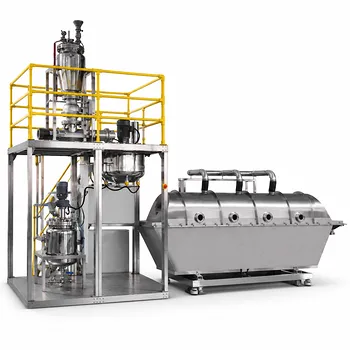
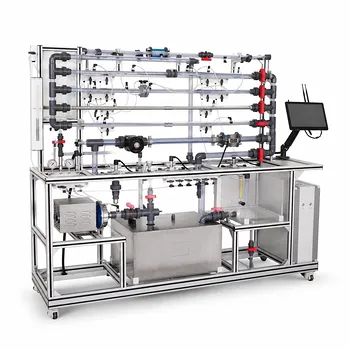
The definition of a Design Space is the single most critical strategic output of a pilot plant study for process scale-up. It serves as the scientifically validated, multidimensional blueprint that links raw material attributes and process parameters to final product quality. By mapping this space at pilot scale, engineers identify which parameters are truly scale-sensitive, enabling them to design robust control strategies and ensure a seamless transition to full production.
A Design Space transforms pilot plant data from a collection of observations into a predictive control model. It’s not just about defining where a process works; it’s about proving where it will continue to work at any scale, by explicitly understanding and mitigating the multivariate interactions that cause scale-up failures.
The Pilot Plant: Your Scale-Up Translator
Bridging Lab Chemistry and Production Reality
Laboratory beakers do not replicate industrial-scale mixing forces, heat transfer limitations, or dwell-time distributions. Unit operations pilot plants bridge this gap by generating real-world data on material inputs, operating conditions, and intermediate attributes.
This empirical data is essential for validating first-principles models like mass and energy balances. Only a pilot plant can confirm that your calculations for vessel sizing or agitation power hold true when fluids are actually moving. The Design Space built from such data is inherently reliable, because it reflects physical reality, not just theoretical extrapolation.
The Data Engine for Your Design Space
A pilot plant becomes the physical platform for Design of Experiments (DOE). Researchers deliberately vary flow rates, temperatures, screw speeds, or feed concentrations across multiple unit operations.
The resulting data stream—flow rates, spectral measurements, intermediate product attributes—fuels the construction of empirical and hybrid models. This transforms a pilot plant from a simple mini-factory into a high-fidelity sensor network for mapping your process’s true behavior.
The Core Role of the Design Space in De-risking Scale-Up
Unmasking Multivariate Interactions
A process rarely fails at scale because of a single, obvious variable. It fails because parameters interact in complex ways.
The Design Space, built through DOE and multivariate statistical analysis, directly reveals these hidden relationships. For example, a lower feed rate in extrusion doesn’t just reduce throughput; it increases backmixing and residence time, which in turn can elevate melt temperature through viscous dissipation. Defining the DS makes these interactions visible and manageable.
Identifying and Designing Out Scale-Sensitivity
The central question of scale-up is: “What changes when we get bigger?” A pilot-plant-derived DS answers this by pinpointing which parameters are scale-sensitive.
Operators test whether impeller tip speed or power per unit volume truly controls particle size distribution. When a critical parameter proves scale-sensitive, the engineering response is to design it out. This means selecting a different mixer geometry, implementing a tight control loop, or switching to a scale-independent parameter as a control target.
Establishing Robust Control Boundaries
Once the scale-sensitive interactions are understood, the Design Space defines the multidimensional operating region where quality is assured.
These boundaries become the active targets for process control systems. Pilot plants equipped with real-time sensor feedback show precisely how control loops correct deviations—for instance, adjusting a cooling jacket to maintain melt temperature within the Design Space. Tools like Multivariate Statistical Process Control (MSPC) then monitor this full space at scale, ensuring consistent product quality long after the pilot campaign ends.
A Structured Workflow for Defining the Design Space at Pilot Scale
1. Predict with First Principles
Begin by modeling expected product performance using engineering fundamentals. Calculating mass and energy balances sets a baseline for what the process should do, highlighting the parameters that theory says are most critical.
2. Design Experiments to Map the Unknown
Where first principles fall short, Design of Experiments (DOE) takes over. The pilot plant allows you to systematically vary multiple operational variables—throughput, temperature, agitation—and measure their combined effect on Critical Quality Attributes (CQAs).
This stage is not random testing; it is a structured plan to build a response surface model that underpins the Design Space.
3. Analyze with Multivariate Models
Convert the raw sensor and quality data into actionable models. Methods like Principal Component Regression (PCR) and Partial Least Squares (PLS) distill dozens of correlated variables into a few key latent factors that predict final quality.
These models form the mathematical backbone of your Design Space, often blending empirical data with the first-principles understanding from step one into a powerful hybrid model.
4. Validate and Refine the Space at Pilot Scale
The physical pilot plant serves as the intermediate validation gate. Before committing to full-scale batches (often 100 kg or more), you verify that the multivariate boundaries established in the lab and in silico actually hold up on larger equipment.
Running verification batches at the edges of your proposed Design Space confirms its robustness and finalizes the safe operating limits for factory production.
Understanding the Trade-offs and Pitfalls
The Risk of Over-Constraining the Space
Defining a Design Space that is too narrow may guarantee quality but can paralyze production. If every small material lot variation forces a shutdown, the process is not commercially viable. A truly robust DS accounts for realistic input variability and allows operational flexibility within safe boundaries.
The Trap of Ignoring Raw Material Variability
A Design Space is defined not only by process parameters but by the multidimensional combination of raw material attributes. A pilot study that only uses a single, consistent lot of feedstock produces a fragile DS. The space must be tested with different material grades and qualities to be scale- and supply-chain-ready.
The Illusion of a Direct Scale-Up
Even a perfectly defined Design Space is a risk-management framework, not a magic guarantee. Scale-up may still reveal unanticipated interactions at the factory’s extreme scales. The DS’s role is to reduce those unknowns to a manageable, monitored residual risk—providing a clear control strategy rather than a blind recipe.
Making the Design Space Work for Your Scale-Up Goal
Depending on your primary objective, the role of the Design Space takes a slightly different emphasis. Align your pilot plant campaign accordingly.
- If your primary focus is developing a robust, regulatory-compliant process: Use the pilot plant to build a DS aligned with Quality by Design (QbD) principles. Leverage DOE and multivariate analysis to satisfy ICH Q8 expectations and pre-define your full-scale control strategy.
- If your primary focus is troubleshooting a failing scale-up: Target the DS definition to isolate scale-sensitive parameters—like shear rate or residence time distribution—and re-engineer them out. Use the pilot plant as a diagnostic tool to correct the root cause before expensive factory trials.
- If your primary focus is smooth tech transfer and operator training: The documented Design Space and the pilot plant experience together turn abstract model boundaries into hands-on understanding. Operators learn the allowable ranges and how the control system responds, creating a shared mental model that prevents errors at production scale.
In every case, defining a Design Space on a pilot plant transforms scale-up from an art of guesswork into a science of measurable certainty.
Summary Table:
| Step | Method/Action | Core Objective |
|---|---|---|
| 1. Predict | First-principles modeling | Establish baseline critical parameters |
| 2. Map | Design of Experiments (DOE) | Generate response surface data on pilot scale |
| 3. Analyze | PCR/PLS multivariate modeling | Build predictive mathematical control models |
| 4. Validate | Running boundary pilot batches | Confirm robust operating limits before scale-up |
Optimize Your Process Scale-Up with LABPARK
Are you looking to bridge the gap between laboratory research and industrial-scale production? LABPARK provides state-of-the-art Educational and Vocational Unit Operations Pilot Plants in chemical engineering, bioprocess & biotech, and environmental & water treatment.
Designed specifically for universities, research institutes, and enterprises, our pilot plants serve as the perfect physical platforms to implement Design of Experiments (DOE) and establish robust Design Spaces (DS). Let us help you de-risk your scale-up process, validate first principles, and train the next generation of engineers with hands-on systems built for real-world reliability.
Contact LABPARK today to discuss your pilot plant requirements and receive a tailored solution!
Related Products
- General Purpose Cosmetics Production Unit Operations Training Pilot Plant
- Multi Pump Fluid Transport Process Piping Unit Operations Training Pilot Plant
- Multi-Functional Drying Educational Unit Operations Pilot Plant
- Fixed-Bed Chemical Reaction and Gas Dust Tar Removal Unit Operations Pilot Plant
- 100L Continuous Loop Hydrogenation Educational Unit Operations Pilot Plant
People Also Ask
- How do deviations in estimating latent heat impact pilot plant thermal systems? Avoid hardware mis-sizing.
- Why is the chemical plant startup schedule crucial? De-risk scale-up with pilot plants.
- When to transition from PID to adaptive control in pilot plants? Key process indicators.
- Why Compare Predicted and Experimental Excess Enthalpy? Key to Accurate Pilot Plant Scale-up
- Why Use PTFE & Hastelloy in Chemical Pilot Plants? Prevent Corrosion & Ensure Safety